Sign in. It’s quick, free and it’s up to you.
An account is an optional way to support the work we do. Find out more.
Sign in. It’s quick, free and it’s up to you.
An account is an optional way to support the work we do. Find out more.
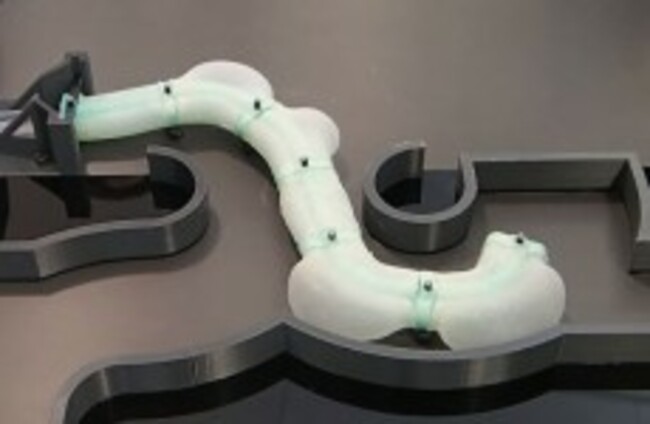
WHEN WE THINK of robot arms, we think of rigid devices that move in fixed ways and aren’t particularly mobile.
As a rule, the mobility of robots is limited by their fixed joints. They aren’t able to move in confined spaces and have to be programmed precisely so they avoid colliding with objects or people.
To solve this problem, MIT’s Computer Science and Artificial Intelligence Lab (CSAIL) has been working on soft robots, those that can squeeze into tight spaces and change direction, and its latest work is a robot arm that can move around like a snake.
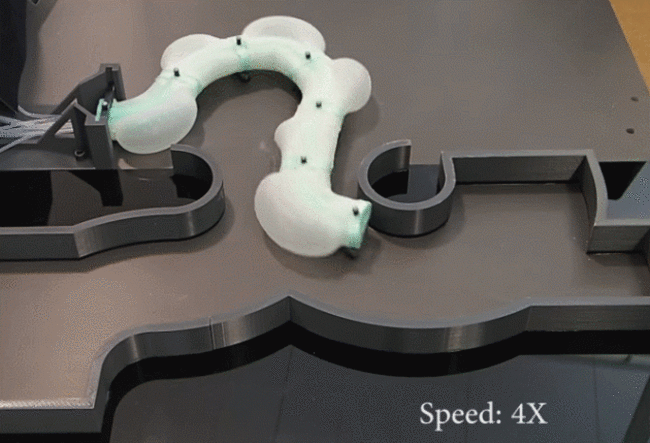
The researchers see the arm being used for finely tuned tasks like handling delicate specimen in research labs to assisting in certain kinds of minimally invasive surgeries.
The next version of the arm will include a finger-gripper which the team will use to pick up and place objects.
The team has already worked on similar projects like a soft robotic fish, which can change direction just like a real fish.
Also, a different group of MIT researchers have developed an algorithm for bounding that they’ve successfully implemented in a robotic cheetah. In layman terms, the robot is able to run and jump over obstacles without help.

To embed this post, copy the code below on your site















have your say