Sign in. It’s quick, free and it’s up to you.
An account is an optional way to support the work we do. Find out more.
Sign in. It’s quick, free and it’s up to you.
An account is an optional way to support the work we do. Find out more.
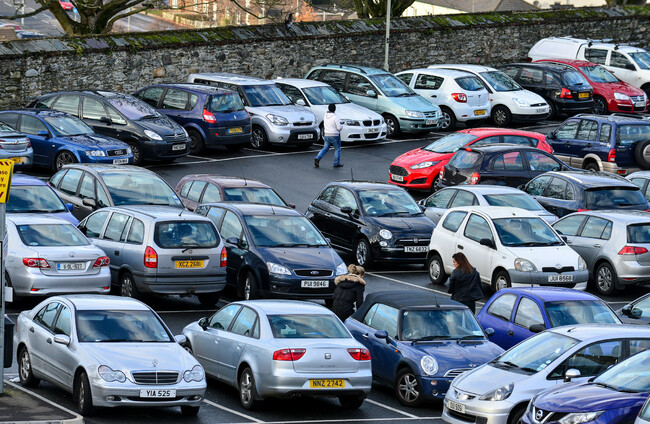
IRELAND IS NOT ready for a levy on car parking until better public transport and other alternatives to the private car are in place, Department of Finance officials have said in advice to government ahead of the the upcoming Budget.
The Department of Finance said that Government should not introduce car-parking levies, citing equity and equality considerations, including that the fees may be perceived as an unfair tax on certain workers, including those without access to remote work.
The Department said that congestion charges would achieve the same objectives as a car parking levy and have the “potential to do so in a more efficient and/or equitable manner”.
As of now, the government cannot determine what the impact of such charges would be, according to the report, as the state does not have the data on the numbers of employer-provided car parking spaces in urban areas.
The department suggested a car parking levy would be “difficult and time-consuming” to implement and could require years of planning, expert input, public consultations and additional research.
The officials point to how a similar scheme in Nottingham, England, took 12 years to develop. In smaller cities, such as Oxford, it took three years to develop, according to the report.
It added: “Similarly, the impacts on individuals and businesses suggest that this may not be the optimal time to implement a new charge owing to the increased cost of living and cost of doing business.”
In January, Environment minister Eamon Ryan said that free car parking for the public service should be scrapped.
Ryan outlined a proposal to phase out parking in public sector buildings which are otherwise served by adequate levels of public transport.
He said the removal of free parking for public servants would be part of “a radical shift” to reduce gridlock and emissions as well as the improving quality of life for inhabitants of cities.
Congestion charges involve charging cars a daily rate for entering the city centre. These schemes are in operation in the cities of London, Singapore, Stockholm and Milan. Some cities charge more during peak traffic times or do not charge during the weekends.
Earlier this year, Cabinet approved plans for Local Authorities to chose to impose congestion charges in their areas – but many, including Ryan and the Department of Finance, said that it was a medium-to-long-term plan.
The Department of Finance report noted that the Organisation for Economic Co-operation and Development (OECD) has previously said that congestion charges are “unfair and socially unacceptable”.
The OECD and Department of Transport have also said that any plans to introduce congestion charges should be preceded by improvements to public spaces and better public transport and permeability.

To embed this post, copy the code below on your site
















have your say