We need your help now

Support from readers like you keeps The Journal open.

You are visiting us because we have something you value. Independent, unbiased news that tells the truth. Advertising revenue goes some way to support our mission, but this year it has not been enough.

If you've seen value in our reporting, please contribute what you can, so we can continue to produce accurate and meaningful journalism. For everyone who needs it.

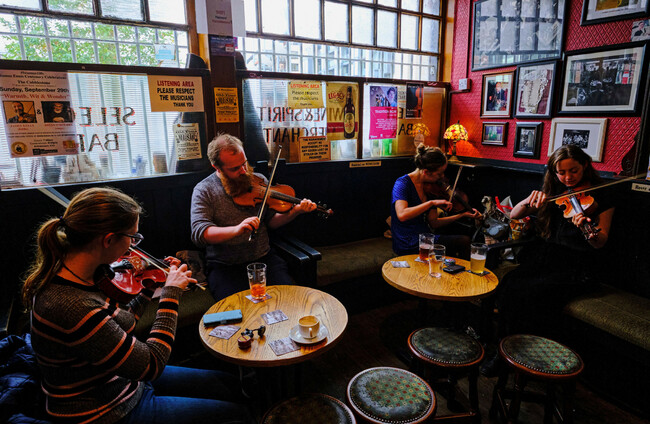
The Cobblestone Alamy Stock Photo

'If we don't practice it, it will die out': Why the Sean Nós tradition is having a moment

Despite facing its challenges, sean nós singing and dancing is alive and well in Ireland.
(Seo alt ónár bhfoireann nua Gaeltachta. Is féidir an bunleagan as Gaeilge a léamh anseo)

“THERE’S A MIX of young and old people, people from different backgrounds, and people who may have never danced before,” Caoimhe Ní Mhaolagáin, a musician and dancer from Dublin, told us during a chat in the backroom of The Cobblestone.

It’s a dark, gloomy Monday night in December and despite the wintery conditions outside, the pub is warm and full of life.

I’m attending a Sean Nós dance workshop hosted by Ní Mhaolagáin which she runs for six week stints throughout the year.

It’s at these workshops, she says, that she has seen a growing interest from people in Irish culture and tradition.

“There are people from Germany, a woman from Poland, and sometimes people from all over the world,” she said.

“You can see that people want a taste of the culture, and if we don’t try to practise it or teach it, the tradition will die out.”

For the uninitiated, Sean Nós is a style of dance, music and singing in Ireland. It’s closely connected to our culture and heritage and has a rich history in the Gaeltacht.

The defining characteristics of the tradition are that musicians or dancers perform alone, and that the performance is rich in meaning and emotion. There is usually no fixed time rhythm in either the music or the dance.

“It’s important when dancing that you follow the old dance steps within the tradition,” Ní Mhaolagáin said, “but you can be creative as well and put your own flair on things.”

“I dance a lot of jigs and reels, but I love performing different things from time-to-time, like slides and waltzes.”

“If I were to jump up and do a dance and someone was to ask me what I did, I wouldn’t be able to tell them – it’s different every time,” she said. 

The tradition of Sean Nós dancing grew out of social gatherings that were held in the 20th century, when people would meet to play music or sing songs.

Many people had their own individual steps, and they would get up to dance and teach others what they knew.

While there were a few terms used for this style of dancing, the term ‘Sean Nós dancing’ was not used widely until the 1970s or 1980s.

Becky Ní Éallaithe, a Sean Nós dancer from Indreabhán in Co Galway, explains that this type of dancing began to rise in popularity in the 90s, and she was fortunate to grow up with the tradition.

“Sean Nós was the style of dance that everyone did, rather than going to step dancing or Irish dancing,” she said.

Oireachtas na Samhna — the annual Irish-language festival — greatly helped the revival of the tradition, as people gathered from far and wide to take part in Sean Nós competitions.

Today, the Corn Uí Riada and the Corn Steip — prestigious competitions in the Irish-speaking world — take place every year as part of the Oireachtas.

In 2008, TG4 decided to broadcast some segments of the Sean Nós competitions live on television (they were already broadcast on RTÉ Raidió na Gaeltachta for some time), which sparked interest in the tradition among newcomers who could watch from home.

The Journal / YouTube

Ní Éallaithe won the Corn Steip in 2025, and she believes that more attention is being drawn to Sean Nós dancing because the competitions are visible on screen.

“It’s widespread across the country now, and there are classes in Dublin and in places all over the country — maybe even all over the world,” she said.

“People are familiar with it, and the step competition contributed greatly to that, because people could watch Sean Nós dancing. They can see the dance, and that draws them in.”

Singing

Not only is the dancing tradition thriving, but Sean Nós singing is also standing strong. 

Micheál Ó Confhaola won the Corn Uí Riada at Oireachtas 2025, and he spoke to The Journal about traditional Sean Nós singing in Ireland.

He says it is difficult to describe the tradition because it is something deeply personal to the performer.

When people are performing music, they can put their own style on a song through extensive ornamentation.

“It’s very easy to learn songs, without a doubt, but there’s a lot of work involved in being able to remember and perform them. The thing you can’t teach is ornamentation,” he said.

He says that people sometimes sing in a “flatlined” way, and that you are not following the tradition if there is no ornamentation.

The Journal / YouTube

Ó Confhaola says there is a lot of emphasis – and pressure – on younger people to perform in Sean Nós competitions, but that they should be allowed to keep the tradition alive in their own way. 

“Even if they don’t want to take part in competitions, the most important thing is that we still have 200 new people taking up singing and engaging with the tradition,” he said, “and that they can carry it on in their own way, whether that’s on the radio or at home.

“That way, the tradition stays alive.” 

Against all odds

Although most people who engage with Sean-Nós are based in the Gaeltacht, it’s clear that Irish-language culture is currently experiencing a new and widespread revival in recent years.

However, the fortunes of the tradition have risen and fallen over the course of the last century.

There was a risk that Sean Nós dancing could be lost when public dancing was banned under the Public Dance Halls Act in 1935.

However, people came together despite the law and the tradition was carried on during social gatherings or oícheanta airneáin.  

Speaking about the importance of protecting our heritage, Ní Mhaolagáin said: “It was illegal to dance publicly and there was a danger they would lose it then [in 1935]. We can see now that we still have sean nós dancing today, but things have improved as well.”

“Sean Nós is our heritage and our culture, and that is extremely important for any country to have.”

The Journal’s Gaeltacht initiative is supported by the Local Democracy Reporting Scheme

Readers like you are keeping these stories free for everyone...
A mix of advertising and supporting contributions helps keep paywalls away from valuable information like this article. Over 5,000 readers like you have already stepped up and support us with a monthly payment or a once-off donation.

Close
Comments
This is YOUR comments community. Stay civil, stay constructive, stay on topic. Please familiarise yourself with our comments policy here before taking part.
Leave a Comment
    Submit a report
    Please help us understand how this comment violates our community guidelines.
    Thank you for the feedback
    Your feedback has been sent to our team for review.

    Leave a commentcancel

     
    JournalTv
    News in 60 seconds