Sign in. It’s quick, free and it’s up to you.
An account is an optional way to support the work we do. Find out more.
Sign in. It’s quick, free and it’s up to you.
An account is an optional way to support the work we do. Find out more.
CATHERINE CONNOLLY IS in a strong position to be elected as Ireland’s tenth president next week – that much is clear according to an opinion poll published in this morning’s Irish Times.
What is also clear is that Irish people would have preferred more choice on the ballot paper.
The Ipsos/B&A poll showed Connolly with the support of 38% of voters and Heather Humphreys on 20%. Not far behind though is those who won’t vote or who will spoil their vote.
On the straight question of candidate support, 18% of people said they didn’t know, 12% said they would not vote and a sizeable 6% said they plan to spoil their vote.
That final figure is larger than the 5% of people who are planning to vote for Jim Gavin, the former Fianna Fáil candidate who withdrew from the race but not early enough for his name to be removed from ballot papers.
In all, that means the two prospective candidates garner raw support of just 58% of people.
Asked directly about what they made of the choices they have, almost half of voters (49%) said they don’t feel represented by the candidates, greater than the 40% who were satisfied.
More than half went even further, with 55% saying that they would favour a change to the constitution to make it easier to get on the ballot.
On this occasion, there were two potential candidates who made it close to getting on the ballot but could not get over the line. They were businessman Gareth Sheridan and conservative campaigner Maria Steen.
In the case of Sheridan, he secured the backing of two county councils, two short of what he needed.

Steen on the other hand got closest to the ballot via the Oireachtas route, getting nominations from 18 TDs or Senators, two short of what she needed.
Steen launched her efforts a few short weeks before the deadline for nominations closed and was making calls to politicians down to the wire in a bid to get the required 20 Oireachtas signatures.
Today’s Irish Times poll asked people whether Steen should have been facilitated on the ballot and a plurality of 45% agreed that she should as against 24% who disagreed and 31% who had no opinion.
Choices
There are a lot of numbers in the above paragraphs but the summary is that the electorate would clearly have liked more choices when choosing their president.
This should not be a surprise to anyone. Even ignoring the politics of the candidates for a second, the literal number of options here is abnormal by recent standards.
In 2018, there were six people on the ballot and there were seven in 2011.
This year, if you include Gavin and count three candidates, it is still the lowest number on a presidential ballot paper for 35 years.
Excluding him as a viable option, the public is down to two choices for the presidency.
The last time this happened was over 50 years ago in 1973 when Fianna Fáil’s Erskine Childers defeated Tom O’Higgins of Fine Gael.
Given that in the intervening period the political landscape has fragmented way beyond that binary choice, it seems particularly jarring that the public on this occasion has just two choices.
There are several reasons for this, of course.
Among them is the fact that even though Labour and the Social Democrats had enough TDs and Senators alone to nominate Connolly by themselves, Sinn Féin also rowed in behind the unity left candidate and didn’t nominate their own, despite having the numbers to do so.
People Before Profit and a number of other independents are also supporting Connolly as part of the concerted effort to have just one left-wing candidate on the ballot.
The other main factor is that there was also a strategy, most explicitly by Fine Gael but also implicitly by Fianna Fáil, to prevent candidates emerging via the council route.
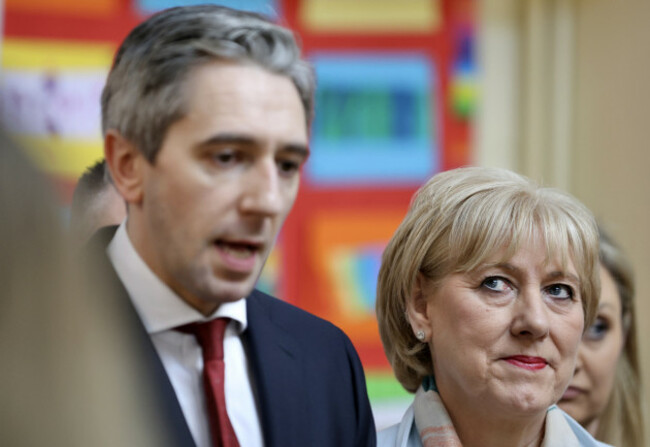
Fine Gael HQ issued a diktat to its councillors to oppose the nomination of candidates, while Fianna Fáil, in less formal terms, also encouraged its members not to support any candidates.
Tánaiste Simon Harris defended his instruction to party councillors to oppose the nomination of candidates but historically there has been precedent for party councillors to allow a nominee go through.
Even though both Fine Gael and Fianna Fáil ran their own candidates in the 1997 presidential election, some of their councillors abstained on votes or supported Derek Nally when he sought nomination via the council route, allowing him to get on the ballot as an independent.
The decision by the larger parties to restrict the field of candidates to their own has been criticised in some quarters and has led to the rise of an online focused campaign to ‘spoil the vote’.
Those arguing in favour of spoiling the vote have said that doing so would be both a demonstration of their unhappiness with the process and an expression that there is no choice on offer that is not backed by the main political parties.
Spoiled votes
A spoiled vote is a vote that is cast by a voter but is deemed to be ineligible to be counted as a preference for any of the candidates.
There are various reasons why a vote may be deemed as spoiled, such as if the ballot was left blank or the preference of candidates was not clear. One common error may be putting a tick beside two candidates instead of numbering them, meaning the returning officer cannot distinguish a preference.
Or, as Citizens Information puts it, a voter may deliberately choose to spoil their vote as a form of protest.
Such votes will not be recorded as being a protest, as votes spoiled for this purpose are grouped with ballots that are filled out incorrectly.
Spoiled votes are recorded by the returning officer, so the total number of spoiled votes will be known after the upcoming election, but spoiled votes will have no bearing whatsoever on who wins an electoral contest because they do not count towards any candidate.

In the 2018 presidential election there were 18,448 spoiled votes, representing 1.24% of the total poll. In the 2011 presidential election it was a similar percentage at 1.04%.
Based on those figures, if the 6% who told the Irish Times poll that they would spoil their vote did so next week it would clearly be a significant increase on recent elections.
Some of those pushing the online campaign to spoil the vote have indicated that they are hosting a campaign launch tomorrow but the campaign has not been supported by any TDs.
Aontú leader Peadar Tóibín TD was central to the effort to get Steen on the ballot and he has criticised other parties for not supporting a greater choice on the ballot.
Tóibín said this week that he was considering not voting in the upcoming presidential election due to what he called a “democratic deficit” but that he was reluctant to advocate the spoiling of ballots.
“Like so many people, I’m deeply frustrated that I don’t feel that there’s an option. I won’t be voting for the government, but I may not vote,” Tóibín said this week.
He added: “Personally, I’m cautious as an individual around spoiling the vote in that, while it can be cathartic for people at a given time, it doesn’t change the direction of the election as such. But as a party, we’re not giving advice to citizens on how to vote in this particular election. “

To embed this post, copy the code below on your site
















have your say