We need your help now

Support from readers like you keeps The Journal open.

You are visiting us because we have something you value. Independent, unbiased news that tells the truth. Advertising revenue goes some way to support our mission, but this year it has not been enough.

If you've seen value in our reporting, please contribute what you can, so we can continue to produce accurate and meaningful journalism. For everyone who needs it.

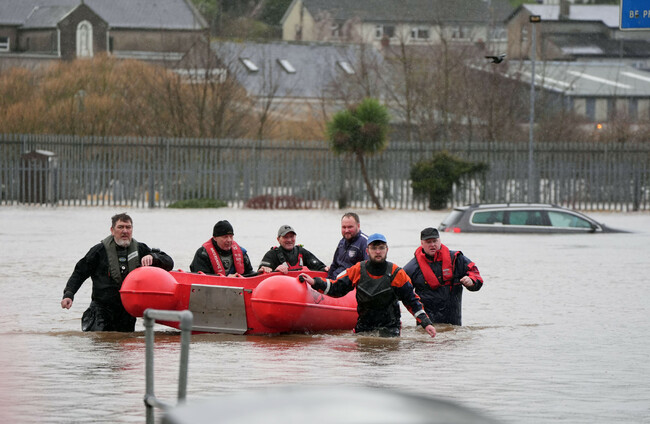
Members of Slaney Search and Rescue working in floodwater in Enniscorthy, Co. Wexford, on 27 Jan, 2025 Alamy Stock Photo

Storm Chandra flooding made three times more likely due to climate change

A rainfall event previously expected once in every 150 years is now expected to happen once in every 60 years.

FLOODING LIKE THAT experienced this week due to Storm Chandra has been made three times more likely due to climate change.

Researchers from Met Éireann and the ICARUS climate research centre at Maynooth University have carried out a “super rapid” analysis of the rainfall before and after Storm Chandra.

The researchers noted that the one-day rainfall directly from the storm was “not particularly remarkable”.

However, they added that the seven-day accumulated rainfall “made an otherwise relatively uninteresting rainfall event far more devastating from a flooding perspective”.

Focusing on the seven-day accumulated rainfall, the researchers found that the magnitude of rainfall has increased by 9% when compared to pre-industrial era.

In the pre-industrial climate, when global temperatures were 1.3 degrees cooler, a seven-day rainfall event similar to Storm Chandra would have been expected once in every 150 years.

Today, a similar rainfall event is expected to happen once in every 60 years, a near three-fold increase in likelihood.

The research aligns with a similar study arising from Storm Claudia last November.

Meanwhile, the researchers noted that Storm Chandra hit when soils on the eastern coast were already saturated and rivers were high from several days of high rainfall.

Increased rainfall over longer time scales suggests an increased likelihood of soils reaching water capacity in the future.

This means that the “relatively innocuous rainfall” associated with winter storms could have more negative effects if it coincides with waterlogged soil.

The researchers also noted that as global temperatures rise due to human-caused climate change, the atmosphere is able to hold more moisture – around 7% more moisture for every 1°C of warming.

Dr Claire Bergin, of the ICARUS Climate Research Centre, remarked that this is the second time so far this storm season that there has been flooding and potential flooding as a result of rainstorms falling on previously saturated soils.

She said such rainfall events are becoming heavier, with more rain falling, and that when this is combined with already saturated soils and high rivers, there is nowhere else for water to go other than to flood on the surface.

“The increase in rainfall magnitude can be directly linked with excess pollution caused by humans,” added Bergin.

“Not only do we need to shore up flood defences, but we also need to reduce global warming.”

Meanwhile, Lionel Swan, PhD student for the ICARUS Climate Research Centre, said: “One point of considerable concern highlighted by our study is that we no longer necessarily need to experience a ‘remarkable’ single day rainfall extreme for it to cause devastating effects.”

Readers like you are keeping these stories free for everyone...
A mix of advertising and supporting contributions helps keep paywalls away from valuable information like this article. Over 5,000 readers like you have already stepped up and support us with a monthly payment or a once-off donation.

Close
50 Comments
This is YOUR comments community. Stay civil, stay constructive, stay on topic. Please familiarise yourself with our comments policy here before taking part.
Leave a Comment
    Submit a report
    Please help us understand how this comment violates our community guidelines.
    Thank you for the feedback
    Your feedback has been sent to our team for review.

    Leave a commentcancel

     
    JournalTv
    News in 60 seconds