We need your help now

Support from readers like you keeps The Journal open.

You are visiting us because we have something you value. Independent, unbiased news that tells the truth. Advertising revenue goes some way to support our mission, but this year it has not been enough.

If you've seen value in our reporting, please contribute what you can, so we can continue to produce accurate and meaningful journalism. For everyone who needs it.

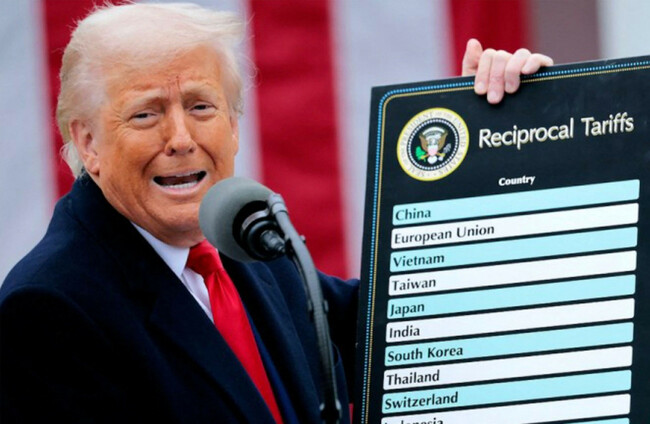
Trump announced a sweeping list of global tariffs in April last year. Alamy Stock Photo

EU calls for stability after US Supreme Court strikes down Trump’s sweeping global tariffs

The court found that current US legislature “does not authorise the President to impose tariffs”.

LAST UPDATE | 2 hrs ago

THE US SUPREME Court has ruled that Donald Trump exceeded his authority in imposing a swath of tariffs that upended global trade, blocking a key tool the president has wielded to impose his economic agenda.

The conservative-majority high court ruled six-three in the judgment, saying the International Emergency Economic Powers Act (IEEPA) “does not authorise the President to impose tariffs.”

While Trump has long used tariffs as a lever for pressure and negotiations, he made unprecedented use of emergency economic powers upon returning to the presidency last year to slap new duties on virtually all US trading partners.

These included “reciprocal” tariffs over trade practices that Washington deemed unfair, alongside separate sets of duties targeting major partners Mexico, Canada and China over illicit drug flows and immigration.

The court noted today that “had Congress intended to convey the distinct and extraordinary power to impose tariffs” with IEEPA, “it would have done so expressly, as it consistently has in other tariff statutes.”

The ruling does not impact sector-specific duties that Trump has separately imposed on imports of steel, aluminum and various other goods.

Formal probes which could ultimately lead to more such sectoral tariffs remain in the works.

The Supreme Court’s decision affirms earlier findings by lower courts that tariffs Trump imposed under IEEPA were illegal.

A lower trade court had ruled in May that Trump overstepped his authority with across-the-board levies and blocked most of them from taking effect, but that outcome had been put on hold as the government sought an appeal.

EU reaction

The European Commission called for stability in the EU-US trading relationship following the ruling.

“We remain in close contact with the US administration as we seek clarity on the steps they intend to take in response to this ruling,” European Commission Deputy Chief Spokesperson Olof Gill said in a statement on social media.

“Businesses on both sides of the Atlantic depend on stability and predictability in the trading relationship. We therefore continue to advocate for low tariffs and to work towards reducing them,” Gill added.

According to reports, Brussels is broadly expecting that the Trump administration could seek to reinstate tariffs through alternative legal routes, such as Section 232 investigations.

Those probes were previously used to impose duties on European steel and aluminium and remain a potential source of renewed trade tension.

In August 2025, the US and EU locked in a framework trade deal setting duties at 15% on most imports, but that arrangement sits within a wider trade landscape shaped by a series of executive actions and temporary truces.

The Irish Business and Employers Confederation (Ibec) said that the Supreme Court ruling will “inevitably weaken the hand of the US Government in relation to the application of across-the-board tariffs”.

“Ibec members will now watch with interest as to how the US Government will respond to the Court’s decision and consider the wider implications of both today’s decision and any possible US policy reaction in the round,” Ibec Executive Director of Lobbying and Influence, Fergal O’Brien, said.

Irish effect

For Ireland, the stakes are particularly high.

The US has long been the State’s most important export market, a trend that intensified sharply in 2025 amid tariff uncertainty.

The value of Irish goods exports to the US surged by 52% to almost €112 billion last year, according to data from the Central Statistics Office.

Almost 43% of all Irish goods exports were destined for the US in 2025, up from around 33% the previous year.

The spike was heavily influenced by tariff policy, as US companies rushed to import and stockpile goods from Ireland ahead of actual or threatened levies, including Trump’s so-called “liberation day” tariffs announced in April 2025.

More than half (€138.6 billion) of all Irish goods exported in 2025 were medical and pharmaceutical products.

Trump has repeatedly expressed dissatisfaction at the scale of US pharmaceutical manufacturing in Ireland.

However, while tariffs on pharmaceuticals have been threatened, they have largely not been imposed to dater.

The Department of Foreign Affairs and Trade has been contacted for comment.

With reporting from AFP

Readers like you are keeping these stories free for everyone...
A mix of advertising and supporting contributions helps keep paywalls away from valuable information like this article. Over 5,000 readers like you have already stepped up and support us with a monthly payment or a once-off donation.

Close
46 Comments
This is YOUR comments community. Stay civil, stay constructive, stay on topic. Please familiarise yourself with our comments policy here before taking part.
Leave a Comment
    Submit a report
    Please help us understand how this comment violates our community guidelines.
    Thank you for the feedback
    Your feedback has been sent to our team for review.

    Leave a commentcancel

     
    JournalTv
    News in 60 seconds