Sign in. It’s quick, free and it’s up to you.
An account is an optional way to support the work we do. Find out more.
Sign in. It’s quick, free and it’s up to you.
An account is an optional way to support the work we do. Find out more.
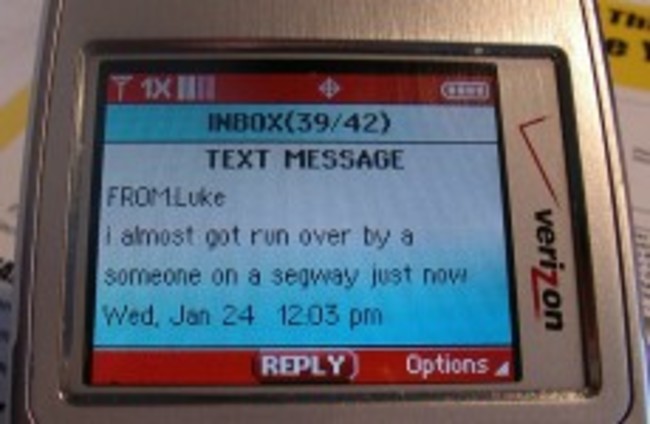

WHEN IT COMES to exchanging information, texting is about as casual as it gets.
You can communicate with someone without actually talking to them, send quick abbreviations, and you aren’t required to use complete sentences.
Still, no matter how efficient texting may be, you should always be aware of the context when sending a text, particularly if it’s a professional relationship.
If you’re texting colleagues, bosses, employees, customers, pets, friends, or family, there are a few etiquette rules you should abide by, says career coach Barbara Pachter in her recently published book “The Essentials Of Business Etiquette“.
We’ve pulled out the most useful rules below:
Texting is meant to be a fast form of communication, so it’s common to use abbreviations and shortcuts such as “LOL” (laugh out loud), “np” (no problem), or “u” (you). But there is such a thing as an inappropriate abbreviation.
“Using shortcuts has become more common in the business world, but make sure it’s appropriate for ‘u’ to be that informal,” says Pachter.
If you choose to use them, Patcher suggests only using those that are widely known, which the receiver would understand the meaning of. And with shortcuts that lean toward the unprofessional — “WTF,” for example — a good rule of thumb is to only type what you would be comfortable saying out loud. Ultimately, the safest route is to type out the entire word or phrase.
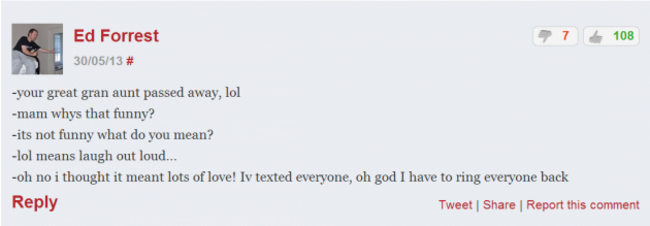
And of course, make sure you know exactly what they mean, unlikely the mother of one reader of TheDailyEdge.ie.
When you’re writing short and fast, you’re not thinking about your tone and “your text may sound harsher than you intend,” Pachter says.
Try to write in complete sentences to prevent sounding abrupt, and always read your message out loud to make sure it doesn’t sound too harsh.
“Avoid negative words such as ‘failure,’ ‘wrong,’ or ‘neglected,’ ” Pachter writes. “Use ‘please’ and ‘thank you.’ ”
“Don’t give negative feedback or quit your job in a text,” Pachter writes. “In both cases, speak to the person concerned. Even if you are leaving a company, you don’t want to burn your bridges — you may need a reference in the future.”
The bottom line is that texting is too casual a medium to give bad news. It’s difficult to know what tone you’re giving off in a text message, so Pachter says it’s safer to stick to only good news when sending texts to people in your professional network.
If you do want to break this rule, and break up with someone through text, there’s an app for that.
(Credit: CNDProductions360/YouTube)
“The potential attendees may not check their phones in time,” she writes. “Older workers may not look at their phones as often as their younger counterparts.”
If you’re going to change a meeting time or venue at the last minute, give the person a call out of respect.
“Smartphones allow you to speak your message, which the phone then converts to text,” says Pachter. “But a lot can be lost in the translation. Make sure that what you said is what is showing as text, before you hit the send button.”
You have no idea what voices your phone may be picking up. It could be a conversation nearby or even lyrics from a song on the radio, and voice-to-text software sometimes isn’t perfect…

To embed this post, copy the code below on your site
















have your say