Sign in. It’s quick, free and it’s up to you.
An account is an optional way to support the work we do. Find out more.
Sign in. It’s quick, free and it’s up to you.
An account is an optional way to support the work we do. Find out more.
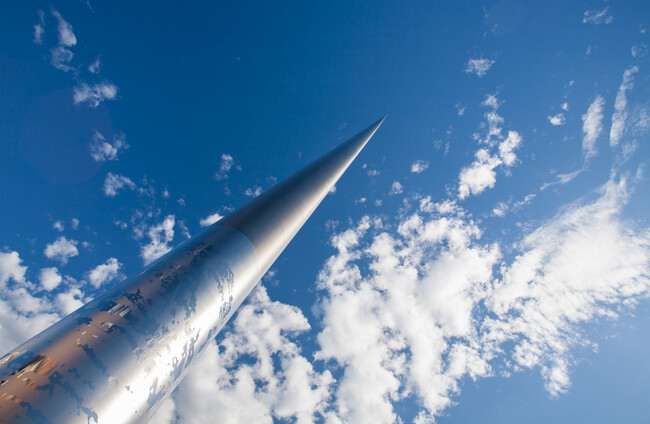
FOR A LITTLE less than two hours on Thursday morning, I asked nearly one hundred people what – if anything – they felt about The Spire. The answers amounted to a near unanimous feeling of mild positivity.
In typical Irish fashion, the 121m steel monument intended to celebrate the turn of the millennium wasn’t finished until three years later. Today marks the 20th anniversary of the structure’s completion.
Shortly after its inception, the project was beset by complaints and challenges – including a High Court challenge, difficulties in obtaining planning permission, and environmental regulations.
These days, however, there are evidently many among us who are perfectly happy with architect Ian Ritchie’s vision “of elegant and dynamic simplicity, bridging art and technology”.
By way of establishing this, I stood beneath the behemoth with my little notebook, feeling like the Ned Broy meme. The methodology was flawless (note: this methodology is not flawless).
The emphatically polite response by natives and tourists alike caught me off guard. Not one respondent thought it was a monstrosity, or an abomination, or any of the dramatic words I expected to hear from a town whose citizens – as many of them will surely admit – are rarely afraid to complain.
There could be several elements that biased the results of the process, of course. There could be some self-selecting thing happening where people who tend to like The Spire naturally gravitate towards The Spire.
It could also be that it is easier to tell a strange man that you like a 121m-tall steel pole, potentially an object of his worship, rather than risk what might happen if you tell him you don’t like it and it turns out that he’s some kind of Spire fanatic. Indeed, another lesson learned is that people are much more likely to cross the road at a red light if they are being approached by a stranger with a notebook. One man broke into a full sprint.
Nevertheless, the answers I did get revealed a throughline of impressive consistency.
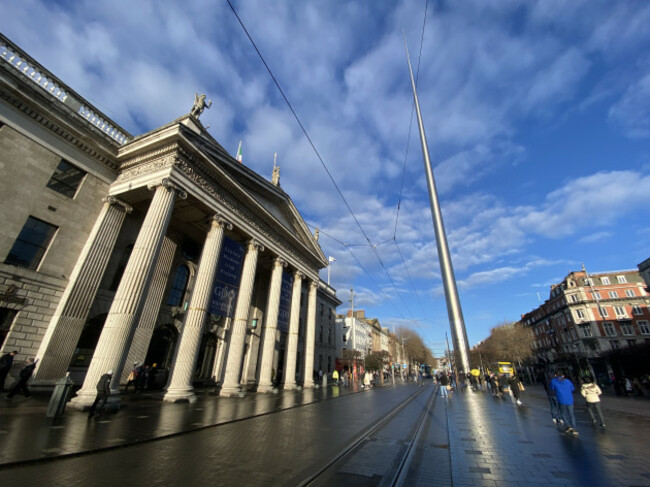
Of the at least 70 (I eventually stopped marking down responses because my hands got too cold, again: flawless methodology) people who stopped to answer my question of “The Spire: y/n?,” only six were what I would call a hard no.
An older couple from Yorkshire, a younger couple from London, another couple from Brazil that spent minutes taking photos of each other in front of it from an angle that quite simply could not have captured what The Spire actually is, were all of them happy that they had seen it.
One family hunkered down at the bottom of it in order to get the whole skybound thing into the frame, and described themselves as “in tourist-mode” – thinking of The Spire in much the same way as they might think of the Guinness Storehouse.
A young Irish woman waiting to meet her friends, who all ended up having generally positive opinions on The Spire, conceded that it wasn’t very pretty, but said it was a very “handy, central meeting spot”.
Among locals, it seems that the landmark is most-prized for its usefulness. In a city without any skyscrapers, it can be seen from damn near anywhere. Everyone knows where it is, and it is as uncontroversial a meeting place as one could hope to suggest. The goal of The Spire was to be very big, and it has undeniably achieved that goal.
No matter what your opinion on The Spire, we must give it its due. It is large. It is central. With the exception of the black spray-paint graffiti that currently adorns it (the word “COB”), it is very shiny.
Between the few nos and many yesses, there was just one individual, a man who looked to be in his 30s, who took a while to ponder whether or not he likes the Spire, looking back and forth between me and the pillar, before eventually saying: “I don’t know”.
One complaint was raised independently by several visitors from abroad: that there is nothing around The Spire to indicate its history or significance. The reason for that might be that it doesn’t really claim to possess either of those things, but it still seems something worth putting in the Dublin City Council suggestion box.
One woman from Belfast, who was standing right next to The Spire, didn’t seem to realise she was standing next to anything at all, and it required this journalist pointing upwards for her to notice that there was anything unusual about the particularly wide steel circumference to her right.
Once made aware of the hulking column, she and her three friends all agreed with nods and murmurs that it seemed to be a pleasant instalment rather than a negative one.
When The Spire was first greenlit, many of the complaints centred around its cost. However, €4,000,000 spent on an enormous steel pole seems quaint when cast against modern examples of government overspend. Even in today’s money, the outlay on The Spire would hardly cover a few week’s worth of labour and materials in the National Children’s Hospital.
It seems that if you are to straw-poll visitors to O’Connell St, both regular and irregular, you are unlikely to find many detractors. Which is just as well, because there’s no way we would ever settle on something to replace it with, and God only knows what it might cost us.

To embed this post, copy the code below on your site







have your say