Sign in. It’s quick, free and it’s up to you.
An account is an optional way to support the work we do. Find out more.
Sign in. It’s quick, free and it’s up to you.
An account is an optional way to support the work we do. Find out more.
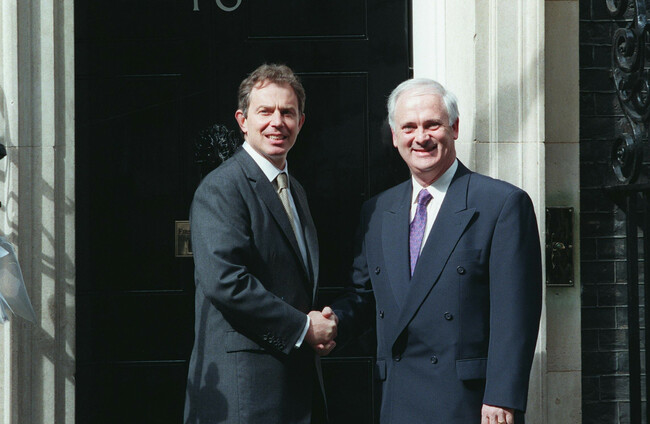
TONY BLAIR TOLD John Bruton in Downing Street 25 years ago that people feared “losing control” to the European Union.
Blair also told his Irish counterpart that he was “amazed” by the Irish economy and hoped it would help pro-EU sentiment in the UK.
The admissions are contained in the minutes of a meeting held between the pair on 8 May 1997 that have been released as part of the State Papers.
Each year, decades-old government documents are released under the National Archives Act, providing journalists and historians with a fresh look into historical events.
Previously confidential files (2021/51/498) from the Department of Foreign Affairs NI Division 1997 show that a newly elected Blair had hoped Ireland’s success in the EU would help to fend off Euroscepticism.
The meeting took place a week after the electoral landslide win by Blair’s ‘new Labour’ and a month before Bruton was defeated by a Bertie Ahern-led Fianna Fáil.
Blair’s win had ended 18 years of unbroken Tory rule and Blair told Bruton and Tánaiste Dick Spring that he expected the Tories to be “pretty Eurosceptic in opposition”.
Blair had visited Ireland the previous December and had toured the country before speaking at Government Buildings in Dublin.
His trip in Ireland had clearly left an impression as Blair is recorded as saying he was “amazed at the rapid and visible development in the Irish economy”.
Spring joked this was because “we had only shown you the good bits” to which Blair’s Foreign Secretary Robin Cook responded: “at least you have good bits to show people”.
Bruton pointed out that Ireland’s development was good news for Britain too and that Ireland was now Britain’s fifth-biggest export market.
Cook acknowledged this and expressed a hope that “Ireland’s positive experience within the EU could have an impact on the European debate in Britain”.
Bruton is reported to have raised the wider importance of the EU in preserving peace on the continent, commenting that German Chancellor Helmut Kohl “whom he knew well”, was committed to the project from a broad historical perspective.
Echoes of Brexit
Under the Tories, the UK had secured an opt-out from the euro’s creation in the Maastricht Treaty in 1992 and when Labour came to power Chancellor Gordon Brown had set “five economic tests” for the UK to join the currency.
The UK never joined the euro but Blair is shown in the files to be keen that the country maintained a strong link to the EU.
Blair told Bruton that an EU meeting due to take place in Amsterdam the following month would be “a test of whether a different relationship between Britain and its European partners worked”.
Blair said that constructive engagement was needed to “turn around attitudes in Britain” and that he “couldn’t overstate” the “negative effect in the country” if he couldn’t show “a better way of doing business with Europe”.
Blair added that he “believed in European integration” but that the question was about the “pace, shape and content of integration”.
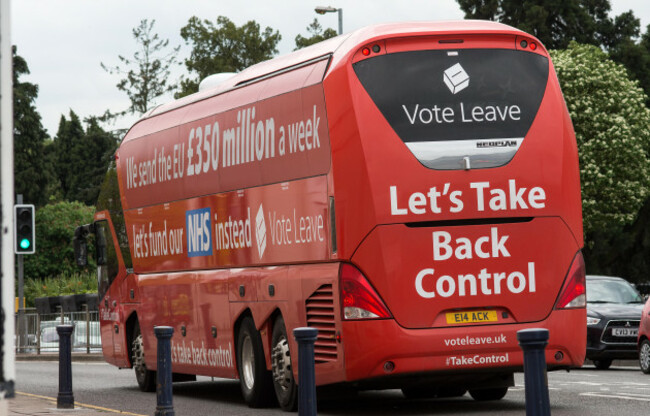
With unknowing prescience about the famous slogan used by Brexiteers during the 2016 referendum, Blair said that governments had to “bring their peoples with them”.
If they did not, he said, people would “feel that they had lost control and would end up blaming Europe for failures of policy”.
The United Kingdom voted to leave the European Union on 23 June 2016 and ‘Brexit’ officially became a reality on 31 January 2020.

To embed this post, copy the code below on your site













have your say