Sign in. It’s quick, free and it’s up to you.
An account is an optional way to support the work we do. Find out more.
Sign in. It’s quick, free and it’s up to you.
An account is an optional way to support the work we do. Find out more.
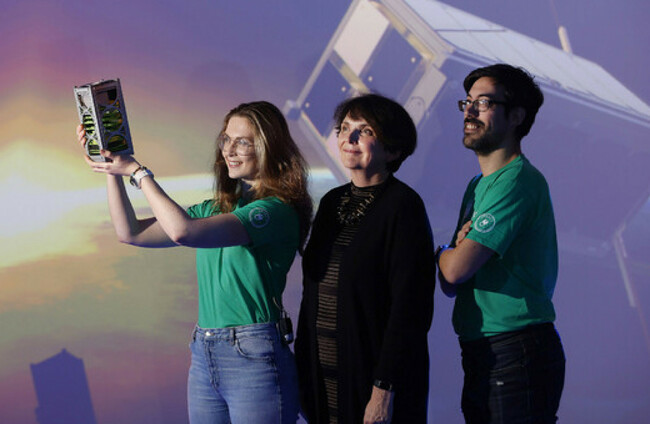
IRELAND’S FIRST EVER satellite, which was designed, built, and tested by students at University College Dublin, has completed its mission orbiting the Earth.
EIRSAT-1 is a CubeSat, a satellite that is a little bit smaller than a shoebox.
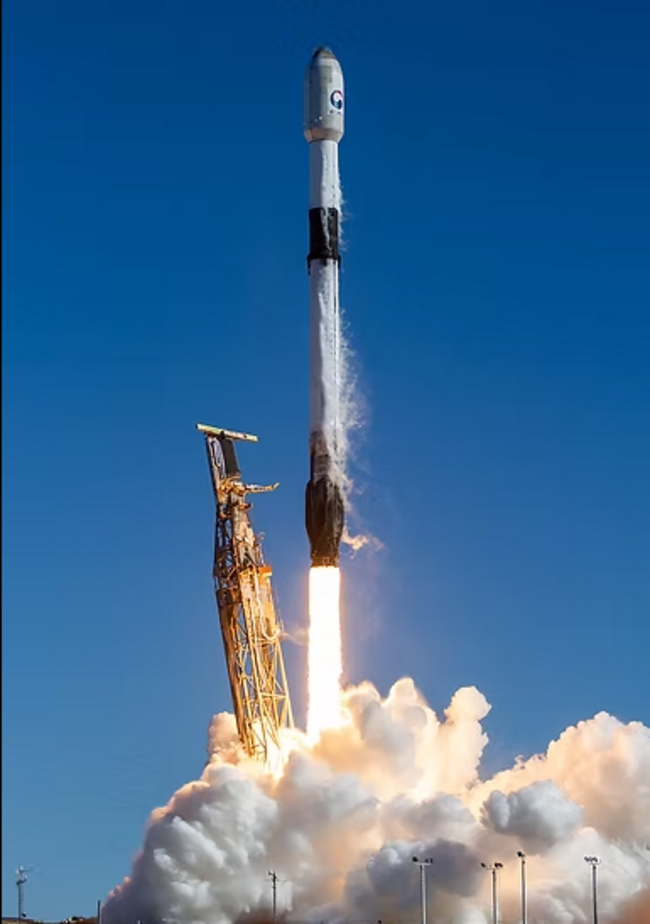
In December 2023, the SpaceX Falcon 9 rocket carrying EIRSAT-1 lifted off from the Vandenberg Air Force Base in California.
The satellite has three “payloads”, or experiments in it, one of which is a gamma-ray burst detector.
Gamma-ray bursts occur during the death of massive stars and are detected here from galaxies that may be billions of light-years away.
Last October, EIRSAT-1 detected two gamma-ray bursts.
EIRSAT-1 went on to detect 10 cosmological gamma-ray bursts and two solar flares – a solar flare is a tremendous explosion on the Sun that happens when energy stored in “twisted” magnetic fields is suddenly released.
Over the course of the project, the EIRSAT-1 team published 24 academic journal and conference papers, sharing the results of the research and technological developments.
Following its mission, EIR-SAT-1 will de-orbit in the next day or two.
Lorraine Hanlon is the Director of UCD’s Centre for Space Research and the Endorsing Professor for EIRSAT-1.
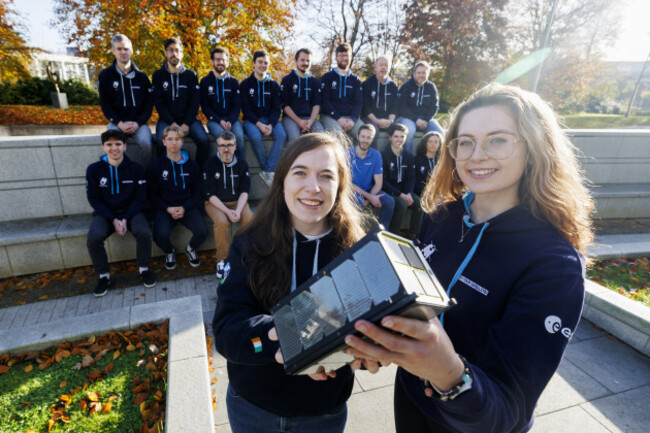
She said it’s a “sad day for the team” but that she’s “proud that EIRSAT-1 has reached the end of its mission having achieved all of its goals”.
Meanwhile, Dr Padraig Doolan, Irish Delegation to the European Space Agency at Enterprise Ireland, said: the “successful conclusion of EIRSAT-1 marks a milestone for Ireland’s space sector”.
“It shows how Ireland not only participates, but also leads complex space missions from design through to operations,” he added.
Elsewhere, UCD Vice-President for Research, Innovation and Impact, Professor Kate Robson Brown remarked that “Ireland became a space faring nation with the launch of EIRSAT-1”.
She added that UCD is now “in prime position to take Ireland forward into a new and ambitious era of growth for the space sector which will deliver both scientific discovery and societal impact”.
More than 50 students, mostly postgraduates in Physics and Mechanical and Materials Engineering and some in Computer Science and Mathematics, space systems skills not previously seen in Irish industry as part of this mission.
Meanwhile, UCD C-Space has been selected by ESA for a follow-on project called COMCUBES, led by Dr David Murphy, that will develop a CubeSat swarm to deliver faster and more detailed information about gamma-ray bursts.

To embed this post, copy the code below on your site













have your say