Sign in. It’s quick, free and it’s up to you.
An account is an optional way to support the work we do. Find out more.
Sign in. It’s quick, free and it’s up to you.
An account is an optional way to support the work we do. Find out more.
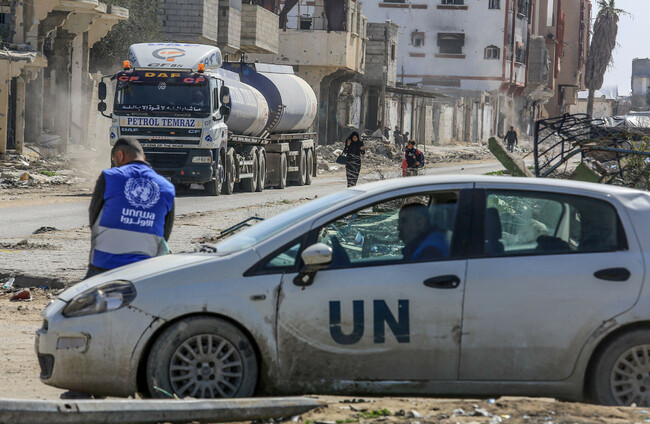
THE FIGHTING HAS largely stopped in Gaza, but Israel’s war against the humanitarian agencies trying to support Palestinians there continues.
The primary target has been UNRWA, the UN organisation that essentially acts as a civil service for Palestinian refugees in Gaza, the West Bank, Syria, Lebanon and Jordan.
The Journal spoke to Irishman John Whyte, the senior deputy director for UNRWA in Gaza with responsibility for operations, about Israel’s efforts to hinder humanitarian access to the famine-stricken territory.
UNRWA was founded in 1949 following the Nakba (Catastrophe), when hundreds of thousands of Palestinians were forced from their homes during the Arab-Israeli war that led to the founding of the state of Israel.
Many of those refugees make up large portions of the populations in the Gaza Strip and the West Bank, living in refugee camps supported by the aid agency.
Last year, Israel’s parliament voted to ban UNRWA and since it came into effect in January, the legislation has thrown up new obstacles to the entry of food and other aid into Gaza.
The ban on UNRWA has meant that it cannot operate in Israel, which is the occupying power that controls the points of entry into the Gaza Strip. That means Whyte, who left Gaza in March, cannot re-enter because he would need permission from Israel to do so.

“We need contact with the Israelis to be able to go in and out, which is why I’m now stuck outside,” Whyte said.
“Being in there would be preferable. I would go back tomorrow, but it’s not possible. So we have to manage as best we can.”
There are still 12,000 UNRWA workers operating in Gaza, but they’ve been cut off from their colleagues on the outside.
“I’m working with key managers who are still there in charge of operations,” Whyte explained, saying he is dealing with things like logistics, HR, legal investigations and other administrative tasks now that he’s back in Ireland.
“Now, because our staff are in there, they will continue to operate and deliver services, but obviously we are hampered because our supplies are not able to come in.”
Although UNRWA is now banned, its supplies can still enter Gaza via other relief agencies, but that comes with its own challenges. There are currently 5,000 UNRWA trucks waiting to enter the strip.
“They just won’t let anything that’s owned by UNRWA go in,” Whyte said.
“So they’re requiring us to hand our supplies over to other agencies who then bring them in. But we also have to take the UNRWA logo off everything, which causes us a lot of hassle.”
In addition to the law banning UNRWA, Israel has more recently imposed new requirements on other aid agencies and international NGOs, demanding they disclose sensitive information about their Palestinian employees.
Some organisations have refused to do so and have been deregistered as a result, meaning they cannot operate in Palestine.
“All of this is trying to just undermine the humanitarian effort, which has been the case right throughout the war.”
Whyte said these obstacles are part of Israel’s use of humanitarian aid as a weapon of war, and evidence that Israel is “really trying to undermine every facet of Palestinian life in Gaza and to make the place unliveable, to the extent that they have almost succeeded in that.”
Need more information on what is happening in Israel and Palestine? Check out our FactCheck Knowledge Bank for essential reads and guides to navigating the news online.

To embed this post, copy the code below on your site












have your say