Sign in. It’s quick, free and it’s up to you.
An account is an optional way to support the work we do. Find out more.
Sign in. It’s quick, free and it’s up to you.
An account is an optional way to support the work we do. Find out more.

LAST UPDATE | 4 Feb
THE DEFAULT POSITION will be that victim counselling notes will not be disclosed in sexual offence trials, according to Justice Minister Jim O’Callaghan.
There would be a “presumption of non-disclosure” under the proposals, meaning the default position will be the notes would remain private.
However, speaking to reporters after Cabinet today, the minister stated that in “exceptional” cases, the notes may be disclosed if it is deemed to be “in the interest of justice”. This would only be in a “very small number of cases”, he said.
Furthermore, a “disclosure hearing” in front of a judge would have to take place for any such notes to be disclosed, as opposed to the current system where judicial oversight is waived.
The judge would have to rule that the notes contain material relevant to legal proceedings.
O’Callaghan wants to legislate that such records are only released where a judge decides after a disclosure hearing that they contain evidence relevant to legal proceedings.

He said the measures would restrict the use of counselling notes “as far as possible” after Attorney General advice that a complete ban would be unconstitutional.
Minister Callaghan will seek to apply the same conditions to other records containing sensitive personal data, such as medical records and child protection records.
The proposed amendments to the Criminal Law and Civil Law (Miscellaneous Provisions) Bill are go to Cabinet tomorrow.
In November, the Oireachtas Justice Committee recommended a complete and unconditional ban on the use of counselling records in sexual offence trials.
It advised against giving a judge the power to ultimately decide if they can be used or not.
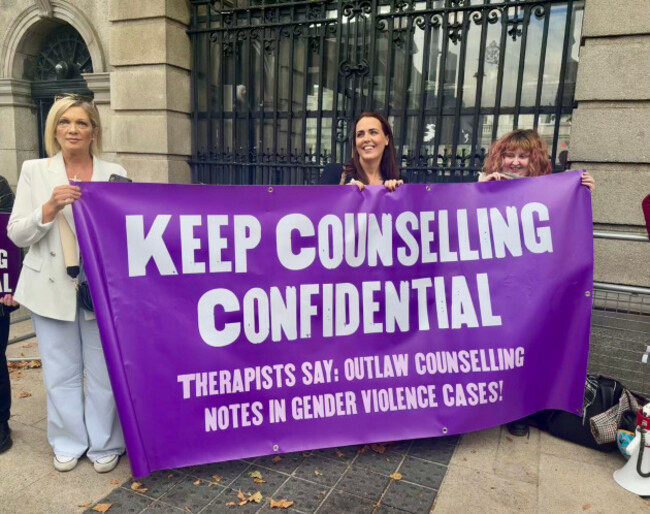
Solidarity TD Ruth Coppinger, who has been campaigning on the issue, told The Journal that she welcomes the fact that the government is now bringing stronger amendments to the bill on counselling notes, but said she would have see the wording before she could decide her stance.
Coppinger said she wanted to hear what the criteria is for the defence to claim therapy notes are essential for a fair trial, stating it is impossible to imagine any scenario where third party counselling notes are needed.
Secondly, she wants to know how such notes would be accessed.
“They would need to have such a high level of privilege that a defendant should have to go to the High Court to even make a case for access,” she said.
“Once again, I commend the survivors and therapists who have so strongly brought this centre stage, forcing the government to move forward at all times. We now need to get this right and to the satisfaction of survivors,” she said.
Chief Executive of Dublin Rape Crisis Centre, Rachel Morrogh, said it is with some reserve that the centre welcome news that a new statutory privilege will be created and that all personal records will be covered by this legislation.
“In our view, it’s absolutely critical that the amendments push the limits of what is constitutionally possible so that counselling notes have the strongest and most robust protection that is legally achievable,” she said.
With reporting by Christina Finn

To embed this post, copy the code below on your site















have your say