Sign in. It’s quick, free and it’s up to you.
An account is an optional way to support the work we do. Find out more.
Sign in. It’s quick, free and it’s up to you.
An account is an optional way to support the work we do. Find out more.
IRELAND’S WATER QUALITY is worse now than it was in the late 2010s, with pesticides, land drainage and sewage among the main culprits driving the decline.
Water quality has declined across rivers, lakes and estuaries, according to the Environmental Protection Agency (EPA), though slight improvements have been made in coastal waters and groundwater.
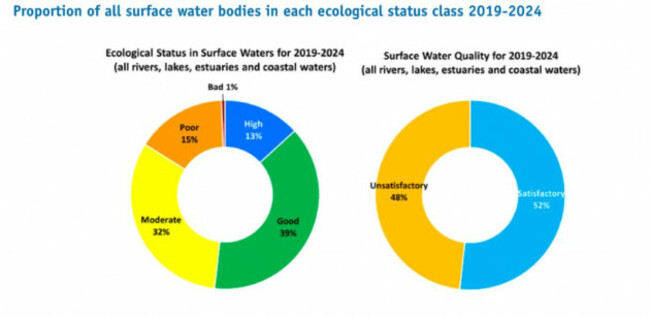
Overall, between 2019 and 2024, 52% of Ireland’s surface waters were of a high or good ecological status and the remaining 48% were of moderate, poor or bad status.
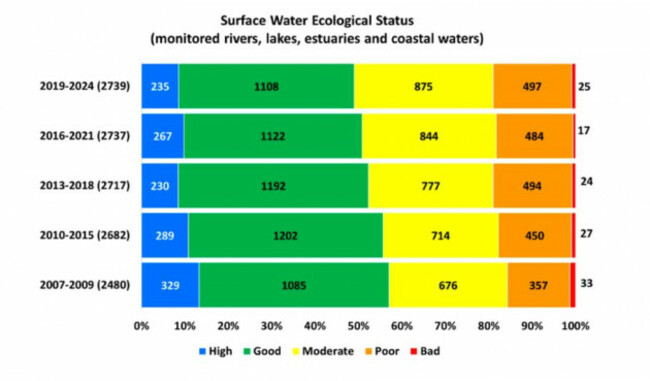
It’s a decline since the previous assessment period of 2016 to 2021, when 54% of surface waters were in high or good status.
Although it’s a relatively small drop, the EPA has warned that it means Ireland is on track to fail to meet national and EU goals for water quality in the next two years.
“Our rivers, lakes and estuaries are the lifeblood of our landscape and support our ecosystems, and our health and wellbeing. But they are struggling,” said Dr Eimear Cotter, director of the EPA’s Office of Evidence and Assessment.
They do not have the resilience to cope with the challenges they face, now and in the future.
“Surface water quality overall has been in decline since before the first of these assessments was carried out by the EPA in the late 2000s.”
Dr Cotter said it is “very disappointing to report that water quality is not improving despite the many actions that are underway, across all sectors”.
“It’s clear the scale and pace of implementation needs to be increased and sustained.”
Nearly one-fifth of surface water bodies had too high a presence of chemicals, the report found.
Most of these related to mercury, other metals, pesticides and per- and poly-fluoroalkyl (PFAS) chemicals in the water.
The latest figures show that nitrate concentrations are too high in 44% of river sites, especially in the east, southeast and south of the country.
The concentration of nitrate did fall, though, at 39% of river sites compared with 2016-2021. It increased in 6% and remained the same at 55%.
More than one-quarter of river sites (27%) have high phosphorus concentrations. Compared with 2016-2021, 16% of sites now have higher phosphorus concentrations, 2% have lower and 77% have the same.
There were 142 fish kills recorded from 2019 to 2024, which is an average of 24 each year.
The EPA report says that the net decline in water quality is part of an ongoing pattern of continuing decline that has been happening since the first assessment of ecological status was done from 2007 to 2009.
It details that the quality of our freshwater and marine ecosystems is being damaged by activities that release pollutants into the water.
According to the report, one of the main causes is run-off of nutrients, sediment and pesticides from agricultural lands and farmyards.
Activities like land drainage, navigational dredging and the presence of barriers such as dams, weirs or culverts in water courses are also main drivers, as well as discharges of poorly treated sewage from urban waste water treatment plants, domestic treatment systems and storm water overflows;
Run-off from hard surfaces in urban environments of sediment and contaminant-loaded water run-off of nutrients and sediment from forestry operations are also contributing to poor water quality.
A separate report from the EPA last week said that raw sewage is still being discharged daily from wastewater treatment plants into water near 15 urban centres across Ireland.
An investigation by The Journal Investigates earlier this year found that more than half of local authorities failed to meet farm inspection targets for slurry spreading and management last year.
In some places, water quality has improved. However, in many cases, the improvements have not been significant enough to push the particular water body from poor to satisfactory condition.
Additionally, the number of water bodies improving in status is lower than the number of water bodies declining.
The result is that any improvements in water quality are being offset by declines occurring elsewhere.
The EPA warns that at the current level of progress, Ireland will fail to meet the EU and national goal of restoring all waters to good or better status by 2027.
It advises that Ireland will need to take significant actions to improve our water quality, including targeted measures to address pressures on water bodies, reductions in nutrient losses to waters, and more investment from Uisce Éireann.
There also needs to be better sharing of data between state agencies and other bodies involved in water quality.

To embed this post, copy the code below on your site














have your say