Sign in. It’s quick, free and it’s up to you.
An account is an optional way to support the work we do. Find out more.
Sign in. It’s quick, free and it’s up to you.
An account is an optional way to support the work we do. Find out more.
EARLIER TODAY NORTH Korea claimed to have carried out a successful hydrogen bomb test.
The United Nations Security Council is to hold an emergency session as a result.
North Korean state television announced that the bomb test was successfully performed at 10.00am (3.30am Irish time). If true, the development massively raises the stakes over the hermit state’s banned nuclear programme.
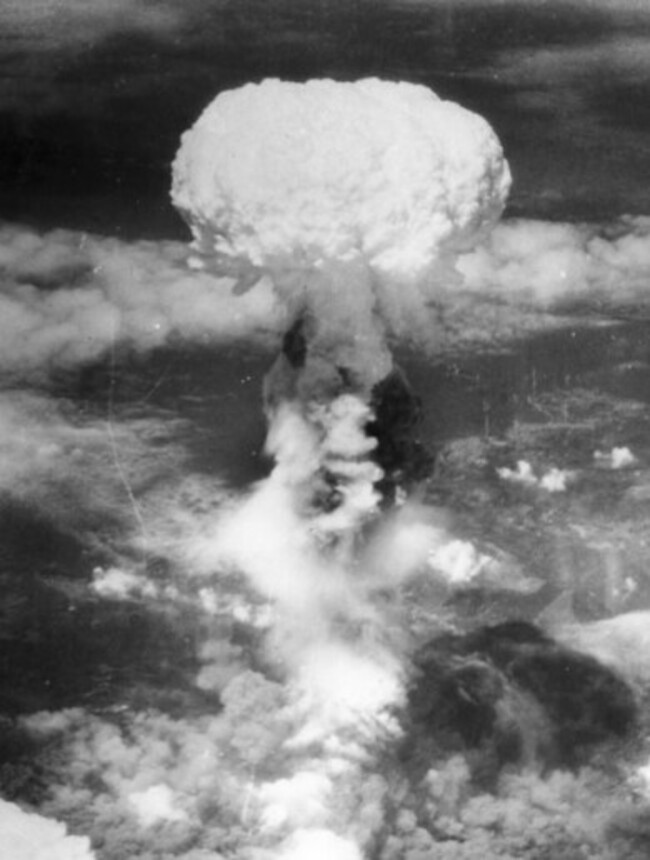
The world’s nuclear arsenals have typically comprised two types of warheads: atomic bombs (A-bombs) such as those dropped on Hiroshima and Nagasaki, and much more powerful hydrogen or thermonuclear bombs (H-bombs).
A third category of enhanced radiation (ER) warheads, once dubbed “neutron bombs”, was developed using the thermonuclear principle, but they are not considered to be widely deployed at present.
Britain, France, China, Russia and the United States – the five permanent members of the UN Security Council – officially have nuclear weapons.
India and Pakistan also have nuclear weapons along with Israel, which maintains a policy of nuclear ambiguity, and North Korea is known to have carried out tests. If North Korea masters the technology needed to produce miniature warheads, it could conceivably use them to arm ballistic missiles able to reach neighbours in Asia and possibly the United States.

The A-bomb
Atomic bombs work on the principle of nuclear fission, where energy is released by splitting atoms of enriched uranium or plutonium encased in the warhead. The first test of an A-bomb took place in July 1945 in New Mexico in the US, and immediately demonstrated the new weapon’s awesome power.
Hiroshima was destroyed by one A-bomb with a uranium-fuel warhead that had the power of 15 kilotons (0.015 megaton). Nagasaki was destroyed three days later by a plutonium A-bomb of similar power, 17 kilotons – or the equivalent of 17,000 tons of TNT. The Soviet Union tested its first atomic bomb in August 1949 in the desert of Kazakhstan.
The H-bomb
The hydrogen or thermonuclear bomb works on the principle of fusion of two nuclei, and generates temperatures similar to those found at the sun’s core. When a H-bomb is detonated, chemical, nuclear and thermonuclear explosions succeed each other within milliseconds. The nuclear explosion triggers a huge increase in temperature that in turn provokes the nuclear fusion.
The first US test of a H-bomb was on 1 November 1952 in the Marshall Islands, a chain in the Pacific Ocean. A year later the Soviet Union tested its own H-bomb, and the largest blast to date took place on 30 October 1961, when the Soviet Tsar Bomba exploded in the Arctic with a force of 57 megatons.
No H-bomb has been used in a conflict so far, but the world’s nuclear arsenals are comprised for the most part of such weapons.
Many people don’t believe North Korea’s latest claim.
Bruce Bennett, an analyst with American think tank Rand Corporation, told the BBC: “The bang they should have gotten would have been ten times greater than what they’re claiming.
So Kim Jong-un is either lying, saying they did a hydrogen test when they didn’t, they just used a little bit more efficient fission weapon – or the hydrogen part of the test really didn’t work very well or the fission part didn’t work very well.
- Additional reporting from Órla Ryan

To embed this post, copy the code below on your site














have your say