Sign in. It’s quick, free and it’s up to you.
An account is an optional way to support the work we do. Find out more.
Sign in. It’s quick, free and it’s up to you.
An account is an optional way to support the work we do. Find out more.
IN THE BOOKSHOPS of Budapest, books that were easily available only a few years ago can no longer be openly found on the shelves.
In police stations, authorities are preparing to use facial recognition software to identify and imprison organisers of the annual Pride parade.
And in the homes of the city’s LGBTQ+ community and their loved ones, people are anxiously watching as their government chips away at hard-fought-for human rights and democracy.
Across the border – west to Romania, or north to Slovakia – more European Union citizens wonder if their country will be the next to ban Pride.
Budapest Pride is marking its 30th anniversary this year. Organised Pride events started out small – a film festival; picnics on a mountain outside of the city – at a time when most LGBTQ+ people weren’t safe to let their identity be publicly known. The first march was in 1997, and the marches have continued each year since then (aside from 2020 on account of the pandemic).
But this year, the Hungarian government wants to imprison its organisers.
Prime Minister Viktor Orbán has led the country for almost as long as Pride has existed there, serving from 1998 to 2002 and again from 2010 up to the present day. During that time, his party, Fidesz – which once occupied the same political grouping in the EU as Fine Gael – has moved further and further to the right.
In 2021, the parliament passed legislation to restrict the visibility of LGBTQ+ content, embedding into law that only over-18s should be allowed to engage with information and media that pertains in some way to LGBTQ+ people.
The law has had numerous ramifications. For one, it’s meant that bookshops have had to take children’s books with LGBTQ+ characters off the shelves or wrap them up in plastic. One of the country’s bookshop chains, Líra Könyv, was fined $34,000 in 2023 for failing to wrap up “Heartstopper”, a popular book-turned-Netflix hit featuring a relationship between two teenage boys.
A legal opinion for the EU Court of Justice said that by enacting the law, Hungary has violated the EU Charter of Fundamental Rights by interfering with rights to human dignity, to freedom of expression, and to protection from discrimination. The country has “significantly deviated from the model of a constitutional democracy”.
On top of the anti-LGBTQ+ law, Hungary passed legislation this year curtailing freedom of assembly and introduced sweeping new powers to prosecute participants and organisers of protests.
The government layered those laws to justify a ban on the Pride parade that’s scheduled to take place in Budapest today. Budapest’s mayor, a left-wing politician, said he could get around the restrictions by taking over the event to host it on a municipal level. Nonetheless, police intend to enforce the ban, and it’s expected that attendees identified as taking part could be fined up to €500, and organisers could face imprisonment of up to a year.
It is a distressing time to be a member of the LGBTQ+ community in Hungary. But the government’s mounting attacks, while repressive, have also emboldened many people to stand up for their rights and refuse to be pushed to the sidelines of society.
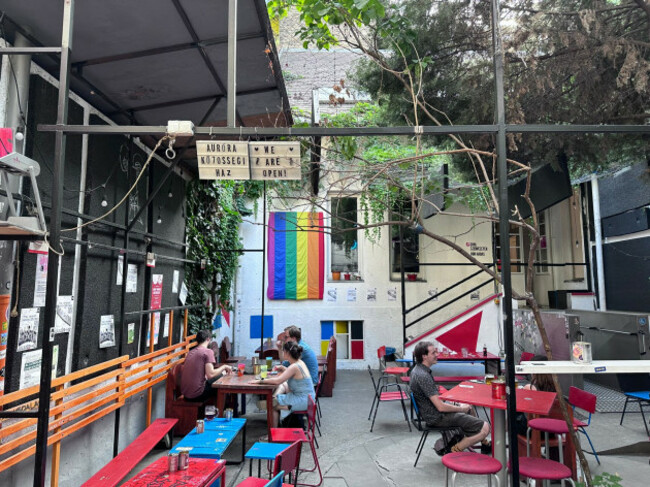
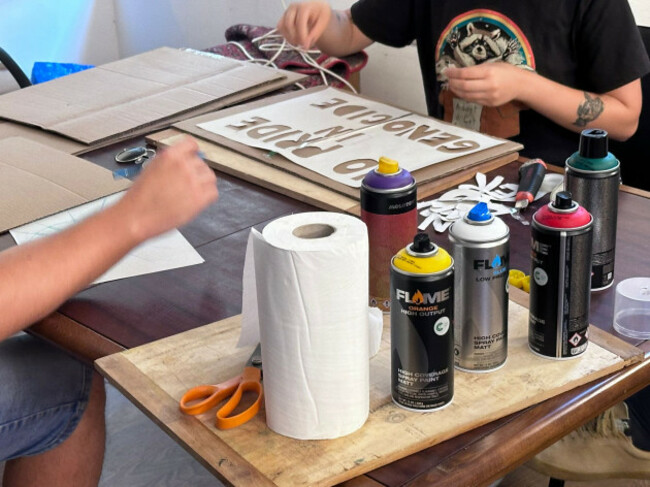
Maja has been an event organiser at a community centre in Budapest for the last two years. The centre collaborates with several human rights campaigns and hosts music gigs, workshops, exhibitions, film nights and more. When The Journal visited, there were plenty of locals enjoying a warm summer’s evening in the garden, and a poster-painting session inside to create banners for the Pride march.
The centre is due to have a tent at the end point of the Pride parade in what’s known as the “civil village”; a kind of fair where various groups and organisations set up stalls.
“Last year we had little bingo cards in the tent – the goal was to get people to talk to each other and to build community. We also had an exhibition about how it’s important that Pride has to be about solidarity, and how it’s more than just big corporations going out with the rainbow,” she said, referring to businesses that support Pride when it suits them but shy away when it doesn’t.
“This was a big topic this year in Hungary. When they first talked about banning Pride, a lot of big corporations stayed very, very quiet. There were big corporations who went out to march when it was more accepted or ‘trendy’, but they are now really quiet and not trying to help the community.”
One of the biggest differences this year compared to others is the level of preparation that’s gone in to organising and participating.
“This year we have to do a lot more preparation about what can you do in advance, what can you do there, what can you do after if they fine you for being there,” Maja said.
“There are different groups or blocks that march in the Pride, including a group that’s in solidarity with Palestine, and that’s also something that was banned in Hungary: showing solidarity with Palestine and protesting in their interest.
“There’s a lot of preparation for how to show what’s important to you, how to show what you believe in, and how to march for your rights and your community and not a fine or get taken away by cops.”
Maja expects that people who may not ordinarily attend Pride will turn out this year to support the community.
“My impression is that not just people who already belong to the community will march this year, but also a lot of others. Liberals who normally don’t go to Pride because it’s not that personal for them, but now, in this kind of political climate, there’s a lot more people who will go.”
Simon is from the UK and has lived in Budapest since 2016, where he worked for three years before retiring.
He’s always gone to the annual Pride parades but he thinks this one is going to be “by far” the most important, and that it could be a tipping point for change. He has friends from other countries in Europe who are coming to the Budapest march to show solidarity, and expects, like Maja, that it’s going to have a larger attendance than usual because of the volume of additional support.
He said that while Pride in some other countries has become mostly a celebration, in Hungary, it’s still fundamentally a protest because of the discrimination that the community faces.
Simon said he’s aware of the possibility that taking part could be dangerous and is a little concerned about the facial recognition software. He “probably won’t dress wildly flamboyant” the way he has at other Prides, but at the same time, he’s “not going to hide”.
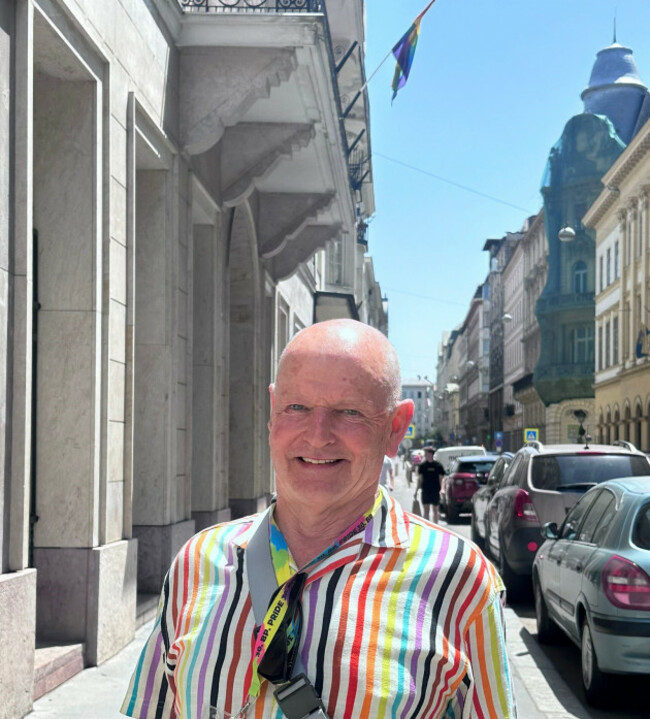
Even as the government tries to marginalise Hungary’s LGBTQ+ community, in Budapest, there are a number of local spots and events that pop up that bring people together.
There’s a popular restaurant and bar along the Danube where you can have a spot of brunch while watching a Drag Queen perform, or go along of an evening for a weekly Drag Queen-hosted bingo.
Inside the restaurant one evening this week, a women from South America who moved to Hungary several years ago told The Journal that she’s attended Pride each year since she arrived in Budapest but that she won’t be going this year.
It’s too dangerous, she said, for people like her and her friends who could risk losing immigrant work visas.
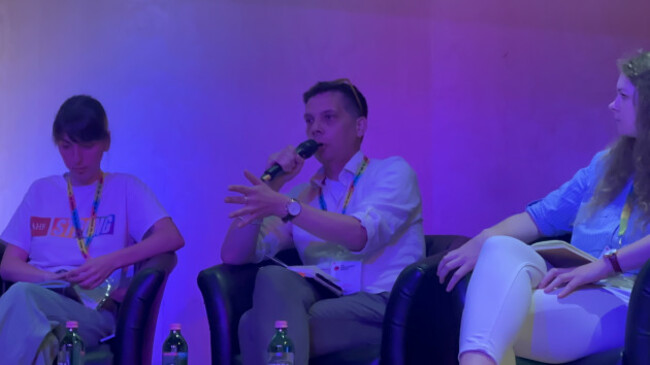
At a conference on Thursday organised by Budapest Pride, speakers warned that what’s happening in Hungary is a warning bell for human rights and democracy around Europe.
Asked to give a worst-case scenario forecast of where Europe could be in ten years, former Taoiseach Leo Varadkar said a repeat of the 1930s is not beyond the realm of possibility – though he strongly hopes it won’t come to that.
German MEP Terry Reintke, the co-chair of the Greens/EFA political grouping, said during a panel discussion that “the far-right is growing stronger”.
“They have a very aggressive agenda, and for me, this is about trying to keep the far-right in check – and that depends on how other democratic forces are going to react to this.”
András Léderer of the Hungarian Helsinki Committee, a Budapest-based human rights monitor, said the Hungarian government’s aim is to “discourage individual citizens to dare to behave as individual citizens, to have an opinion, to go and meet with like-minded people and discuss those issues”.
“The political calculation in Hungary was that it can isolate and alienate people who dare to behave as citizens.”
Later that day, The Journal visited a Pride event being held by a small film club. It convened in an apartment-turned-community library nestled inside a winding maze of a shared building, with books lining the walls almost from floor to ceiling.
Around sixteen film enthusiasts gathered to watch the items on the night’s agenda. The theme was centred around marking two significant advancements internationally for LGBTQ+ rights a decade ago in 2015. One was the US Supreme Court’s ruling to allow same-sex marriage; the other was Ireland making that same choice by referendum.
In Hungary, same-sex marriage is prohibited by the country’s constitution, which was enacted by Orbán’s government in 2012.
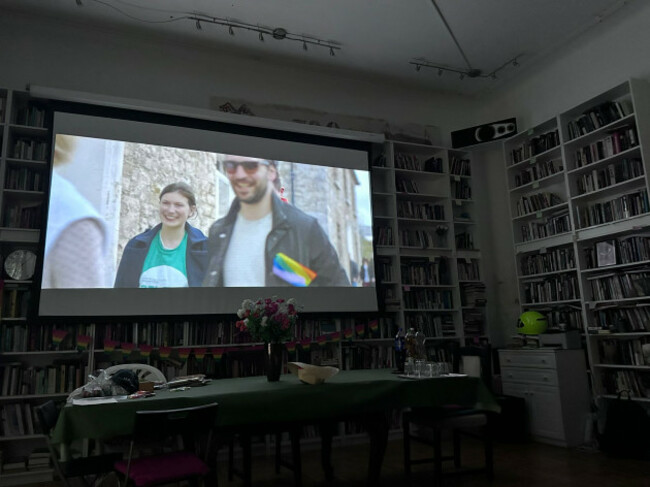
The organisers gave a short presentation about Ireland, the marriage referendum, and this year’s Dublin Pride. With Hungarian subtitles on the screen, they played two of the campaign videos that were shared in the lead-up to the vote by the Yes side.
The first was the “Can I have Sinead’s hand?” ad where a man asks everyone he meets for permission to marry his girlfriend, the message being that no-one should have to ask tens of thousands of others for sign-off to marry whom they choose.
The second was probably the most prominent ad that came out of the Yes campaign – the one where young adults ask their family members to come with them to vote. “Mam, it’s time.” “Granny, do you need a lift to the polling station?” You know the one.
In a dark library, in a city struggling to stand up for itself, it made for emotional viewing – a reminder of how tirelessly the LGBTQ+ community in Ireland had to fight for equal rights; of how little time, really, has passed since then; of how many people in the world are still fighting that battle, like the Hungarians who were there watching, waiting, wondering when it might be their turn to celebrate equality too.

To embed this post, copy the code below on your site
















have your say