Sign in. It’s quick, free and it’s up to you.
An account is an optional way to support the work we do. Find out more.
Sign in. It’s quick, free and it’s up to you.
An account is an optional way to support the work we do. Find out more.

HUNDREDS OF PEOPLE across Europe died as a result of severe weather last year, as Europe experienced its warmest year on record in 2024.
Storms were often severe and flooding widespread, claiming at least 335 lives and affecting an estimated 413,000 people across the continent, according to the EU climate service Copernicus and the World Meteorological Organisation (WMO).
Severe weather events, intensified by global warming and human-driven carbon emissions, caused €18.2 billion in damages, with flooding accounting for 85% of the total.
Europe is now the fastest-warming continent, and the impacts of climate change are “here are clear”, the WMO said.
2024 was the warmest year on record for Europe, with record temperatures in central, eastern and southeastern regions.
The last ten years have been the warmest ten years on record.
There was a distinct east-west contrast in several climate variables, as the east was extremely dry, while the west (including Ireland) witnessed warm and wet conditions.
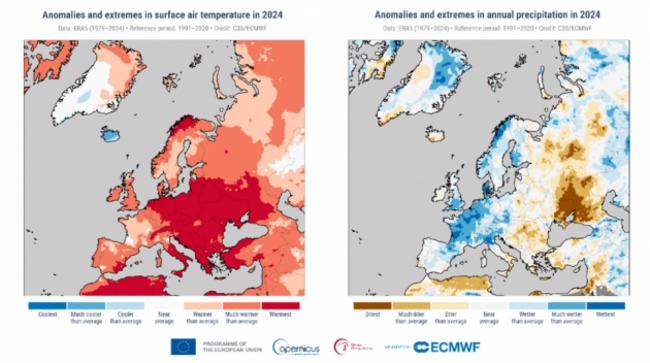
Western Europe saw one of the wettest years recorded since 1950.
Southeastern Europe experienced a record 66 days with “strong heat stress” and 23 “tropical nights” over the summer.
Sea surface temperatures also hit record highs, averaging 0.7 degrees above normal, with the Mediterranean Sea reaching 1.2 degrees above average.
Europe is one of the regions with the largest projected increase in flood risk, but a global warming of 1.5 degrees could result in 30,000 annual deaths in Europe due to extreme heat, the WMO said.
Almost one third of Europe’s river network saw flooding that exceeded at least the ‘high’ flood threshold last year.
All European regions saw a loss of ice – glaciers in Scandinavia and Svalbard saw their highest rates of mass loss on record.

It was the third warmest year on record for the Arctic as a whole and the fourth warmest for Arctic land.

To embed this post, copy the code below on your site














have your say