Sign in. It’s quick, free and it’s up to you.
An account is an optional way to support the work we do. Find out more.
Sign in. It’s quick, free and it’s up to you.
An account is an optional way to support the work we do. Find out more.
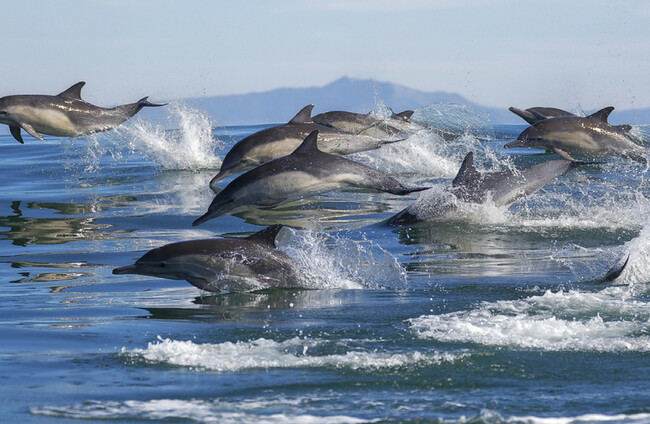
WHALES AND DOLPHINS live in tightly knit social groups and have rich “human-like” cultures and societies, according to new research.
A new study published in Nature Ecology & Evolution yesterday has found that whales and dolphins (cetaceans) have complex relationships, talk to each other and even have regional dialects.
The study links the complexity of cetacean culture and behaviour to the size of their brains.
The study was the first of its kind to create a large dataset of cetacean brain size and social behaviours. Researchers complied information on 90 different species of dolphins, whales and porpoises and found overwhelming evidence that cetaceans have sophisticated social and cooperative behaviour traits, similar to many found in human culture.
Researchers said that this is linked to brain size and expansion.
According to the research, the list of behavioural similarities between humans and cetaceans includes:
Commenting on the research, Dr Michael Muthukrishna, Assistant Professor of Economic Psychology at LSE said that the research was not just about understanding cetacean behaviour more but also human behaviour.
“This research isn’t just about looking at the intelligence of whales and dolphins, it also has important anthropological ramifications as well,” he said.
In order to move toward a more general theory of human behaviour, we need to understand what makes humans so different from other animals. And to do this, we need a control group. Compared to primates, cetaceans are a more ‘alien’ control group.
The research was a collaboration between scientists at The University of Manchester, The University of British Columbia, Canada, The London School of Economics and Political Science (LSE) and Stanford University, United States.

To embed this post, copy the code below on your site














have your say