Sign in. It’s quick, free and it’s up to you.
An account is an optional way to support the work we do. Find out more.
Sign in. It’s quick, free and it’s up to you.
An account is an optional way to support the work we do. Find out more.
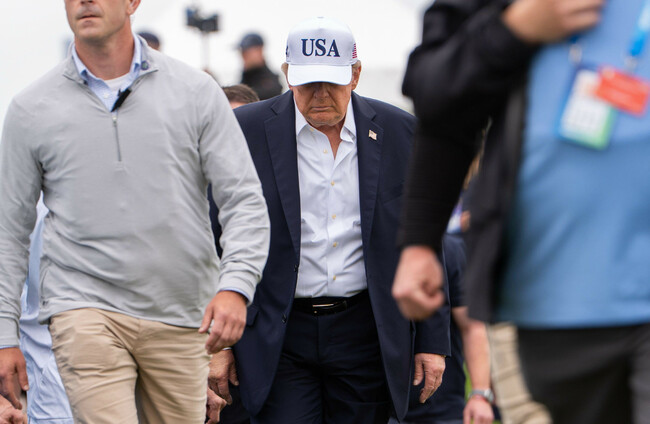

DONALD TRUMP MADE for an uncomfortable harbinger of Irish Unity during his visit to Ireland, but it doesn’t take a very stable genius to know that Ireland should be united.
The intervention will have served many purposes for the US president: controlling the media narrative and playing to the Irish American lobby ahead of the mid-term elections, but it also exposes a geopolitical reality – Ireland has many friends waiting in the wings to support unification. If only the government had the courage to accept it.
Irish revolutionaries understood more than a century ago that Ireland’s constitutional future could not be separated from international politics. The first Dáil established a foreign service before Ireland had an internationally recognised state, while De Valera spent 18 months seeking recognition for the Irish Republic, raising funds and mobilising Irish America. Though the international recognition they sought remained elusive until after the Anglo-Irish Treaty, that vital groundwork has gone on to pay dividends ever since.
Decades later, John Hume picked up the baton and drummed up support in Washington to intervene in Northern Ireland’s conflict. Relationships were built. Tip O’Neill pushed Reagan, Clinton made Northern Ireland a priority, enlisting US Senator George Mitchell to mediate peace talks to resounding success.
Everyone remembers George Mitchell. Fewer remember just how broadly Northern Ireland’s peace process really reached. Torkel Opsahl, a Norwegian human rights lawyer, chaired the Opsahl commission from 1991 to 1992 – a large-scale citizen enquiry to find pathways out of the conflict.
Former Finnish prime minister Harri Holkeri helped chair the negotiations that ultimately produced the Good Friday Agreement. Canada’s General John de Chastelain took on the seemingly intractable problem of paramilitary decommissioning. Later, former Finnish president Martti Ahtisaari and South Africa’s Cyril Ramaphosa were trusted to inspect IRA arms dumps while the European Union invested millions into peace and reconciliation.
The Good Friday Agreement would never have been formalised by the UK and Ireland had they worked alone. The international community provided critical interventions with resources, expertise, political influence and perhaps most importantly, the credibility to do things the parties to the conflict could not do for one another.
Why, then, when we talk about completing the constitutional journey for which the Good Friday Agreement itself lays the groundwork, do we suddenly imagine Ireland must do it alone?
Ireland’s standing on the international stage has changed dramatically since 1919. It is a sovereign EU member state, economically intertwined with the United States, with extraordinary levels of access to Washington and an internationally recognised agreement that already provides the democratic mechanism for constitutional change.
Britain’s power, by contrast, has shrunk considerably over the last century. At the moment of partition, Britain possessed the world’s largest empire and remained one of the dominant military and diplomatic powers on earth. When Irish representatives went looking for international recognition in 1919, they were attempting to internationalise a dispute with one of the principal architects of the post-war international order.
By the 1960s, Britain’s diminished international position had become sufficiently obvious, so much so that former US Secretary of State Dean Acheson famously said in 1962 that Britain had “lost an empire and has not yet found a role.” In the decades following, the empire continued to fold, with 24 countries gaining independence from the UK between 1966 and 1984 alone.
Then came Brexit, the ultimate act of geopolitical self-destruction for a nation that once dominated international affairs. Britain may find it has very few friends that will be willing to support efforts to maintain partition in Ireland during a unity referendum, and it certainly knows it cannot rely on America. Washington’s longstanding commitment is to the Good Friday Agreement, not to maintaining the union. Trump’s intervention has simply made that distinction impossible to ignore.
In the days following Trump’s remarks, the Irish government has sought to suck the air clean out of any momentum toward meaningful debate on Ireland’s future.
There was no shortage of irony when Trump gestured towards Micheál Martin and declared Ireland had “the right man” to get unity moving. Martin has spent much of his political career demonstrating considerably less enthusiasm for the task. Most recently, he stated that talk of a border poll makes him “go bananas”.
This week, while Sinn Fein was in Cardiff meeting with independence movements in Scotland and Wales, Martin responded by claiming that Sinn Féin may “set back unity” with the move, and that “we have never embroiled Northern Ireland in British politics”, a sentiment which would come as a surprise to anyone who knows a single iota about Northern Ireland’s history.
Rather than fixate on the actions of Sinn Féin, or beat back interventions from the international community, the Irish government should have enough confidence to recognise that preparing for unity does not mean going it alone.
We have spent a century building friendships around the world. The question now is whether we have the political courage to ask for help.
Emma DeSouza is a writer and campaigner.
To embed this post, copy the code below on your site













have your say