TheJournal.ie uses cookies. By continuing to browse this site you are agreeing to our use of cookies. Click here to find out more »
Dublin: 17 °C Thursday 20 June, 2013

1916 Rising conference to take place in Dublin

The conference will examine the visual elements of the Easter Rising – from flags to national symbols – and examine identity and memory.

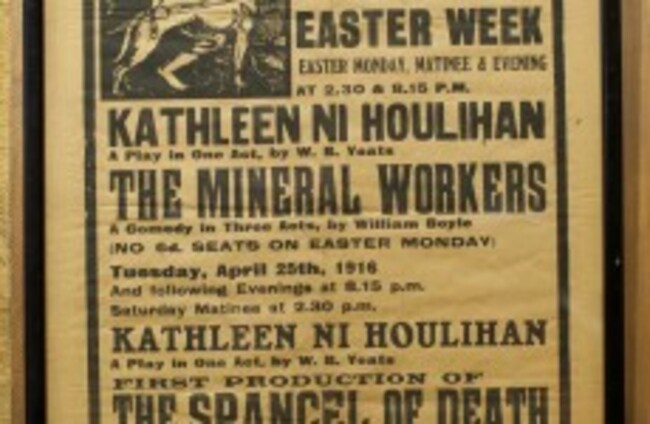
A poster from the performances that weres scheduled to take place at the Abbey Theatre on the day of the 1916 rising
Image: Leon Farrell Photocall Ireland.

FASCINATING ASPECTS OF the 1916 Rising will be explored at a conference in Dublin this April.

With the centenary of the Easter Rising just three years away, Joanna Brück of University College Dublin and Lisa Godson of the National College of Art and Design/GradCAM have organised Object Matters: Making 1916, which will take place at the Wood Quay venue in Dublin’s Civic Offices on 26 and 27 April.

Dr Brück recently undertook an archaeological dig in St Stephen’s Green for remnants of trenches that were believed to have been built by the rebels during the rising.

The aim of the event is to showcase the new and exciting research on visual and material culture of the 1916 Rising, looking at the origins of the tricolour, Celtic Revival dress, the politics of commemoration, how 1916 is displayed in museums, Volunteer uniforms, prison art and more.

The three main speakers at the event will be:

  • Nicholas Allen (University of Georgia) – on ‘Lost city of the archipelago: Dublin at the end of empire’
  • Pat Cooke (University College Dublin) – on ‘Aetheriality and materiality: material culture and the myth of 1916′
  • Mary E Daly (University College Dublin) – on ’1916 as the national commemoration?  The paradox’

Culture

The event will look at the Rising from many different aspects, including some that people may not have considered before, and looks at them through the perspective of visual and material culture. Scholars from a range of disciplines – including archaeology, film studies, history, anthropology, museum studies, art history, literary studies and design history – will all meet to speak at the conference.

Themes will include the materialisation of memory; the meaning of place; the creation of national symbols; text as material culture; and representing the Rising in art and film.

Tickets (€20 unwaged/€40 waged) for the conference can be booked online at the official website.

Read: Members of public invited to have their say on future of 1916 buildings>

Read: National Library releases documents from Roger Casement’s incarceration>

Read: Scars of the Easter Rising you can still see on Dublin streets>

  • Share on Facebook
  • Email this article
  •  

Read next:

Comments (36 Comments)

  • Interesting.. I don’t see one comment of interest at attending the conference. I’m sure the content of the conference will clarify and add more information to the history of the 1916 Uprising.

    Congratulations to the facilitators of this conference. I look forward to the event.

    Reply
  • I could say the same about the American Revolutionaries, the French Republicans…basically every single rising that has ever occurred in human history. Me thinks you’re just trying to get a rise out of others with a provocative statement.

    Reply
  • The rebels of the 1916 rising were derided by the general populous – sound familiar?

    Reply
  • Well I’m sure the lads from 1916 would be glad to see the likes of Bertie with a 150,000 pension while the rest if use live in poverty

    Reply
  • The men of 1916 loved their country .The politician,s of to day love themselves,s

    Reply
  • Sounds well interesting. Would love to go.

    Reply
  • So true Dermot. What did they die for?

    Reply
    • @patrick Lyons – They killed so that we the Irish could be free and have our own independence.
      They killed but were then slaughtered and killed by the occupiers and ‘burglars’ that robbed the Irish of their rights, freedom & homeland.

      Reply
  • the men and women of 1916 would they have bothered if they could see the present day situation.

    Reply
    • M J W 10/02/13 #

      You’re Right our benefactours fought for a better country.Not for so called Irish Men bowing to that crown,those thieving Bastards who live in the life of freeloading ponces,i can’t mention names such as.Sir BOZZO or Sir WIGGY.because the Journal will Censor Me?

      Reply
    • Many Irish people made mistakes, made very bad decisions and now the Irish people are paying. Still massively preferable to being part of the UK and bowing down to the Queen. If you think we would be better off just look at Scotland and the north sea gas. Independent Scotland would be as rich and successful as Norway.

      Reply
    • Can the public attend these Conferences?

      Reply
    • @Stephen: We’re an independent Ireland, we have Gas, why aren’t we as rich and successful as Norway?

      Reply
    • Ferdia, I am no geologist but as far as I know the Irish gas is in fairly deep water, certainly compared to the north sea which is very shallow. Plus, and again I am open to contradiction, our gas was found only fairly recently. Two major and very important differences from the Scottish and Norwegian situations.

      Reply
    • re irish gas – it looks like we may be like thos ” rich ” in resources African countries that get ” help ” from outside .
      The €420,000,000,000+ Ireland is giving away

      Vast quantities of gas and oil have been discovered under Irish waters in the Atlantic Ocean over the past 15 years. The Government’s figures put the value of these reserves at €420 billion (€420,000,000,000), but this is a very conservative estimate. The real figure is likely to be much higher, especially as the global price of oil and gas rises (see explanation below*).

      So what will the Government be spending these new-found riches on? The answer is: Nothing. This wealth will be leaving Ireland, thanks to a deal made between the corrupt Haughey government and multinational oil companies. Minister Ray Burke (later jailed for corruption) changed the law in 1987, reducing the State’s share in our offshore oil and gas from 50% to zero and abolishing royalties. In 1992, Minister Bertie Ahern reduced the tax rate for the profits made from the sale of these resources from 50% to 25%.

      According to respected economist Colm Rapple, the amount of tax paid will be very low and will not be paid until many years into the operation of a gas or oil field, because the deal allows the companies to write off 100% of costs (even the anticipated cost of shutting down the operation!) before they declare the profits to be taxed (see http://www.colmrapple.com). In major oil/gas producing countries, the state takes an average (median) of 68% of the value of gas and oil.

      While people in Ireland are suffering in a recession, being told to tighten their belts, to grin and bear the painful cuts to health, education and their dole, the pension levy, the giant oil companies of the world are preparing to remove Ireland’s valuable natural resources and divvy up the billions of euro of profits between their shareholders.

      So the next time you hear a politician defending the Corrib Gas fiasco by mentioning the “national interest”, remember that Corrib actually represents a net loss to the Irish exchequer of tens of billions of euro.

      http://www.shelltosea.com/content/gas-oil-robbery

      Reply
  • The men and women of 1916 were selfless idealistic heroes. Pity their venal successors didn’t have the same idealistic vision

    Reply
  • This article needs more comments whinging about the current government

    Reply
  • JakkiB 10/02/13 #

    Most of you on here need to go to this exhibition and then you might learn something about your History instead of spouting trash

    Reply
  • Cancel any commemoration of it….a storm in a teacup that 99% of the population wanted nothing to do with at the time !

    Reply
  • Yes but we could call hitler a hero in that case…….

    Reply
  • Watch out for the flag waving users the political users and the secrete society cartel gang that have only one agenda ,,,self….

    Reply
  • I suggest the young men of 1916 were no different than the young men of SF/IRA of today. Killing people is not the way to foster a healthy attitude to life and to humanity. All flags and anthems cause more trouble and will continue to do so for our grandchildren and their grandchildren. What is the point? Grow up and foster a culture of personal responsibility. No more killing for a so called cause.

    Reply
    • You are correct in my humble opinion.

      Reply
    • Agree EU Auditor… No more killing for a cause. Foster a culture of personal responsibility…. However, I would argue that the young men and women of the 1916 uprising are nothing like the women and women of today.

      I’d argue that the men and women of 1916 uprising had a vision for this country, a dream and hope. Generally, I don’t think any of the so mention exists. I see no national pride. I do not see a united front against greed. I do not see strong leadership and guidance from the executive leaders of our government to instill pride. What I do see is a fractured people still suffering from the past and unable to look forward to the future.

      Remember… Politicians sum up the symbol of patriotism as Charles Haughey. At his funeral he was hailed as the greatest patriot of this country.

      Reply
    • phil 10/02/13 #

      Would you say the same qbout Mandela and south Africa. The genicide that was the famine was still in living memory for many at this time. The landlord and tennat system was destroying Irish country life. If you opress a people they will rebel. Its been seen all across the globe.

      Reply
    • There are many differences between Ireland and South Africa. They have not stopped their fight against oppression and inequality. In our country we have. The old oppressors (English) have been replaced by a new set of oppressors (Irish government).

      If it weren’t for being part of the EU… Many of the advancements in Ireland wouldn’t have happened.

      South Africa is still working on their issue. And Ireland is hardly working. This is not to say that people don’t want to change.

      Reply
    • No way, I have read deputations from many participants over the last few days and they all describe how an RIC man was accidentally shot by one of them, they all described how devastated they were at the needless loss if life. They also made sure they got confession before the event. They didn’t know what ruthless was, they only wanted freedom, to which I am grateful for.

      Reply
    • KEVIN.N 10/02/13 #

      You have to be joking? Americans and people all around the world who fought for their country’s freedom/independence from the British were called “terrorists” as well. Your point? The majority of the Irish people backed the freedom fighters (yes freedom fighters) of 1916. The London government was acting like a typical dictator rejecting all the votes showing most Irish wanted to separate. The idea that a famine could happen in one of the richest countries on the face of the earth and result in millions of Irish dying is enough to point out the absurdity of Ireland being in any Union with Britain. Completely outrageous.

      Reply

Add New Comment