Sign in. It’s quick, free and it’s up to you.
An account is an optional way to support the work we do. Find out more.
Sign in. It’s quick, free and it’s up to you.
An account is an optional way to support the work we do. Find out more.
FAST FOOD WORKERS and their supporters beat drums, blew whistles and chanted slogans yesterday on picket lines in dozens of US cities, marking the largest protests yet in their quest for higher wages.
$15 an hour
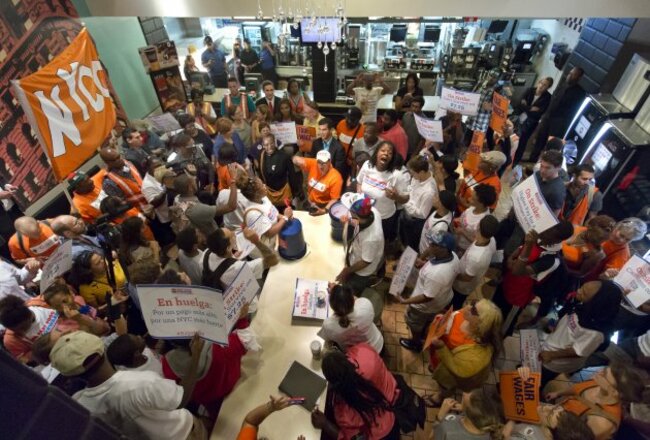
Protesting fast food workers fill a McDonald’s restaurant on New York’s Fifth Avenue. Pic: AP Photo/Richard Drew
The nationwide day of demonstrations came after similar actions organized by unions and community groups over the past several months. Workers are calling for the right to unionize without interference from employers and for pay of $15 an hour.
That’s more than double the federal minimum wage of $7.25 an hour, or $15,000 a year for full-time employees.
Walkouts
Thursday’s walkouts and protests reached about 60 cities, including New York, Chicago and Detroit, organisers said. But the turnout varied significantly. Some targeted restaurants were temporarily unable to do business because they had too few employees, and others seemingly operated normally.
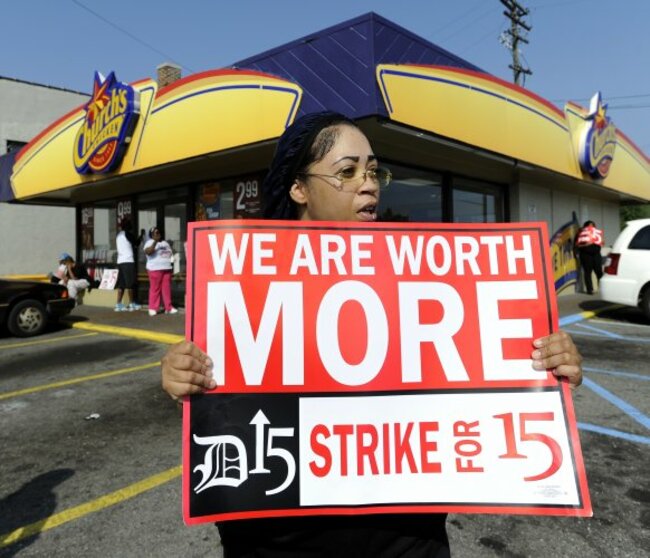
Taco Bell employee Shanise Stitt pickets with other protestors in front of the Church’s Chicken fast food restaurant in Detroit . Pic: AP Photo/Detroit News, David Coates
Jobs in low-wage industries have led the economic recovery. Advocates for a higher minimum wage say that makes it crucial that they pay enough for workers who support families.
The restaurant industry says it already operates on thin margins and insists that sharply higher wages would lead to steeper prices for customers and fewer opportunities for job seekers.
The drive for better pay comes as the White House, some members of Congress and economists seek to raise the federal minimum wage. But most proposals are for a more modest increase, with President Barack Obama suggesting $9 an hour.
The Service Employees International Union has been providing financial support and training for local organizers in the fast-food strikes around the country.
The National Retail Federation called the actions “yet more theater orchestrated by organized labour, for organized labour.” The group said it showed the labour movement is facing depleted membership rolls.
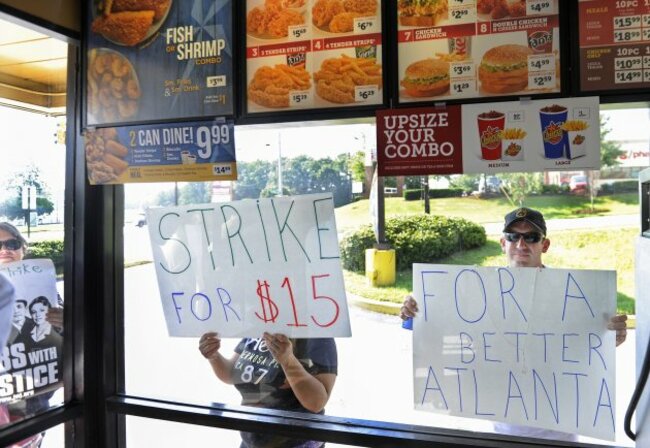
David Atten, right, joins others in demonstrating as he presses a sign to the window of a Church’s Chicken. Pic: AP Photo/John Amis
In New York, City Council speaker and mayoral candidate Christine Quinn joined about 300 to 400 workers and supporters in a march before the group flooded into a McDonald’s near the Empire State Building.
The lack of public awareness illustrates the challenge workers face in building wider support. Workers participating in the strikes represent a tiny fraction of the industry.
Not everyone was supportive. Striking workers in Topeka, Kansas, were briefly confronted by Richard Moore, who said he understood the strike but not why workers were seeking “$15 for flipping burgers.”
Moore, 57, had been sitting on a curb holding a sign saying he was a veteran looking for a job.
The latest protests follow a series of strikes that began last November in New York City.
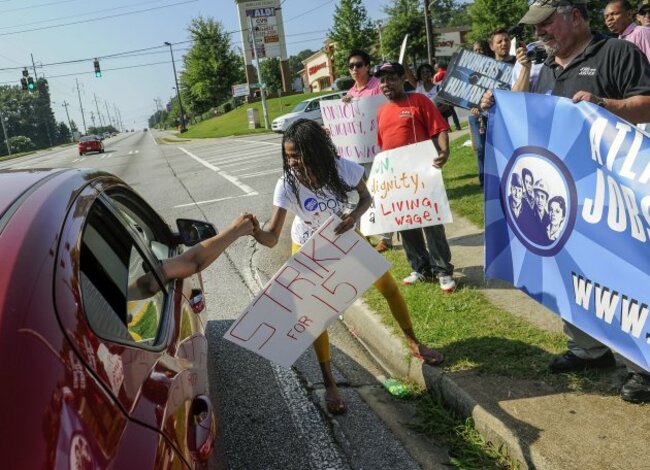
Lea Noel gets support from a passerby as she and other demonstrators protest low wages outside a Church’s Chicken fast food restaurant. Pic: AP Photo/John Amis
McDonald’s Corp. and Burger King Worldwide Inc say they don’t make decisions about pay for the independent franchisees that operate most of their US restaurants. At restaurants that it owns, McDonald’s said any move to raise entry-level pay would raise overall costs and lead to higher menu prices.
The company said it provides professional development for interested employees and that the protests don’t give an accurate picture of what it means to work at McDonald’s.
We respect our employees’ rights to voice their opinions. Employees who participate in these activities and return to work are welcomed back and scheduled to work their regular shifts as usual.
Wendy’s said in a statement that it was “proud to provide a place where thousands of people, who come to us asking for a job, can enter the workforce at a starting wage, gain skills and advance with us or move on to something else.”
Even though they’re not in unions, fast-food workers who take part in strikes are generally protected from retaliation by employers.

To embed this post, copy the code below on your site








have your say