Sign in. It’s quick, free and it’s up to you.
An account is an optional way to support the work we do. Find out more.
Sign in. It’s quick, free and it’s up to you.
An account is an optional way to support the work we do. Find out more.
LAST UPDATE | 10 Mar 2024
INTERNATIONAL MEDIA OUTLETS have been covering Ireland’s referendum results – and as expected much of the coverage has focused on the Care amendment, in particular the retention of the ‘women in the home’ wording.
The Family amendment was rejected by 67.7% of voters, while the Care amendment was rejected by 73.9%. The latter is the highest ever percentage No vote of the 38 referendums that have taken place in the history of the State.
Ireland, the first country to legalise same-sex marriage by referendum, was portrayed as a beacon of progressiveness on the world stage, during that vote almost a decade ago – but international headlines today paint a different picture.
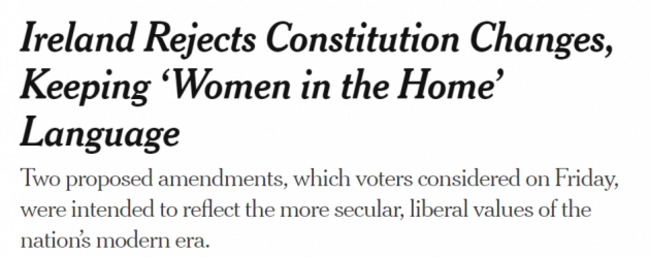
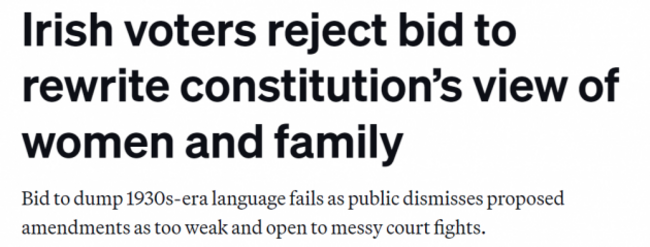
The country was asked to vote on two referendums – one to broaden the definition of family, and the other to amend wording around a woman’s “life and duties in the home” and to acknowledge the roles of other carers.
In tandem with the removal of the ‘women in the home’ language, a new sentence was to have been included which would reference “care” for the first time in the Constitution. It said care is provided by “members of a family to one another” and that where this is the case the State must “strive to support” it.
While there were strong opinions on both sides, many voters were conflicted between a desire to remove the “women in the home” wording and a discontentment with the way its replacement portrayed disabled people and the State’s responsibility to them.
According to headlines abroad, the result was a failed attempt to remove “old-fashioned family values”.
Politico Europe’s analysis asserted that voters dismissed both changes because they were “maddeningly vague and threatening to property rights”.
French TV here in Dame Street #NoNo pic.twitter.com/xe4O9hCQr5
— Michael McDowell (@SenatorMcDowell) March 9, 2024
It is true that a great deal of confusion surrounded both amendments, as the public struggled to differentiate between a State’s constitution and Government policy.
On the proposed expansion of the definition of family – which hit a snag due to the confusion about what a “durable relationship” is – Politico said the “property-obsessed land” (i.e. Ireland) feared that “estranged wives” and “live-in girlfriends” would start demanding their share.
The Government did little to clarify what the real implications of the amendment would have been, despite calls from legal experts and others.
Politico pointed to the two-fifths of children who are born “out of wedlock” in this country, demonstrating how out-of-kilter the Constitution’s version of family is with reality.
‘Shambolic’
Stephen Murphy, Sky News’s Ireland correspondent, described the Government’s approach as “shambolic”.
He wrote: “This will be held up for many years as an example of how not to run a referendum campaign. Pay no attention to any international clickbait headlines declaring that on International Women’s Day, the Irish voted to keep women at home.
This wasn’t about the “sexist” language. It was about the Government’s shambolic approach to the vote.
In its summary of events, AFP reported: “All the major political parties had supported a Yes-Yes vote and until recently polls had suggested a smooth passage for both on International Women’s Day.
“The votes were seen as the latest attempt to reflect the changing face of European Union member Ireland, and the waning influence of the once-dominant Catholic Church.”
Taoiseach Leo Varadkar accepted responsibility for the defeat yesterday, admitting the Government had misjudged its approach.
He said, when asked about expected international coverage, that he didn’t expect the result to be “the talk of the town” abroad.
Taoiseach on international coverage of Ireland voting to reject the referendum on Women in the Home on International Women’s Day:
— Sadbh Cox (@SadbhCox) March 9, 2024
“I’m sure it will be reported on I’m just not sure it will be the talk of the town in Naples, New York or anywhere else for that matter”. pic.twitter.com/x4CyYvtPFR
In the US, CNN has described the whole thing as an “embarrassing” defeat for the Government. The outlet contrasted it with the results of the same-sex marriage and abortion referendums.
Similarly, The New York Times said today’s result is a deviation from the trend in recent years, where the Irish “rolled back socially conservative policies”.
The paper pointed out that the wording that the Citizens’ Assembly had recommended for the referendum was not adopted, and that this is what ultimately doomed a Yes vote, particularly when it came to care.
The Assembly’s wording would assert that the State is “obliged to take reasonable measures” to support care at home and in the community, rather than “strive” to support familial care, as was put to the people.
Despite unhappiness with the wording from early on, most opposition parties with the exception of Aontú also advocated for a Yes-Yes vote.
The Guardian noted that while the result was particularly embarrassing for the Government, “opposition parties and advocacy groups” had united to support a Yes-Yes.
The Financial Times, meanwhile, said both referendums had been roundly rejected.
With reporting by Órla Ryan

To embed this post, copy the code below on your site














have your say