Sign in. It’s quick, free and it’s up to you.
An account is an optional way to support the work we do. Find out more.
Sign in. It’s quick, free and it’s up to you.
An account is an optional way to support the work we do. Find out more.
(Seo alt ónár bhfoireann nua Gaeltachta. Is féidir an bunleagan as Gaeilge a léamh anseo.)
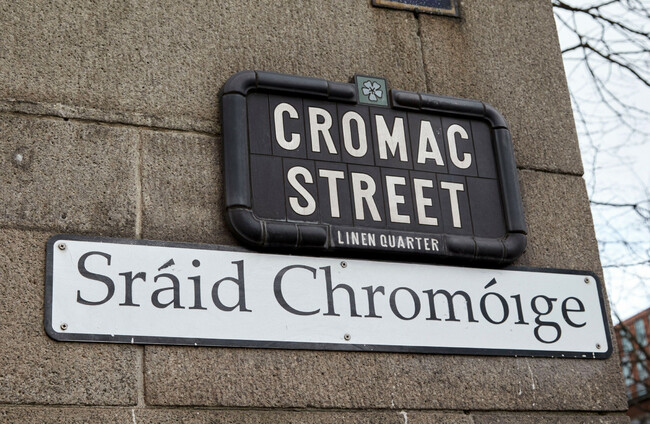
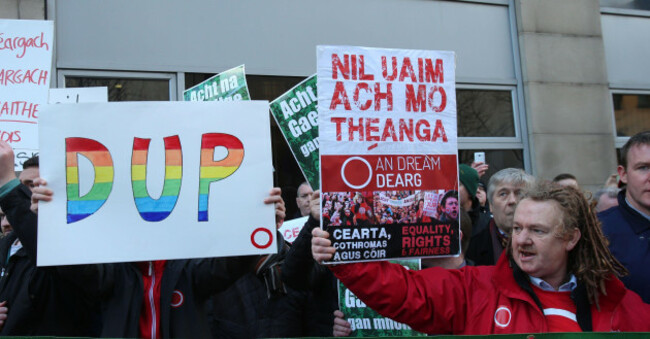
Irish language groups in Belfast are to demonstrate outside City Hall on Thursday in response to threats from a loyalist paramilitary group, the UVF, after the Council voted to make the Irish language more visible in the city.
As a result of the vote in the Council last Wednesday, local authority buildings around the city will have bilingual signage, a new logo in Irish and English which will appear on stationery, signage, vehicles and the uniforms of some workers.
The adoption of the language policy was opposed by the Democratic Unionist Party, Traditional Unionist Voice and the Ulster Unionist Party. Ulster Unionist councillor Jim Rodgers condemned the threats to council workers and property on Monday. Sinn Féin, the SDLP, the Alliance Party, People Before Profit and the Green Party voted in favour of the new policy, resulting in a 42-17 victory.
In an open letter signed by the leaders of parties who voted for the new policy along with the President of Conradh na Gaeilge, Ciarán Mac Giolla Bhéin, grave concern was expressed about the threats publicised in the media on Sunday.
In this weekend’s edition of The Sunday Life, it was reported that a UVF spokesperson had threatened that any Council depots or vehicles bearing dual language logos would be burned.
The letter said the threats “from loyalist paramilitary groups are a cause of great concern to all of us, to everyone who supports the Irish language and equality in general”.
The Council party leaders said a central part of the Good Friday Agreement of 1998 committed Northern Ireland’s parties, along with the two Governments, to take “decisive action” for the promotion and development of the Irish language.
“We consider that the Irish language policy passed by a democratic majority in Belfast City Hall on Wednesday night is a direct result of those commitments. It is designed in accordance with the fundamental principles of the Identity and Language Act.
“These are threats not only to the Irish language community, but to the entire democratic process, and to a properly established society.”
According to Pól Deeds, deputy chief executive of Foras na Gaeilge, the latest threat is the result of “the promotion of bigotry in the media – particularly the BBC – following the announcement of the Belfast City Council policy”.
“The Executive Office has failed to uphold its own policy – and UK law – and is therefore failing in its duty of care to the new Commissioner before he has even taken up his post,” he said in the posting to his personal X account.
During commentary on various BBC Northern Ireland programmes following the vote, contributors made reference to all the unionist parties and the Orange Order being against the new policy and an equivalence was drawn between Irish language rights and the rights of the Orange Order to march controversial routes.
The Journal has sought a response from the Executive Office on Mr Deeds’ post and clarity on when the Irish Language Commissioner will be officially announced. In a response on Tuesday, a spokesperson for The Executive Office said the “recruitment process was nearing completion”.
In a response sought from BBC Northern Ireland on Mr Deeds’s comments about the media ‘promoting bigotry’, a spokesperson for the broadcaster said it had no comment regarding Mr Deeds’ posting.
The Journal’s Gaeltacht initiative is supported by the Local Democracy Reporting Scheme

To embed this post, copy the code below on your site











have your say