Sign in. It’s quick, free and it’s up to you.
An account is an optional way to support the work we do. Find out more.
Sign in. It’s quick, free and it’s up to you.
An account is an optional way to support the work we do. Find out more.
LAST UPDATE | 15 Jan 2024
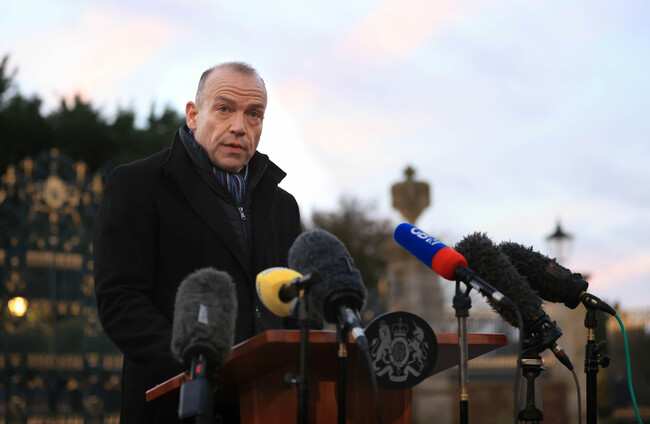
NORTHERN IRELAND SECRETARY of State Christ Heaton-Harris has insisted that it is “hard to see any barriers” to resurrect devolved Stormont government.
As the region approaches two years without the Stormont Assembly, Heaton-Harris said he believes “all the conditions necessary are now in place for the political representatives in Northern Ireland to govern on behalf of the people who elected them”.
He said the Government has done “everything we can” in talks with the DUP over the Northern Ireland Protocol, and said it is “time for decisions to be made”.
“It is time for the talking and debate to finish. It is time for Stormont to get back to work,” he added.
If Stormont has not been restored by the Thursday deadline, Heaton-Harris said he will have “various decisions to make”, adding: “I will set out my next steps in due course.”
Unions across Northern Ireland have voiced their frustration with both political parties and Heaton-Harris over the public sector pay deal money being withdrawn after the DUP turned the Government offer down.
Public sector workers protested outside Hillsborough Castle today while the major Stormont parties met with Heaton-Harris ahead of a major strike planned for Thursday over pay.
In December, the UK Government offered the parties a £3.3 billion (€3.8 billion) package to stabilise finances in Northern Ireland, including £600 million (€697 million) to settle public sector pay claims.
It will be available when the institutions are restored.
The parties urged Heaton-Harris to release the money for the pay awards now to stop Thursday’s strike, but he said public sector pay is a “devolved matter”.
The Secretary of State added: “As of, whatever it is, a minute past or a minute to midnight on, Thursday night, I might need to call an election. I have a duty to decide whether an election is called.
“And also, actually, for an executive to be reformed I need a piece of primary legislation. So next week, I will be laying primary legislation before the floor of the House, which is an evolution of some of the things I’ve been saying.
“I will need to also, eventually, in the course of the next few weeks, pass a budget for next year, and all of those matters will be taken into consideration at that point,” he added.

Thursday will see the largest public sector strike in Northern Ireland’s history when workers with 15 trade unions will take part in industrial action across health, education and the civil service.
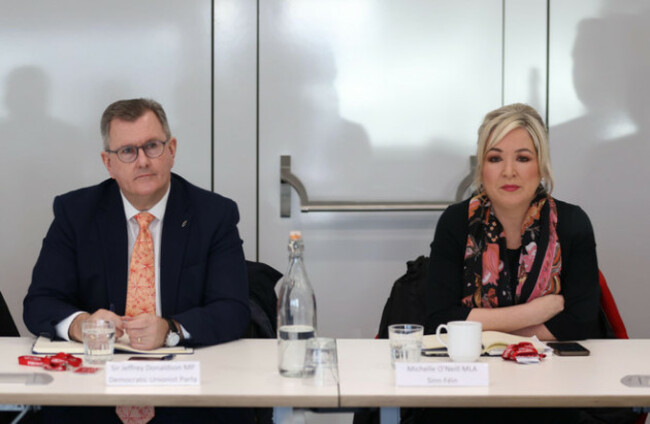
Sinn Fein’s Stormont leader Michelle O’Neill said her party has initiated an Assembly recall to restore the Executive and “urgently deliver a fair pay deal for public sector workers”.
The recall motion will require the backing of 30 MLAs to succeed.
It urges that the Assembly meets urgently to elect a Speaker and Deputy Speakers, appoint ministers and back a motion which endorses fair pay settlements for public sector workers.
It also calls for the DUP to “respect the democratic outcome of the May 2022 Assembly election” in which Sinn Fein made history by becoming the first nationalist or republican party to top the Stormont poll and entitling it to nominate the first nationalist or republican First Minister.
The Assembly has been effectively collapsed for almost two years, with the DUP refusing to participate until unionist concerns around post-Brexit trading arrangements are addressed.
The party has insisted it will not end its blockade until it secures legislative assurances from the Government on Northern Ireland’s trading position within the UK.
DUP leader Sir Jeffrey Donaldson earlier said resuming business at Stormont tomorrow would not “solve problems”.
“We need the funding in place,” he said. “The Secretary of State and the Treasury have indicated that there is funding available and we’re saying they should now bring that forward and make those public sector pay awards.
“There’s nothing to stop that from happening – you don’t need to have a functioning Stormont in order for the Secretary of State to use the temporary powers that he has given to himself for that purpose.
“He has the power to set the budget. He has the power to deal with this issue and we’re saying to the Secretary of State that he should get on and do that,” he added.

To embed this post, copy the code below on your site















have your say