Sign in. It’s quick, free and it’s up to you.
An account is an optional way to support the work we do. Find out more.
Sign in. It’s quick, free and it’s up to you.
An account is an optional way to support the work we do. Find out more.
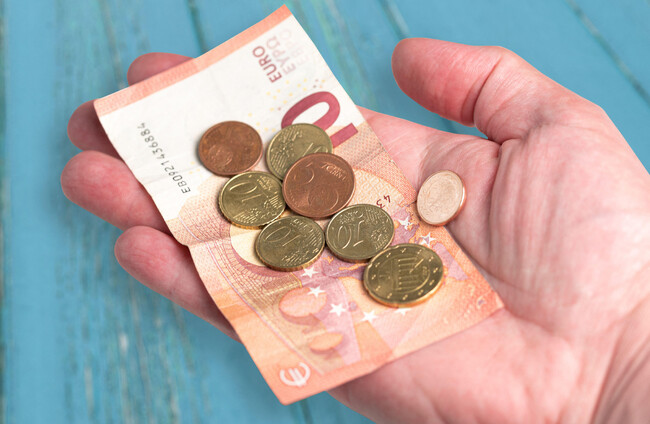
IRELAND’S MINIMUM INCOME benefits aren’t even close to enough to keep people out of poverty, according to new research.
Those earning less than €377 per week are considered to be below the poverty line, but the minimum income benefits for a single person, including jobseeker’s and disability allowance, are just €254, rising to €264 next year.
Spanish investigative outlet Civio conducted the analysis in collaboration with the European Data Journalism Network, which includes The Journal.
Susanne Rogers, a research and policy analyst at Social Justice Ireland, says there is still an attitude in Irish society that those who don’t work are lazy, and that poverty is “an individual failing”. But she says many people are trapped in poverty since childhood.
Jobseekers are disproportionately “demonised”, considering they only account for about 15% of the state’s welfare recipients, she said.
Ireland ranks seventh in the EU for the buying power of its welfare payments, according to Civio’s research.
It’s behind Denmark, Belgium, the Netherlands, Luxembourg, Spain and Austria.
The poverty threshold is 60% of the median income of each country.
The analysis found that Ireland’s welfare payment for an unemployed single person receiving supplementary welfare allowance is 37.8% below the poverty line.
For couples who don’t have children it’s 30.8% below the line, and for couples with two children it’s 36.9% below.
‘Extreme poverty’ is defined as earning 40% or less of the median income in the country you live in.
This means children in households that rely solely on state support are close to living in extreme poverty.
The analysis found that Denmark and Luxembourg are the only EU countries where minimum income benefits are above the poverty line, and that’s only for couples or families with children. Single people are still below the poverty line in both countries.
Ireland fares better than several Western European countries, including France and Germany, where payments are 51% and 61% below the poverty line, respectively, for a single person.
The countries where payments had the lowest purchasing power were Estonia, Czechia, Latvia and Croatia. They were more than 70% below the poverty line.
According to Rogers, governments rarely talk about radically increasing welfare payments as it is “not a big vote winner”.
“Every time we go and talk about social welfare or adequate rates, the first thing that crops up is [whether it is] a disincentive to work,” she said.
“The big fear seems to be that if we give people enough money to survive on through the social welfare system, most of us are going to go [stop working].
“Only people who have never been on social welfare seem to think that that’s what’s happening.”
Rogers said there’s an impression that if the country is at near full employment then those without jobs have made that choice. However, she says some people who have very little education or support, or who struggle with addiction, may not have a choice.
She said people tell themselves that those on welfare “are unlike us” and if they were “smarter” or “made different decisions” then they wouldn’t be poor.
That fits into the stories that we can tell ourselves: That poverty is an individual failing.
She said people don’t understand that “if you’re born into poverty, the odds are you will spend your entire life with poverty”.
Rogers hopes that even if government ministers haven’t lived below the poverty line themselves, they’ll learn about that experience by working with constituents. But she is unsure whether that’s enough to change policy.
“I just don’t know whether it’s a vote winner, to be putting money into the social welfare system when the rhetoric is always about the ‘squeezed middle’, about people ‘who get up early in the morning’,” she said.
However, keeping people on low incomes can lead to more state spending in other areas, she says.
“I don’t think [politicians] fully understand that if you don’t support low-income households, those costs don’t disappear. They just crop up elsewhere.
“They crop up in the health system, or in the education system, or in the justice system.”
European civil society organisations have been calling for years for minimum income programmes that can be extrapolated to all member states.
In 2023, the EU made a series of recommendations for countries on how to improve its welfare systems and decrease poverty, but it was not mandatory to implement them.
Analysis and additional reporting by María Álvarez del Vayo and Maria Toldrà (Civio, Spain). This article was published in collaboration with the European Data Journalism Network in the context of ChatEurope.

To embed this post, copy the code below on your site














have your say