Sign in. It’s quick, free and it’s up to you.
An account is an optional way to support the work we do. Find out more.
Sign in. It’s quick, free and it’s up to you.
An account is an optional way to support the work we do. Find out more.
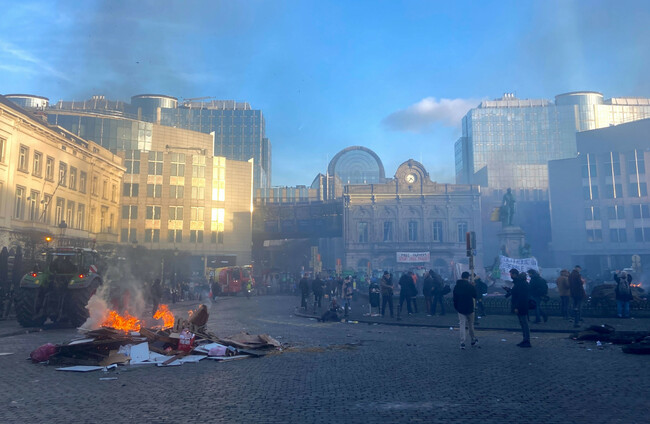

BRUSSELS WAS IN gridlock today as protesting farmers shut down the city centre over what they say is a sector in crisis.
After days of demonstrations in France, Germany and Belgium, farmers have taken their grievances over pay, bureaucracy and fuel prices, among other things, to the EU’s doorstep.
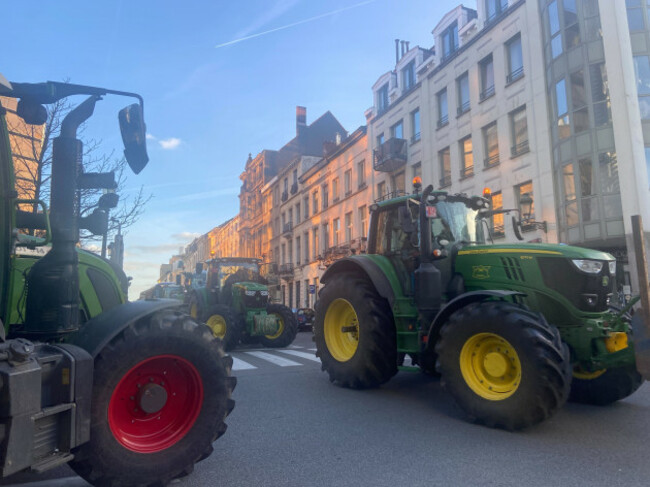
Traffic jams plagued streets surrounding the European Parliament, as tractors, trailers and hay bales occupied the city’s centre.
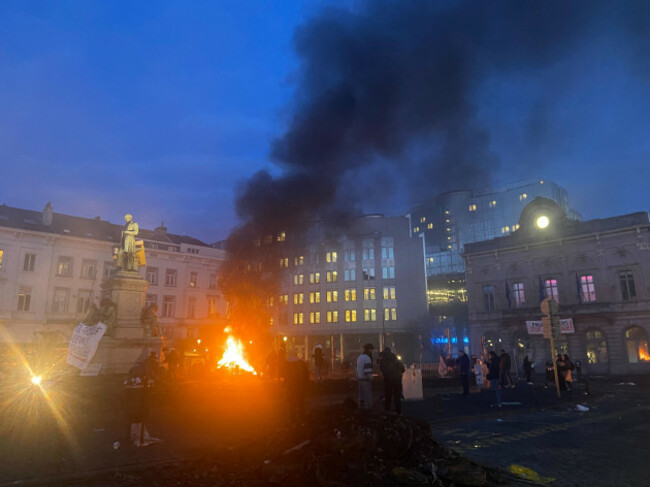
Smoke filled the air as farmers burned the bales, as well as tyres and wooden pallets.
Much anger is directed at environmental requirements included in the EU’s updated Common Agricultural Policy (CAP) and the bloc’s forthcoming “Green Deal”.
Anti-riot police deployed water cannons in response to protestors throwing bottles, rocks and eggs.
Signs read, “Politicians don’t even know what a cow is but write stupid laws”, and “If you sow misery, you reap anger”.
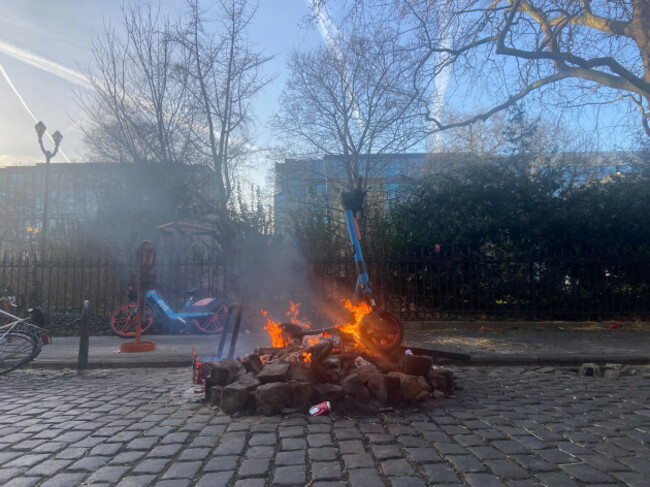
Loud bangs from flash bombs scared off some onlookers, while others joined in, drinking and talking to the farmers.
Caroline is a PhD student, with a focus on food security. She travelled two hours by train today to show solidarity with farmers.
“It’s good that Europe has a significant presence in policy, but I think farmers also need to be given the chance to implement it,” she said.
She said today’s scenes were not as violent in comparison to other recent protests.
According to Caroline, it’s significant that so many individual farmers went to today’s demonstration of their own accord, unlike some protests where only union representatives get involved.
Stefan and Konstantinos work in the energy sector. They told The Journal that changes are coming, but farmers should be protected.
“Everybody is going to be affected … but that doesn’t mean that states, the EU itself, cannot, for example, subsidise them or help them in order to [make the transition] smooth,” Stefan said.
Konstantinos said the protest was mild in comparison to some demonstrations in Romania, where he is from.
One business owner on Place de Luxembourg, the square one on which the parliament is situated, told The Journal that his restaurant was largely unaffected by the riots. Inside, people were drinking and eating like they would any day. The music was loud enough to drown out the sound of horns and explosions happening just metres away.
A waiter in the bar next door described the hubbub as “fun”. “I think it’s right that they are standing up for their rights,” he said.
Posting on X, Irish Green MEP Ciarán Cuffe shared a video of the protests as he arrived at the European Parliament today.
Cuffe wrote alongside the video: “Challenging trip into work today. There are real concerns about farm incomes and trade deals, but rock-throwing is not the answer.”
The police presence was sparse in the late afternoon, but as the sun set, riot police formed a wall and descended upon protestors. Some taunted police, one even doing wheelies on an electric scooter in front of them.
In France, farmers blocked motorways leading to Paris in an effort to get the attention of the government.
Arnaud Rousseau, chief of the biggest rural union FNSEA, and Young Farmers (JA) president Arnaud Gaillot held a news conference to announce the suspension of the action.
That followed promises of cash, eased regulations and protection against unfair competition by Prime Minister Gabriel Attal, the government’s second wave of concessions in a week.
Rousseau hailed “real progress” and said Attal had been “listening”.
But he also reserved harsh criticism for the “deafness” of European-level officials, lambasting the “technocratic structure walled into its Brussels offices”.
The FNSEA and JA account for most of French farmers’ union memberships.
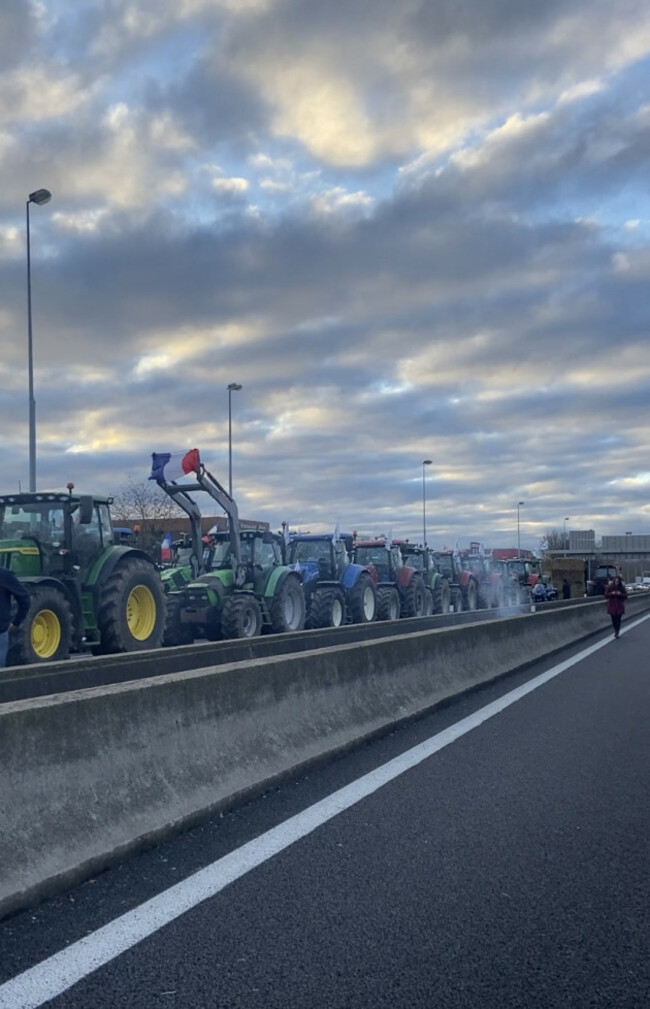
In Germany, strategic routes leading to Hamburg’s port area were blockaded, disrupting access to the country’s biggest such facility and one of the busiest in Europe for international container shipping.
Other smaller ports along the country’s northern coast — Wilhelmshaven and Bremerhaven — were also hit by tractor blockades.
Irish farmers staged their own protests today in solidarity with their European counterparts.
They turned out on main roads in Galway, Longford, Westmeath, and elsewhere, driving tractors adorned with signs saying “no farm, no food” and “enough is enough”.
The Irish Farmers’ Association called for the demonstrations in support of fellow European farmers, as “excessive regulation is forcing them out of business”.
The president of the Brussels-based Copa-Cogeca farming cooperative, which represents more than 20 million farmers in the EU, praised Irish farmers and welcomed them to the movement.
Taoiseach Leo Varadkar was in Brussels today for talks about EU aid to Ukraine. He said that although agriculture and farming were not on the agenda for today’s meeting, it was discussed by leaders last night in light of the protests.
“The priority for us should be implementing existing rules and regulations and not imposing new additional ones on farmers over the next couple of years,” Varadkar said.
He added that when it comes to EU trade deals, we cannot have a situation where farmers in the EU must obey certain regulations that imported products do not need to adhere to.
With reporting by Jane Moore and — © AFP 2024

To embed this post, copy the code below on your site












have your say