TheJournal.ie uses cookies. By continuing to browse this site you are agreeing to our use of cookies. Click here to find out more »
Dublin: 14 °C Tuesday 21 May, 2013

Student study: Ireland could write off 85 per cent of its European debt

The pan-European ESCP business school says Ireland could get rid of €184bn in debts – by simply cancelling them out with others.

Cancelling out two-way debts between European countries could help Ireland write off over €180bn in debts, according to a student study.

AN ECONOMICS SIMULATION carried out by students from an elite pan-continental business school has concluded that the Irish government could write off a whopping €184 billion in debt – simply by cancelling out its debts with those of other countries.

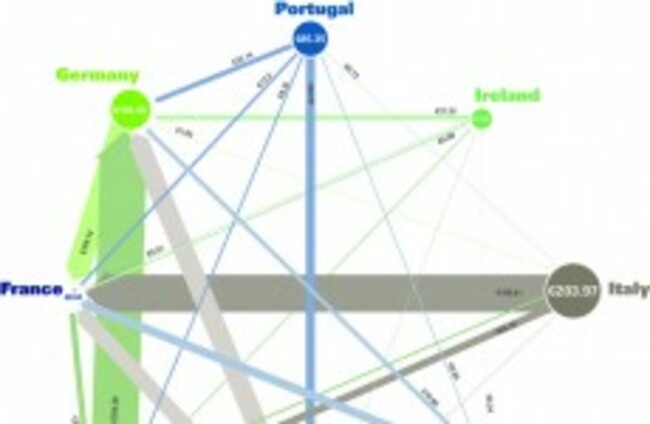
A study carried out by postgraduate students at the ESCP Business School said eight European debt-laden European economies could simply write off over €2 trillion in debt, by cancelling out obligations where countries owed money to each other.

The same simple procedure – where the five weak ‘PIIGS’ economies, Britain, France and Germany all simply ‘cancel out’ any debts they hold to each other – would reduce Ireland’s outstanding debts by over 85 per cent, according to the findings.

The exercise, carried out across three stages on a date in May, worked as follows:

  1. Two countries who owe money to each other – and where those loans fall due at around the same time – simply cancel each other out;
  2. Three countries, who owe money to each other in a ‘triangular’ arrangement – and, again, where all of the loans fall due at the same time – write off their debts to each other;
  3. A session of ‘free trading’ where countries could negotiate other settlements – where, for example, a selection of 2-year and 4-year loans from one side could be traded off with 3-year loans from the other side.

In Ireland’s case, the students found that the debt – of some €215bn at the time of the exercise – could be reduced to a little over €31bn, with the majority of the debt being written off after stage 1 of the simulation.

While Greece would still struggle to make much a dent in its own mountain of debt – seemingly because most of its debts are held by European countries outside of the other seven – other countries would fare far better.

France would be able to become virtually debt-free under the simulation, simply because most of its debt is held by Germany and vice-versa – with France benefitting to the tune of €382 billion overall.

Germany would reduce its debt from €563bn to €103bn – a drop of 81 per cent – while Spain and Italy would approximately halve their debts.

While the students admit that their simulation “does not solve” the problem of the EU debt crisis, they said it at least showed that debt cancellation was a viable policy option:

The fact that so much debt is interlinked presents a real opportunity to solve the problem.

The web of interlinked debt is too thick to be dusted away by classroom games, however policymakers should attempt to replicate this study, and they may find that instead of spinning further webs they might get out a duster to clean things up.

It might all be academic – literally – but on the first anniversary of Brian Lenihan’s admission that we were looking for a €67.5bn bailout, it’s a sobering thought.

More on the study can be found at the nicely-named EUdebtwriteoff.com.

Read next:

Comments (55 Comments)

  • Brilliant … And i am guessing that the Governments plan to cut post grad courses would impact the same level of student who can actually help resolve this countries woes….. Do you think FF/FG/Labour will even explore the proposed option??? emmmmmmmmmmm ……….. No, they pay their advisers and civil servant masters too much money, and these are the same advisers who say, increase austerity, rather than think outside the box.
    Well done to the students involved … RESPCT!!!!

    Reply
  • Sounds straight forward enough, simple economics, sure isn’t that what we need to take us forward instead of 100 people confusing the other hundred.

    Reply
  • Raf 21/11/11 #

    This will never work as it would eliminate the banks that act as middlemen. See, the whole purpose of this web of debt is for the banks to leach off of it.

    Reply
  • Maybe I’m just missing something! But doesn’t most of this debt between country and country originate from bondholders and if the debt between countries is cancelled or written off then it’s back to (horror of horrors!) burning bondholders or at least giving them a tight haircut. The financial jargon cracks me up!

    The origin of all this debt has me flummoxed. It’s a bit like quantum physics – ‘matter is all around us but it does not exist’ Or. It’s like a visit to Paddy Power – ‘I’d like to put ten bob on for the 3.30 at fairyhouse but I forgot my wallet. Tell you what! I’ll be in tomorrow to collect my winnings and I’ll give it to you then.

    Arggggg.

    Reply
  • I’m no economist, but I thought of this idea when I saw this debt chart here:
    http://www.bbc.co.uk/news/business-15748696

    Seems like it would be obvious to anybody, even a child. From the chart
    US owes Spain 170.5 Billion
    Spain owes US 49.6 Billion
    From my astounding mathematical abilities I reckon Spain owes the US nothing. US owes Spain about 120 Billion.
    Maybe I’m missing something? Other than faith in our leaders.

    Reply
  • One of the better solutions. But is it feasable?

    Reply
  • Too simple and too good to be true…the good ole vested interests will kybosh it though…

    Reply
  • Sounds like the Germans might lose out with their debt cancelling with france.

    It doesn’t matter what way this works, even if it solves most of the eu problems. If the Germans think it will cost them a penny they won’t even listen to the idea.

    Reply
  • What about the various rates of interest on each debt. Its not as simple as offsetting capital against capital. Germany are the winners of the current crises. They borrow at low rates and lend to us at high rates. Why would they agree to offset our debt to them against their debt to us when the income from both debts are totally different.

    Reply
    • Eoin Faz 22/11/11 #

      +1

      Reply
    • That’s a fair point, but what’s to say that this couldn’t be taken into account when doing a deal? Interest rates are fixed at the time of sale, so there’s nothing to say that the varied interest couldn’t be taken into account in some kind of swap.

      If Germany has €10bn of Irish bonds at 5%, due to mature five years from today, and Ireland has the same amount, maturing the same time, of 2.5% German bonds, then instead of each country owing the other €10bn, it could simply be treated as if Ireland owed Germany €1.25bn (the €2.5bn interest that Ireland would pay, minus the €1.25bn that Germany would pay back). So instead of having €20bn in debt between the two countries, you have €1.25bn – the difference between the two.

      I don’t know if this was something the students considered or rolled into their examples, but either way it could easily be worked out by the respective treasuries – who would have a full, encyclopedic knowledge of the bonds that each country has on issue.

      Reply
  • However, don’t forget that a few years back, when the US economy was doing so well that they looked like they might be able to pay off their national debt completely, secret government reports were advising against doing so simply because it could crash the entire global economic setup (because people bought US treasury bonds to store their capital and if the US paid off all its debt, those would cease to exist).

    It seems that any sort of simple idea regarding economics (such as balancing budgets, paying off your debts, or not inventing assets out of thin air by imagining what you were going to have ten years from now) are fundamental necessities for individuals and utterly unworkable for national economies.

    Which is why we’re so utterly up the creek without a paddle right now…

    Reply
  • It would be great to know how practical this is ?

    Reply
  • “and Italy would..”

    would what? im assuming this is an error as there’s no full stop unlike the other paragraphs

    Reply
  • I’m afraid it is to good to be true. The problem is that the borrowers and lenders are not the same entities. It’s a bit like AIB using my deposit account to pay off the fellows up the hill’s mortgage. He’s appy, the Banks happy and I’m shafted!

    Reply
    • No I think the point of this is that its only applied to debt where both countries owe each other money.

      So in your example its like you owing the fellow up the hill €100 and him owing you €50. The simple thing they are saying is that you both agree that from now you just owe him €50. So in effect he becomes debt free and you end up owing half the amount of money you currently owe. While no actual cash has moved hands you’ve both agreed to write down you debt by the same amount. In the example above you end up with a situation where instead of €150 of technical debt there is only €50 of actual debt, so the actual amount of debt is reduced by two-thirds. The only thing is that you both have to agree to do it at the exact same time so that there isn’t any imbalance at any point in time.

      It seems very logcial and easy to implement but (leaving aside conspiracy theories) surely if such a simple solution did exist, moves would have been made to do this already because it seems like a logical and sensible idea. Perhaps the Journal could ask some economist to write a column explaining what problems might be encountered in such a scheme. It would be nice to have an informed opinion on this.

      Reply
    • I can see how it’s a problem that the lenders and debtors are not the same entities, however it should (in theory ofc) be possible to cancel out the external debt by restructuring to internal, so that rather than AIB lending your money to French Bank X (which they are doing), French Bank X lending to German Bank Y and BOI borrowing money from German Bank Y to pay for Z up the roads mortgage, AIB simply lend the money to BOI, who lend it to Z, who repays plus interest to BOI, who repay AIB with interest, who owe it to you, with interest.

      That is, as far as I understand, how it’s already supposed to work after all. The only thing the restructuring of the debt by ‘cancelling’ does is knock out most of the middlemen.

      Of course, because those middlemen are all big banks, and doing this prevents them from being able to skim billions off the top, and because that skimming is literally how banks make money, it will never happen.

      Reply
    • Sounds great unless someone makes a boo boo on the old finances side. Ha, imagine?

      Reply
    • Agree with Jim. This is only a partial solution, dealing exclusively with intergovenmental debt. The great thing about it would be that it would make planning for the future easier. If the debts are weighed against each other and cancelled out now it would mean that future calculations are easier. We wouldn’t have to worry about bonds maturing in five years time etc. Plus it limits exposure. If two countries have equivalent debts to each other that are wrote off, one of those countries could subsequently default without significantly damaging the other (although third parties would still be hurt).

      Reply
  • Sounds like a good idea,but im sure there’s more problems arising from this idea.if its cancelling debt owed to each other,its great? Or isnt it? Suppose no country is better off, still broke

    Reply
  • It’s quite likely that these students are more suitable educated and qualified to solve problems such as these than our current Minister for Finance-a school teacher.

    Reply
  • Simple. Ah jaysus economists and governments don’t like simple. They like to con!

    Reply
  • They don’t want to find a solution. Politicians want only to further integrate the EU. The only way they will achieve this is through financial instability.

    Reply
    • Dunno about you, but I’d say these politicians you refer to would be smart enough to know that if the EU was seen to be financially stable it would be much easier to further integrate.. As things stand, with financial instability the number of Eurosceptics is increasing daily.

      We need either more Europe (integrated eurobonds) or less Europe (disband the eurozone), it’s this wishy washy half doing things that got us to this point.

      Reply
  • Reasonably sound idea but the problem lies within the complexity of debt markets. The fact that this isn’t government debt makes it impossible in practice.

    Also, trying to convince a debt holder to repaid early is near impossible. The debt market HATES early repayments!

    Reply
  • And stop the Rothchilds from asset stripping??? They would never allow it. Thats the point of the Euro after all.

    Reply
  • The problem is that the economy is based on debt. No debt or less debt means less money in the system, so it means less work, more poverty, etc… Many people think that we need to pay back the debt, while it’s true in a certain way for Ireland and Greece, this is completely wrong for France, Germany, Spain, Italy, …. Because of the way the world financial system is done, the money which is circulating in the world is based on the debt of someone else. No debt means no money.

    Reply
  • The reason this idea sounds too good to be true is because it has no real benefit.
    Any money saved by writing off the debt would be offset by the loss from canceling out the debt that the other country owes to us.
    Having said that, there would be a small administrative benefit in canceling both debts. But there would also be an administrative cost in calculating the relative values of the remaining interest payments.

    Reply
    • That is true, but bond rates are all about perception, so surely our borrowing rate would drop if our official debt figure was 31 billion instead 185 billion

      Reply
    • No – bond rates are all about ability and intention to repay. Our debt would fall but our assets would also fall. So there would be no improvement in our ability to repay, and therefore no rate reduction.

      Reply
    • @John Turkey: That’s true, of course – we would lose just as much assets as we would debt – but the point of this is that it means we don’t need cash in between.

      If Country A has bonds maturing a day before Country B, country A needs to get its hands on some cash first. It either does this by raiding its own savings or issuing MORE bonds. Country B then needs to use some of its newly repaid cash, and possibly more, to repay its own bonds. You therefore have a situation where both A and B have (probably) borrowed to repay existing loans – getting themselves into more debt as they do so.

      The other thing to consider is that while both the assets and debt would fall, there would have to be SOME small reduction in the yield we’d pay on new bonds because debts are liquid and assets aren’t. Reducing both debts and assets means that there are fewer bonds falling due, and ergo fewer new loans we have to take out. It might not make much sense for Ireland but consider the Italian example, where the €1.9trn mountain of debt needs to be rolled over, over and over again – at higher and higher interest rates, this keeps getting more and more expensive. If you scrap this debt, you might also be scrapping a lot of assets but you’re saving a hell of a lot in the long-term.

      Reply
  • I don’t quite understand international finance (if i did i might be richer) but apart from different timing, parties and interest rates, it’s a zero sum situation. If an economy needs money, it must generate debt. Debts are assets. If all debt was wiped out, the money supply would dry up and we would have a depression that would make the 1930’s seem like a minor hiccup (I think!)

    Reply
    • Your point is fairly sound, but it wouldn’t dry up entirely. It’s worth remembering that bonds aren’t issued by central banks, but by treasuries: if a central bank, which controls monetary supply, issued a bond it’d be effectively worthless because the central bank could always just print more money to ensure it was repaid. Ergo, every country in the world would do the same thing, and bond markets would be defunct because there would be no risk-and-reward situation.

      One would argue that if this arrangement meant a shortage of cash, the central banks would intervene and lower interest rates / print new cash so that liquidity was restored. That’s been the whole point of quantitative easing so far, and is generally the motivation behind reducing central bank interest rates when money isn’t moving around as easily as it could.

      Reply
  • Sadly there’s no way to package this up that would look like something other than a default to the international money markets and they’re what matter. But it’s something that gets me a lot..If there’s a debtor there logically must be a creditor… So someone out there has got to have money. Everyone can’t be broke

    Reply
  • It sounds like a good idea in national terms but unfortunately bond-holders are iindividuals and would want the cash into their hands.

    Reply
  • May be wrong but was once told if it sounds to good to be true then it is too good to be true.

    Reply
  • Not just down to money owed, it’s down to your rating. Germany has triple A rate which means much lower interest rate than say Ireland’s.
    1 billion owed to Ireland is worth much more than it is owed to Germany.
    Country’s will never be out of debt, because they are now PLC’s in a really rich stock exchange.

    Reply
  • This solution appears to make perfect sense – it’s beautiful in it’s simplicity. Now we just need our government to implement it…..Is there anybody out there who (a) can make our glorious leaders aware of this possibility and (b) has enough influence to persuade them to push for this solution? Answers on a postcard please…

    Reply
  • The graph shown is remarkably similar to one shown at occupy Dame street….so, I dont think these guys are the first to come up with the idea!

    Reply
  • well they’re hardly the first ones to come up with that idea…

    Reply
  • I’m dubious given that our national debt won’t hit €200bn until 2013 according to the below story:

    http://www.breakingnews.ie/ireland/national-debt-to-peak-at-200bn-in-2013-519876.html

    Reply
    • Ryan – You’re quite right, but my understanding is that this example incorporates bank debt too. Governments and their treasuries have been known to buy bank bonds as an alternative to sovereign ones – though this has obviously slowed down as sovereigns and banks have become joined at the hip.

      Reply
  • not feasible in the slightest.

    Reply

Add New Comment