Sign in. It’s quick, free and it’s up to you.
An account is an optional way to support the work we do. Find out more.
Sign in. It’s quick, free and it’s up to you.
An account is an optional way to support the work we do. Find out more.
PAY RATES FOR new public servants have been a cause of simmering unrest and controversy in recent years.
Before the Dáil adjourned for the summer, Fianna Fáil TD Jackie Cahill raised the issue of low starting salaries for new primary school teachers, in comparison with their longer-serving colleagues.
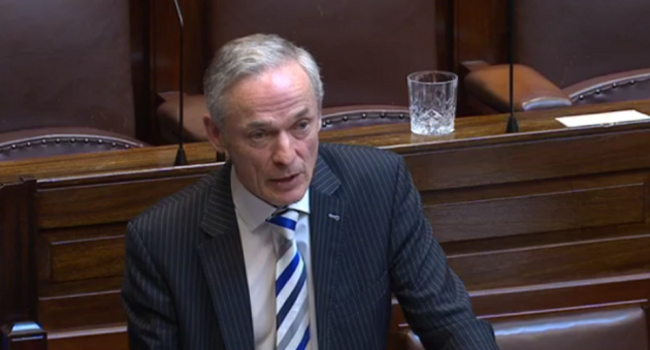
During his response, Education Minister Richard Bruton said “newer [TDs] are on a lower pay than long-standing [TDs].”
Is that really the case?
One of our Twitter followers tweeted @TJ_FactCheck about this claim, so we faithfully looked into it.
(Remember, if you hear anything that makes you double take, email factcheck@thejournal.ie or tweet @TJ_FactCheck and we’ll try to check it out).
Claim: Newer TDs are paid less than longer-serving TDs
Verdict: FALSE
What was said:
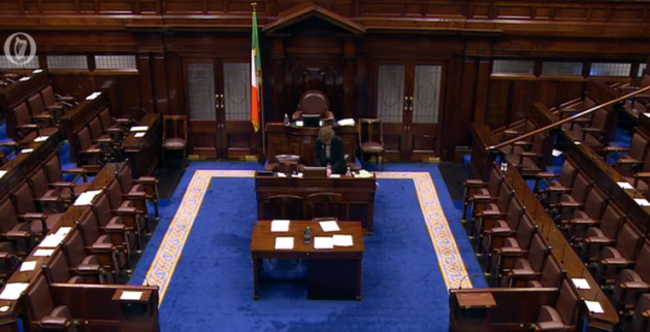
You can see an excerpt from the debate in the video above, watch the entire exchange here, or read the transcript here.
For the purpose of this FactCheck, we’re most interested in these remarks by Bruton:
I think the deputy recognised, in his question there, that this applied right across the public service.
So this isn’t confined to teaching or to any particular area – indeed, it applies here in the House, where newer deputies are on a lower pay than long-standing deputies.
We asked the Department of Education for evidence to support the Minister’s claim, but nobody was available to give a substantive response.
After conducting the research for this FactCheck, we contacted the department again. In response, a spokesperson for Minister Bruton said he acknowledged his claim was “mistaken”.
A spokesperson for the Houses of the Oireachtas, which administers TDs’ salaries, confirmed for FactCheck that every TD gets paid the exact same TD’s salary:
The same salary, regardless of the length of service, is paid to all TDs from the date of the election – subject to the TD signing the Roll of Members of Dáil Éireann within 30 days of the election.
The annual salary for a TD is €87,258 before tax, which they are paid on a monthly basis.
Of course, certain TDs are paid more in their capacity as Ministers, Ministers of State, and office-holders like Ceann Comhairle and Leas Ceann Comhairle (full details here).
But those additional allowances are not determined by their duration of tenure as a TD.
Long Service Increment
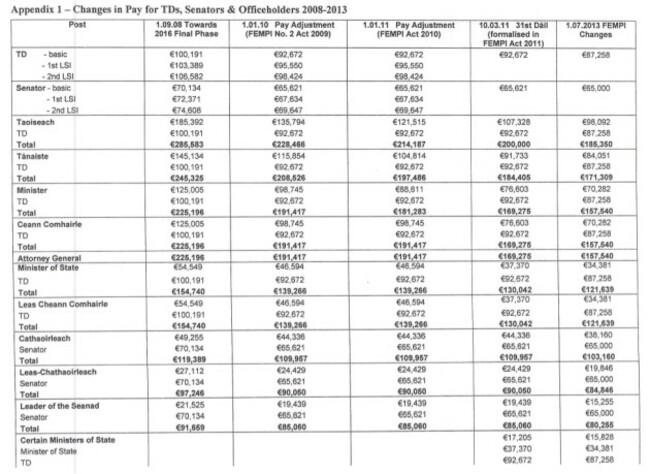
What Bruton was referring to in the Dáil was a provision called the Long Service Increment (LSI). His mistake was in the fact that the LSI was abolished before the start of the 31st Dáil, in March 2011.
Under that arrangement, TDs serving for between seven and 10 years got an annual increment of €2,878 on top of the then basic pre-tax TD’s salary of €92,672.
Deputies serving for 10 or more years got an extra €5,752.
The bonus was even bigger back in 2008, when senior TDs got either €3,198 or €6,391 on top of the then salary of €100,191.
So, for example, a TD with more than 10 years service in 2008, who is still in the Dáil today, is earning €19,324 (18%) less than they did eight years ago.
This changed, as the Department of Public Expenditure, which sets TDs salaries and allowances, confirmed to FactCheck, in the emergency Budget of April 2009.
Then Finance Minister, the late Brian Lenihan, announced that the LSI would be abolished for TDs who had not, at that point, reached seven or 10 years’ in office.
But deputies who had reached that level of seniority in 2009 continued to receive the increment until the next Dáil, in 2011, when it was abolished entirely.
Notably, while public servants such as teachers and gardaí are advocating that starting salaries be brought upwards, the pay equalisation that occurred when the LSI for TDs was abolished, involved higher salaries being brought down to the level of starting salaries.
Yes, newly-elected TDs were once paid less than their longer-serving colleagues. But not currently, and not since five years and two Dáils ago.
Richard Bruton’s claim is therefore FALSE.
FactCheck asked his department whether he would be clarifying, modifying or retracting the claim, and a spokesperson for the Minister told us, in response:
It has recently come to the Minister’s attention that he was mistaken in these comments and as such he is happy to clarify them.
His error was based on a mistaken understanding of the changes which came into effect in 2009 and the further changes which came into effect in 2011
Send your FactCheck requests to factcheck@thejournal.ie.

To embed this post, copy the code below on your site















have your say