Sign in. It’s quick, free and it’s up to you.
An account is an optional way to support the work we do. Find out more.
Sign in. It’s quick, free and it’s up to you.
An account is an optional way to support the work we do. Find out more.
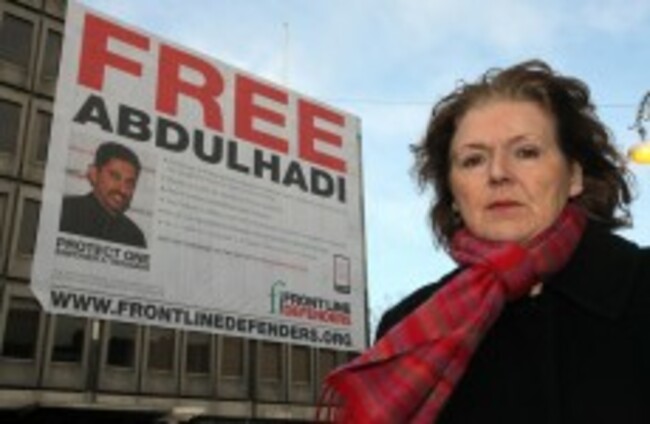
IF YOU HAVE been on St Stephen’s Green recently in Dublin, you will have noticed the giant banner covering three stories of the corner building at Earlsfort Terrace.
The banner bears the legend – FREE ABDULHADI – and carried the picture of a smiling man, along with details of his detainment in a Bahrain prison. While you may have passed the banner many times, you may not know much of Abdulhadi Al Khawaja. EOIN LYNCH tells his story and explains the links between Bahrain and the western world:
“He is a gentle and calm man, dedicated to protecting the human rights of others”: this is how Mary Lawlor of Frontline Defenders describes her former colleague Abdulhadi Al Khawaja who is now serving a life sentence in Bahrain for “organising and managing a terrorist organisation” and “attempt(ing) to overthrow the government by force and in liaison with a terrorist organisation working for a foreign country”.
Abdulhadi Al Khawaja is the co-founder and former president of the Bahrain Centre for Human Rights and a member of the International Advisory Network in the Business and Human Rights Resource Centre, which is chaired by Mary Robinson. Abdulhadi has worked regularly with both Frontline Defenders and Amnesty International within the Middle East.
In February of 2011, he based himself at home in Bahrain where he became involved in pro-democracy demonstrations. On 8 April 2011, the Bahraini police arrested Abdulhadi at home; during the arrest he sustained several injuries including a broken jaw. He was taken to the MoI military hospital in Manama where he was blindfolded and cuffed to his bed for seven days. He was then moved to Al Qurain Prison where he was placed in the solitary confinement of a 2.5-metre x 2-metre cell, and according to the Bahrain Independent Commission Inquiry’s report into the case he was regularly beaten and sexually abused.
In protest, Abdulhadi went on hungry strike, but was force-fed through a nasogastric tube. On 8 May Abdulhadi stood trial before a military court and was convicted of crimes described by international observers, including the US Government, as “unreal” and “unfair”. The fact that a civilian was tried before a military court brings the legality of the case into serious question.
The Arab Spring reached Bahrain on 14 February 2011 when a protest of several thousand people took to the streets of Manama to oppose the apartheid of the Shi’a majority. This island state off the coast of Saudi Arabia has a population of fewer than 2 million people, with 70 per cent of these being Shiites, however the ruling monarchy and the majority of the parliament are Sunni. The constitutional monarchy of Bahrain was legitimised by the British Empire in 1820 when George IV conferred power on to the Al Khalifa family who has ruled the country since.
Manama is one of the most densely populated cities in the world and as a result has no recognisable epicentre, such as Tahrir Square, Egypt. This resulted in protestors making camp at The Pearl Roundabout on the outskirts of the city centre.
Initially, King Hamad, considered a moderate by many, supported the demonstrations stating that people were “entitled to their freedom of speech”. However by 18 February the Kings’ cousin, Prime Minister bin Salman, had ordered a crackdown of the protests.
Widespread violence ensued with many protestors being killed. By 14 March troops from Saudi Arabia and Qatar had arrived in Manama to assist the national troops, martial law was declared and by 19 March, The Pearl Roundabout had been cleared of protestors.
The situation in Bahrain highlights a number of issues to the international community, most obviously that the majority of the population is being discriminated against on the basis of their religion.
What is also very apparent is the degree to which western powers will, or in the case of Abdulhadi Al Khawaja will not; assert their considerable influence over certain nations where human rights are clearly being neglected. The British and Bahraini royals have a lot in common; in fact dignitaries from both countries regularly drop in on each other. Only last month Prince Edward and the Countess of Wessex were presented with a “suite” of jewels on their visit to the Bahrain. David Cameron hosted Prime Minister bin Salman before Christmas to discuss the trade links between the two countries, which is predominately made up of oil and arms.
The US is also a strong supporter and ally of Bahrain, their navy’s Fifth Fleet is resident in the country and is considered to be their stronghold in the Gulf region. Though the British are less inclined to meddle in the internal politics of the country, the US is more then happy to get involved. In 2010 when the Sunni political majority looked to expel the Shi’a Al Wefaq party from parliament, the US Ambassador, Thomas Krajesk, declared that the US would not support the move and the Sunni parties quickly changed their minds.
We are becoming increasingly accustomed to the hypocrisy of western powers, however this familiarity does not make it any less deplorable and the question must be asked why cases such as Abdulhadi AlKhawaja go unnoticed around the tables of power?
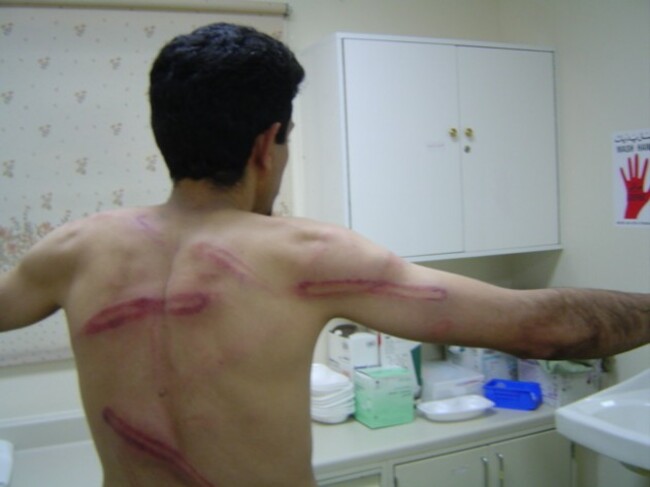
(Image shows marks of beating on the back and arm of Abdulhadi Al Khawaja after Bahraini police attacked a peaceful protest on 15 July 2005. Pic courtesy of the Bahrain Centre for Human Rights).
Despite the crackdown on protests in late March of last year, clashes between groups of protestors and police are continuing on daily basis.
Using surveillance gathered during The Pearl Roundabout encampment, police are now raiding the homes of people involved, or suspected of being involved and making arrests. In custody people are beaten and tortured, then being released after a short time. There have been a number of deaths in custody, such as that of the blogger Zakariya Rashid Hassan al-Ashiri, who was beaten to death by police. This has spread fear and anger through the capital Manama, which is only heightened by the fact that people leave custody with untreated broken bones, and severe facial and head injuries.
Twenty doctors and nurses from both Shi’a and Sunni backgrounds are currently awaiting trial on a myriad of charges against the regime. If convicted, each could face up to 15 years in prison. During an initial hearing the group was presented with an array of guns and weapons in front of them as national and international media were invited to record the image. All of the medics have since said that they had never seen the weaponry before the hearing. Several of these doctors were trained at the Royal College of Surgeons Ireland – the RSCI is noticeably quiet in the support of their former students.
Both of Abdulhadi’s daughters campaign tirelessly for their father’s release. Zaniab is based Bahrain, while Maryama is an exile from Bahrain and currently living in Denmark. Zaniab is allowed occasional access to her father in prison and has visited him as recently as 7 January, despite evidence of swelling on his face she says, “he is in strong spirits”. He reportedly told her “Peaceful resistance is a celebration, do not despair”.
No date for Abdulhadi’s appeal has been set as of yet.

To embed this post, copy the code below on your site










have your say