Sign in. It’s quick, free and it’s up to you.
An account is an optional way to support the work we do. Find out more.
Sign in. It’s quick, free and it’s up to you.
An account is an optional way to support the work we do. Find out more.
Updated 5.12pm
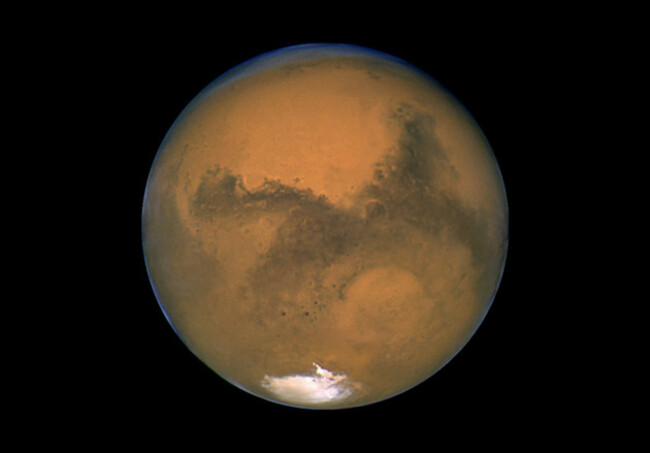
LIQUID WATER HAS been observed on the planet Mars, Nasa has revealed.
“Mars is not the dry, arid planet we thought of in the past,” Jim Green, the agency’s planetary science director, told a press conference.
Under certain circumstances, liquid water has been found on Mars.
This raises the possibility that alien life could be discovered on the Red Planet.
“Today we’re revolutionizing our understanding of this planet,” Green said, ”Our rovers are finding there’s a lot more humidity in the air.”
The rovers searching the planet’s surface have also found that the soil is much more moist than anticipated.
The results of a new study, published in the journal Nature Geoscience, ”strongly support the hypothesis” of liquid water on Mars today.
It has previously been suggested that markings on the surface represent the flow of salty water. Scientists have long believed that water once flowed freely across the red planet and was responsible for forming its valleys and canyons.
In April, scientists reported in the same journal that perchlorate salts, like the ones in the new study, were “widespread” on the surface of our planetary neighbour and humidity and temperature conditions just right for salty brines to exist.
Perchlorate is highly absorbent and lowers the freezing point of water so that it remains liquid at colder temperatures.
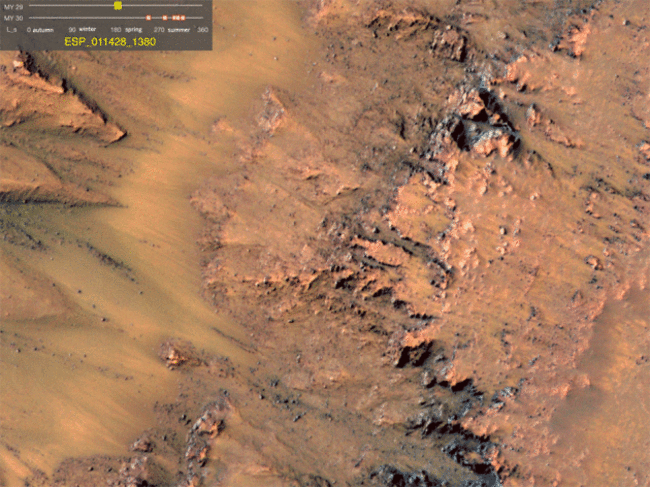
These dark, narrow streaks tend to appear and grow during the warmest Martian months, and fade the rest of the year.
The researchers said today further exploration is warranted to determine whether any microscopic life might exist at modern-day Mars.
They based their findings on images and data from NASA’s Mars Reconnaissance Orbiter, which has been circling Mars since 2006.
Asked if the data was unequivocal proof of liquid water on Mars, an author of the study, Alfred McEwen from the University of Arizona, told AFP: “I would say almost”.
But if there was, it was likely “wet soil, not free water sitting on the surface,” he said by email.
More details to follow. Additional reporting by Nicky Ryan and The Associated Press.

To embed this post, copy the code below on your site













have your say