Sign in. It’s quick, free and it’s up to you.
An account is an optional way to support the work we do. Find out more.
Sign in. It’s quick, free and it’s up to you.
An account is an optional way to support the work we do. Find out more.

OVER 350 EVICTIONS carried out in the last ten years were determined to be illegal, according to a new report.
The Community Action Tenants Union (CATU) published the report today, outlining the increasing prevalence of officially recorded illegal evictions among private and corporate landlords in an already precarious market for tenants.
Co-author of the report, Fiadh Tubridy, describes evictions as one of the “most harmful” elements of the housing crisis.
“We hope this research will help both draw attention to the extent of the problem as well as to the many gaps in legislation and enforcement which allow for evictions to take place on such a widespread scale,” she said.
According to CATU, 353 evictions officially classed as “illegal” took place between 2015 and 2024, meaning the Residential Tenancies Board (RTB) itself deemed them unlawful.
The RTB classes an eviction as illegal when a landlord has “unjustly deprived” the tenant of their home by “abusing” the legal process for no-fault evictions, such as by claiming that they would sell a house and then not follow through with it.
The report was completed by CATU in collaboration with researchers from Maynooth University and Utrecht University in the Netherlands.
The group claims that three-quarters of the 4,524 eviction orders issued by the RTB between 2015 and 2024 involved tenants refusing to leave a property by a date agreed with the landlord.
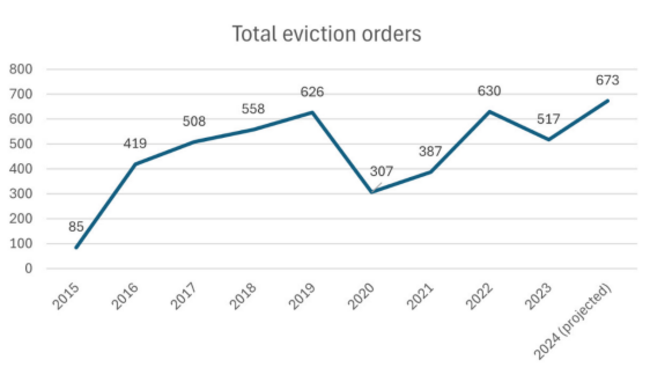
However, the report caveats the above figures, claiming they only reflect evictions directly dealt with by the RTB, and do not reflect other cases whereby landlords inevitably evict tenants “off the books”. It says many are cases of landlords “taking advantage of” no-fault eviction loopholes to force a tenant out.
Eviction orders have been steadily increasing since 2015. Last year saw the highest number issued to tenants registered with the RTB, with 673 orders given to tenants to leave the property compared to just 85 in 2015.
CATU argues that an official definition of what constitutes an illegal eviction remains unclear in Irish tenancy legislation, which it claims leads to tenants being “intimidated into leaving their homes”.
It also says that this uncertainty gives rise to increasing numbers of no-fault evictions – where a landlord terminates a tenancy because they want to sell the property or give it to a family member – which is calls for a “complete ban” on.
Eviction law, it alleges, is too open to interpretation, permitting landlords to lean on no-fault evictions as a reliable method of increasing rents which would otherwise be in violation of their tenancy contract with the in-situ tenant.
“It is inherently very difficult to disprove a landlord’s stated intention, which can often only be judged long after the eviction has been carried out, and an unreasonable onus is placed on the evicted tenants themselves to discover the abuse,” the report states.
Commenting on the findings, CATU member Sam Mutter says: “In the short-term, we need a complete ban on no-fault evictions and ultimately we need to shift towards far greater availability and accessibility of public housing so people don’t have to deal with the precarity.”
To embed this post, copy the code below on your site

















have your say