Sign in. It’s quick, free and it’s up to you.
An account is an optional way to support the work we do. Find out more.
Sign in. It’s quick, free and it’s up to you.
An account is an optional way to support the work we do. Find out more.
LAST UPDATE | 24 Dec 2022
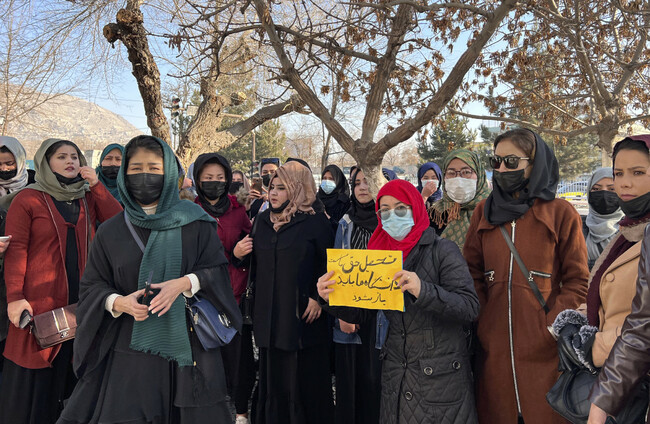
TALIBAN SECURITY FORCES have used a water cannon to disperse crowds protesting against the ban on university education for women, witnesses said, as the decision by the government continued to cause anger in Afghanistan and beyond.
Afghanistan’s Taliban rulers on Tuesday banned female students from attending universities.
Women have since demonstrated in major cities in a rare sign of domestic protest since the Taliban seized power last year.
According to witnesses in the western city of Herat, about two dozen women were heading to the provincial governor’s house today to protest against the ban, chanting: “Education is our right,” when they were pushed back by security forces firing the water cannon.
Video shared with the Associated Press shows the women screaming and hiding in a side street to escape the water cannon. They then resume their protest, with chants of “Disgraceful!”
One of the protest organisers, Maryam, said between 100 and 150 women took part in the protest, moving in small groups from different parts of the city toward a central meeting point. She did not give her last name for fear of reprisals.
“There was security on every street, every square, armoured vehicles and armed men,” she said.
“When we started our protest, in Tariqi Park, the Taliban took branches from the trees and beat us. But we continued our protest. They increased their security presence. Around 11am they brought out the water cannon.”
A spokesman for the provincial governor, Hamidullah Mutawakil, claimed there were only four or five protesters. “They had no agenda, they just came here to make a film,” he said, without mentioning the violence against the women or the use of the water cannon.
There has been widespread international condemnation of the university ban, including from Muslim-majority countries such as Saudi Arabia, Turkey, the United Arab Emirates and Qatar, as well as warnings from the US and the G7 that the policy will have consequences for the Taliban.
An official in the Taliban government, minister of higher education Nida Mohammad Nadim, spoke about the ban for the first time on Thursday in an interview with Afghan state television.
He said the ban was necessary to prevent the mixing of genders in universities and because some subjects being taught violated the principles of Islam.
He said the ban would be in place until further notice.
Despite initially promising a more moderate rule respecting rights for women and minorities, the Taliban have widely implemented their interpretation of Islamic law, or Sharia, since they seized power in August 2021.
They have banned girls from middle school and high school, barred women from most fields of employment and ordered them to wear head-to-toe clothing in public. Women are also banned from parks and gyms.
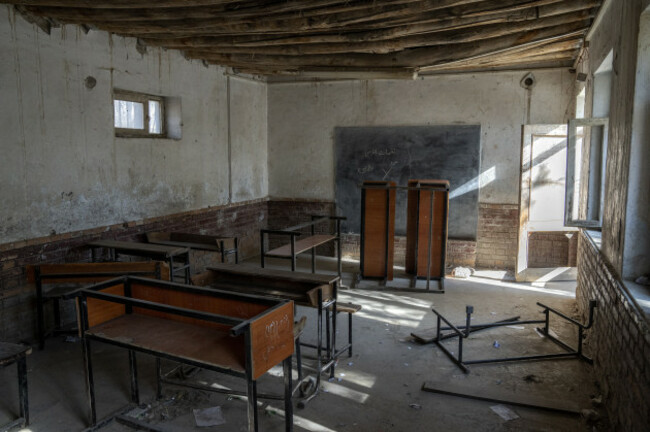
Afghan society, while largely traditional, had increasingly embraced the education of girls and women over the past two decades.
Also today, in the south-western Pakistani city of Quetta, dozens of Afghan refugee students protested against the ban on female higher education in their homeland and demanded the immediate reopening of campuses for women.
One of them, Bibi Haseena, read a poem depicting the grim situation for Afghan girls seeking an education. She said was unhappy about graduating outside her country when hundreds of thousands of Afghan women and girls were being deprived of an education.
Separately, the Taliban has ordered all national and international NGOs to stop their women employees from working after “serious complaints” they were not observing a proper dress code.
“There have been serious complaints regarding the non-observance of the Islamic hijab and other rules and regulations pertaining to the work of females in national and international organisations,” said a notification sent to all NGOs, a copy of which was obtained by AFP and confirmed by a ministry spokesman.

To embed this post, copy the code below on your site















have your say