Sign in. It’s quick, free and it’s up to you.
An account is an optional way to support the work we do. Find out more.
Sign in. It’s quick, free and it’s up to you.
An account is an optional way to support the work we do. Find out more.

THE LABOUR LANDSLIDE is “inevitable” but Keir Starmer becoming the UK’s prime minister this week is not, according to Samy Darwish.
Darwish is campaigning for Andrew Feinstein, an independent running in Starmer’s London constituency of Holborn and St Pancras.
“Andrew’s going to win the election,” he tells The Journal without skipping a beat. “Angela Rayner (Labour’s deputy leader) will be the next prime minister.”

Darwish, a British expat, has such confidence in Feinstein that he flew in from Dubai to canvass for him. He was previously a Labour voter – he’s a Jeremy Corbyn fan and backed Tony Blair before the war in Iraq.
However, Labour’s handling of Corbyn – who was ousted after the party was engulfed by claims of antisemitism - pushed him away, and Starmer’s “atrocious” stance on Gaza sealed the deal.
Darwish said Feinstein, who served as an MP for the African National Congress (ANC) in South Africa from 1994 to 2001, is a man with “real integrity”.
Imagine if someone said, ‘Nelson Mandela is going to come over here and stand in your constituency’? Well, that’s impossible, obviously. But we’ve got our own little piece of Nelson Mandela.
Darwish is eligible to vote in Vauxhall, a different London constituency, but doesn’t like any of the candidates running there. He has decided not to vote at all.
He said the UK’s First Past The Post voting system – where people can only cast their vote for a single candidate – is “pants” and should be reformed.
That’s another debate for another day, and Darwish is focused on a different goal this week.
He said getting Feinstein elected would be “killing two birds with one stone” – a fresh start for Holborn and St Pancras, and doing the country “a big favour” by “getting rid” of Starmer.
Despite being an MP in South Africa for several years, to some Feinstein is better known as an investigative filmmaker – he is particularly interested in who profits from the global arms trade.
Does he believe he can take the seat from Starmer? “We honestly don’t know,” he tells The Journal.
Recent opinion polls suggest Starmer is home and dry – but polling in the UK has been proven wrong at various pivotal moments in recent years.
“We don’t know, that is the honest answer,” Feinstein, who has lived in the UK for almost 23 years, said.
“But the mood on the street, the mood at the doors – we’ve knocked on over 45,000 doors in this constituency – is that people want him out.
“It’s very difficult to predict how it will play out electorally. But there is no doubt that we believe we can win.”
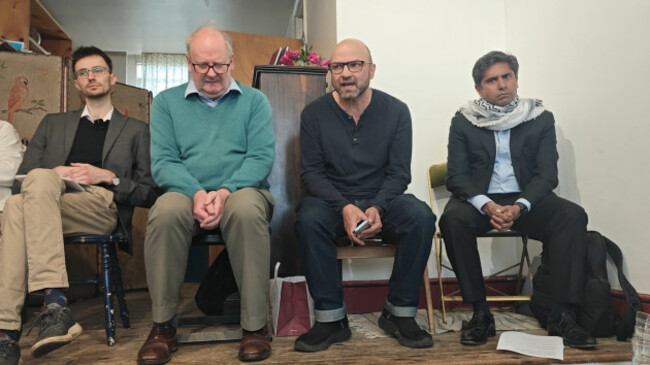
We’re speaking in Kentish Town, where Starmer lives, after a public meeting organised by the Camden Palestine Solidarity Campaign (PSC).
All 12 candidates running for election in the constituency were invited. Three showed up – Feinstein, Thomas Scripps from the Socialist Equality Party, and John Poynton from Ukip.
The Green Party’s David Satnsell couldn’t be there but sent a representative, Faaiz Hasan. The Labour leader is among the candidates who did not attend.
When the start of the meeting was delayed while we waited for someone to arrive, one man asked: ‘Is it Starmer? We’ll be waiting a long time.’
Cue stifles of laughter from the crowd.
“The fact that our MP is a former human rights lawyer who does not have the humanity to call for an unqualified ceasefire in Gaza, to demand an immediate halt to arms sales to Israel – which I believe are in violation of British law and international law – is beyond shameful,” Feinstein later told the crowd to applause.
Starmer’s position on Gaza has caused anger among some in his own party, with the leader facing criticism for not calling for a permanent ceasefire sooner.
The war started after Hamas’ 7 October attack on southern Israel resulted in the deaths of 1,195 people, mostly civilians, according to an AFP tally based on Israeli figures.
The militants also seized 251 hostages, 116 of whom remain in Gaza, including 42 the army says are dead. Israel’s retaliatory offensive has killed at least 37,925 people, also mostly civilians, according to data from the health ministry.

In the aftermath of 7 October, Starmer spoke about Israel’s right to defend itself against Hamas. In November, a host of his shadow ministers – including Naz Shah, Paul Barker and Afzal Khan - broke ranks to call for an immediate ceasefire.
The vast majority of Labour supporters also want a permanent ceasefire, according to opinion polls. In its election manifesto, Labour has committed to recognising a Palestinian state – but many people view this as too little, too late.
In June, Starmer said a Labour government would have a “duty” to play a “full part” in resolving the conflict.
“The best thing we can do for both sides, for everybody concerned, is to press for that ceasefire immediately, straight away. That’s been our position for weeks and weeks and weeks and months,” he said.
Starmer also suggested that legal advice on UK arms sales to Israel could be reviewed under a Labour government after over 100 artists and celebrities called for him to revoke UK export licences to Israel if his party wins the election.
Even if Starmer’s seat is safe, his comments on Gaza may result in some people no longer voting for the party – no matter how much they want to get the Conservatives out of power.
“We don’t know the extent that Gaza is going to impact electorally,” Feinstein said.
“Is it going to trump the fact that huge swathes of people just want rid of the Tories and therefore people might be a bit reluctant to not vote Labour?”
Polls have fluctuated in recent weeks but Labour still has a lead of around 20 points over the Conservatives with Reform UK in third and the Liberal Democrats in fourth, according to this analysis by BBC News.
However, polling company YouGov puts Starmer’s personal popularity rating at just 22%. (Rishi Sunak is not far behind him on 18%, for context.)
“The extraordinary thing about Keir Starmer is that for someone whose party is so high in the polls, there has never been a leader who has such bad favourability ratings,” Feinstein points out.
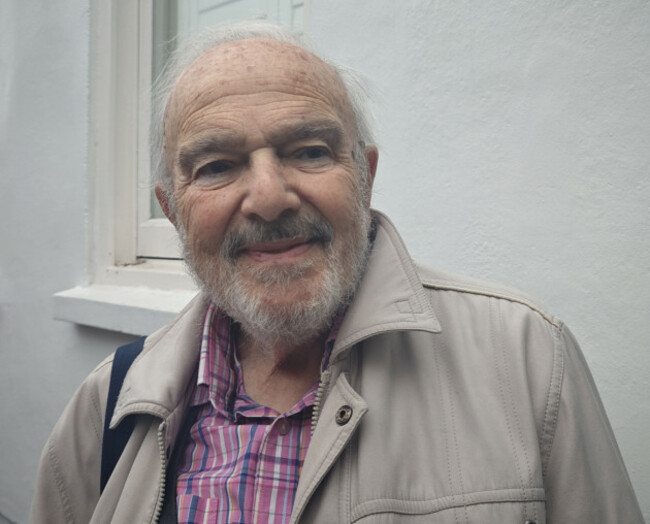
Sabby Sagall, a Jewish socialist activist and chair of Camden PSC, said Starmer’s comments on Gaza in recent months have “caused huge anger, not least among left-wing Jews”.
“I voted for Keir Starmer before, in the last general election, but this time I’ll be voting for Andrew Feinstein,” Sagall tells The Journal.
When asked if he thinks Feinstein can pull off a shock win, he said: “One hesitates to make rash predictions. It will be a huge task, but I think someone like Andrew could do very well.”
Sagall said some people using the atrocities of the Holocaust to justify what’s happening in Gaza is “appalling”.
Some of his relatives had a “very narrow escape” when on a train bound for Auschwitz.
“There’s a French branch of my family. My first cousin, who’s 90 years old, she’s still alive. She lives in London, actually. They had a very narrow escape.
“In 1943 or 1944, when the German army occupied France, they were hiding in the so-called ‘free zone’, the Vichy zone of France.
“Then the Germans occupied that, and they were finally caught and put on a train to Auschwitz.
“But because my late uncle, my cousin’s father, had connections with French railways, he had done business with French railways, he got the family – himself and his wife and two children, my cousins – taken off the train at the German border in a very narrow escape.”
Feinstein himself is the son of a Holocaust survivor.
“I am constantly – like others sitting in this room – called a self-hating, antisemitic Jew,” he told the crowd on Monday evening.
“My mother was a Holocaust survivor who lost dozens of her family in Auschwitz…
Israel had a very important part in our family history because one of my mother’s cousins, who is still alive, still has the striped pyjamas in which she was liberated.
“She thought she’d lost everyone. She managed to travel to Palestine, as it then was, and discovered her father had survived and also managed to travel to Palestine.”
When asked to expand on this by The Journal after the meeting, Feinstein said the labelling by some people of any criticism of the actions of Israel’s government or army as antisemitic is designed to “close down any debate”.
“I thought I had lived through the darkest times I could as a white Jewish South African in the late apartheid period when oppression, militarised oppression of the majority of our people, was at its height. This is even worse.
“For Israel to claim that it is acting on behalf of all Jews, is just appalling. It’s actually an insult to the dozens of [my mother's] family who lost their lives in Auschwitz, to the millions who lost their lives.
As Jews – with our history of oppression – we have a responsibility to call out oppression, atrocities, war crimes and genocide, regardless of who is perpetrating it.
“Hundreds of thousands, if not millions, of Jews all over the world are standing up against Israel’s appalling behaviour, which is not in our name.”
South Africa has brought proceedings before the International Court of Justice (ICJ), alleging that Israel is committing genocide in Gaza – something Israel denies.
Feinstein told the meeting that being from South Africa, and serving as an ANC MP shortly after apartheid ended, has helped form his views on Palestine.
He said, due to the nation’s history of apartheid, “the struggle for Palestinian freedom is etched into South African politics in a way that I don’t think people understand”.
Feinstein continued: “So when people asked what business is of South Africa to bring the case to the ICJ – of course it’s our business because we had liberated ourselves from settler colonialism and racism.
“That gives us a moral authority. And our struggle is one with the struggle of the Palestinian people.”
He later told The Journal that South Africa’s ICJ case “shows that the oppressed have become the lawyers and the judges, that the oppressed are seeking justice for the Palestinian people and for the world”.
Whether or not people’s views on Gaza play a factor in the outcome of the election – in Starmer’s constituency and the UK in general – remains to be seen.
But many voters in Holborn and St Pancras want their MP, whoever that may be, to call for an immediate and permanent ceasefire in a conflict that has claimed some 40,000 lives since October.
Contains reporting by Press Association and © AFP 2024

To embed this post, copy the code below on your site













have your say