Take part in our latest brand partnership survey

We need your help now

Support from readers like you keeps The Journal open.

You are visiting us because we have something you value. Independent, unbiased news that tells the truth. Advertising revenue goes some way to support our mission, but this year it has not been enough.

If you've seen value in our reporting, please contribute what you can, so we can continue to produce accurate and meaningful journalism. For everyone who needs it.

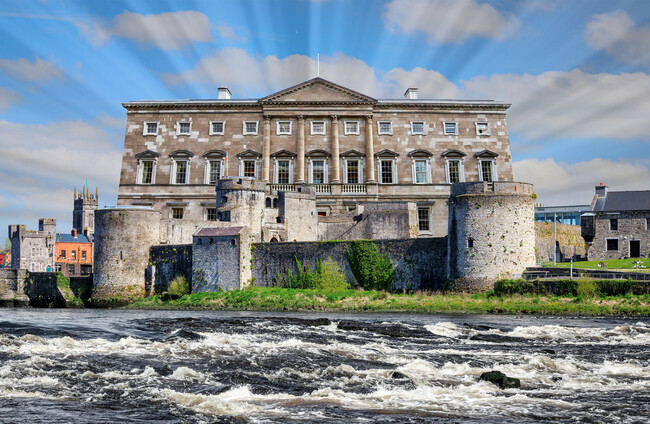
There's No 10 in the North but what about Leinster House on the Shannon? Alamy Stock Photo/The Journal

Burnham wants to make Manchester the second seat of power. Could that happen in Ireland?

A 2023 report called Ireland one of the most centralised countries in Europe, putting us only above Hungary, Russia and Moldova.

ANDY BURNHAM’S RAPID ascent to power in the UK has been built on promises to rip power away from London, moving key levers of power to his Manchester base via a new ‘No 10 in the North’.

Now installed as UK Labour leader and set to become prime minister, the former Manchester mayor has spoken of how “political power was centralised and economic power privatised” in the 1980s, and that he intends to reverse it.

Could Burnham’s plan to bring core powers of the British government to Manchester work in Ireland, by moving key parts of government to Cork or Limerick, Galway or Waterford?

This would not just be the decentralisation move taken in the early 2000s when more than 3,000 civil service jobs were moved out of Dublin before the plans were shelved, but would mean real, systemic power shifted well beyond the current centre of government.

What could it look like? The south-east or north-west could have responsibility for its own public transport for example. Or Cork could have responsibility for the entire country’s health service, as Limerick does for certain elements of the housing system. Or perhaps each city would have a mayor who would look after roads, schools and planning.

These ideas would also be an attempt to reverse what has long been the election plan for many TDs, who promise to be boosters for their local area by going to Leinster House to bring home the economic development bacon.

This includes not just the Healy-Reas in Kerry, but also senior opposition TDs such as Sinn Féin’s David Cullinane, whose campaign posters in the past touted him as being ‘Waterford’s champion’ in the Dáil.

Limerick experiment

As the country’s first ever directly elected mayor, John Moran holds the unique role of Ireland’s experiment in basing powers outside the capital, and he believes there are big lessons to take away from the rise of Burnham in the UK.

That role has given Moran responsibility to design long-term strategies for Limerick’s economic development, housing and its annual budget.

Moran told The Journal that Ireland should push for greater local government control of certain major services, such as housing and public transport, with Burnham earning plaudits as mayor for bringing the region’s bus network back into public control.

Moran, who met with Burnham last year in Dublin as part of discussions to devolve powers on health policy, believes that the only way to ensure “fair” regional treatment and growth is to boost the powers of politicians in Ireland’s cities.

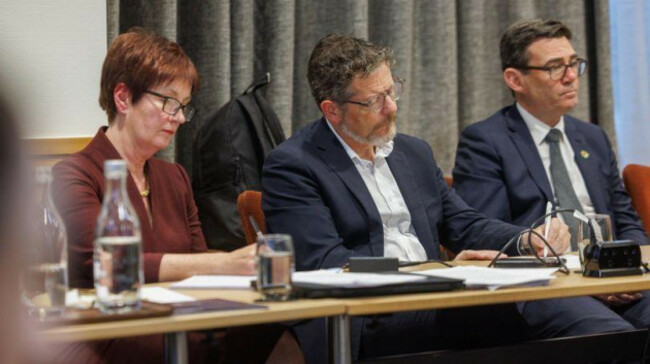
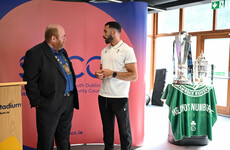
lher-1-810-x-456 John Moran and Andy Burnham in Dublin last November. Will add credit Will add credit

Burnham was able to put “place before politics” by his attempts to focus on regional development, Moran said, adding that he had also been “creating an alliance of like-minded mayors” in nearby regions during his Manchester brief.

“I think there’s a big learning for us in that, because it would change how local government works in Ireland if a directly elected mayor in Cork was able to call the mayor in Galway, explain that there is something happening in their community that is a really important issue for us, but maybe the national government doesn’t quite get it,” Moran said.

What powers could we see devolved to regions?

The idea of the directly elected mayor role, in Ireland and Europe, is to try and allow more autonomy over big areas of policy for a region.

In Burnham’s case, his flagship policy over recent years became his move to reverse the deregulation of the bus network in Greater Manchester and bring it back into public control.

This means that the council receives tenders from companies interested in providing the buses – but power over the network lies with the local authority.

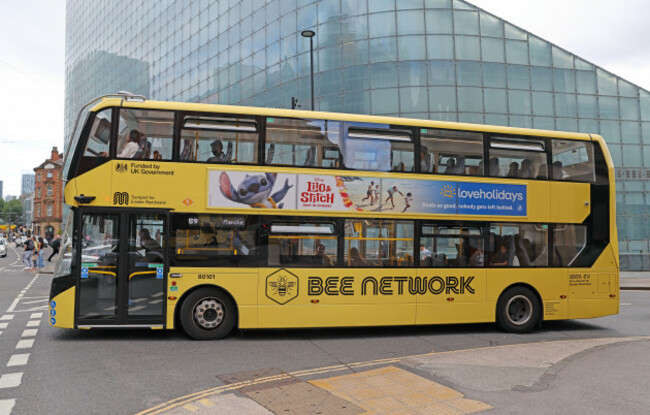
It turned into a popular move for Burnham, helped by canny branding that saw the buses adopt the worker bee as their logo, a nod to a symbol used in the past by northern England’s labour movement.

Indeed, when The Journal visited Makerfield ahead of Burnham’s stomping election victory last month that saw him become an MP, his bus plans were cited repeatedly by locals, especially from elderly passengers who benefited from Burnham using his mayoral powers to widen the free-travel hours beyond 9 to 5.

bee-network-electric-double-decker-bus-outside-the-national-football-museum-near-manchester-victoria-station-approach The Bee Network bus system became one of Burnham's major successes from his stint as Manchester mayor. Alamy Stock Photo Alamy Stock Photo

Moran said there was a need to develop the mayoral model to hold real power over public transport as Burnham did in Manchester.

At present, he said, the role has “soft powers” as when he can convene meetings of state agencies, be it the HSE, the National Transport Authority or gardaí.

“It means I can put in phone calls to people and say, ‘we’ve got a problem here and can we get into a room to talk about it,’” Moran said.

But this still means that the HSE or the National Transport Authority is the body that really sets the agenda.

Weaknesses in Burnham’s plan

Trying to copy Burnham’s idea of a No 10 in the North would in itself be an enormous task, on both political and administrative levels, according to those who spoke to The Journal.

There may also be an inherent weakness with Burnham’s grand plans for a No 10 in the North, as they risk being swept away within a short few years if the tide takes him out in any future election.

“If it’s not built into legislation then it could be reversed by a Nigel Farage or any politician coming in after him who is not as keen on the idea,” said Deiric Ó Broin from the school of law and government at Dublin City University (DCU).

He believes the best move is to continue trying to improve the directly elected mayor model.

Moran believes a focus on finetuning the office powers and reorganising branches of local government could produce cities and towns that feel better represented.

He added that while there have been calls for a return to the town council model that was scrapped in 2014, he believes work must happen higher up the chain first.

“Putting stuff in at the bottom without doing stuff in the middle means it won’t work,” he added.

“There are a lot of silos in local government, between transport, housing and community, when there might be a better way by having a director of a region in the county.”

The Limerick mayor said Burnham’s pointed criticisms of a “one-size fits all model” of centralisation were notable as he argued that different types of local government may be needed long-term.

Moran further pointed to Dublin, Limerick city and county and Co Louth, home to two large towns, as areas that may need different solutions.

Moran, who served as secretary-general of the department of finance from 2012 to 2014 during one of the toughest periods following the 2008 crash, queried Burnham’s plans for his No 10 in the North.

“He’s trying to move the policy bubble out of London,” Moran said.

Instead, Moran added, the incoming prime minister may believe that “if he’s up in Manchester, when people want to meet him, they are going to have to go to Manchester and maybe get a different perspective”.

Could we see it in Ireland? Moran thinks there are “easy wins” for something similar here.

“Have the cabinet meet in each of the cities twice or three times a year, have all the ministers come down, have dinner with a local mayor, maybe hold a conference as part of it,” Moran said.

‘One of the most centralised European nations’

Whatever the solution, major work is needed to turn Irish local government around.

In 2023, a Council of Europe report found that Ireland is “one of the most centralised countries in Europe,” putting us only above Hungary, Russia and Moldova.

Ireland has only really begun to experiment with moving elected powers away from Dublin in recent years through the directly elected mayor’s job in Limerick. Similar plans for Cork and Waterford were narrowly shot down by voters.

Ireland has a similar local government model to many parts of the UK, where an unelected public servant oversees the budget and key functions. Manchester, Limerick and other cities are all examples of trying to break away from that.

Ó Broin said there are advantages with the empowered mayor model, but that it has to overcome often “poisonous” politics to have any chance of success.

“It’s about politicians having an opportunity to have executive power,” Ó Broin said, explaining that could be their only chance of holding significant sway outside a role at cabinet.

“So if you’re a Pascal Donohue type character, and say your party has a bad national election, but there’s a big mayoral office in Dublin that is the equivalent power of a cabinet minister, if not more, then that becomes very attractive.”

And as with Burnham’s time in Manchester, which allowed him to reinvent himself after leaving Westminster, “if you do it well, it’s a springboard back into national politics”, Ó Broin said.

But Ó Broin warned we can’t “underestimate the power of ego” and that currently serving politicians may be put out by attempts to shake things up. “The issue is a challenge for councillors,” he said.

“If you create a big job it will attract a big name, but if you’re a councillor you’re probably not a big name.”

Housing and bins

Aside from transport and health, Ó Broin believes there are a number of areas that Ireland should consider coming under local authorities and directly elected mayors.

This includes bins, to a council being in charge of childcare, crèches, and even schools as part of new housing estates.

Also critical here is the role of council housing, and Burnham himself has signalled that he intends on an ambitious building programme to counter trends of the past 40 years.

As in the UK, Irish councils have gradually depleted their stock of homes – between 1990 and 2016, 43% were sold to tenants – with critics blaming this for weakening council finances.

So how likely is any of this to happen?

Ireland “doesn’t have a Burnham character yet” because Ireland’s experiment in devolution is still young, and Ó Broin doesn’t believe it will take off until political parties give it their backing by standing their “big beasts” for the office.

He pointed to how, in the election for Limerick’s first directly elected mayor, only one sitting TD stood for the role, while senior deputies from Fianna Fáil and Fine Gael sat it out in place of councillors.

“Do we have the institutions and mechanisms to produce a Burnham? We have one and that is Limerick, but political parties need to be standing for these positions too. For that to happen, the jobs involved have to be interesting and substantial enough to bring those candidates in – arguably we don’t have that just yet,” Ó Broin said.

Close
5 Comments
This is YOUR comments community. Stay civil, stay constructive, stay on topic. Please familiarise yourself with our comments policy here before taking part.
Leave a Comment
    Submit a report
    Please help us understand how this comment violates our community guidelines.
    Thank you for the feedback
    Your feedback has been sent to our team for review.

    Leave a commentcancel

     
    JournalTv
    News in 60 seconds