Sign in. It’s quick, free and it’s up to you.
An account is an optional way to support the work we do. Find out more.
Sign in. It’s quick, free and it’s up to you.
An account is an optional way to support the work we do. Find out more.
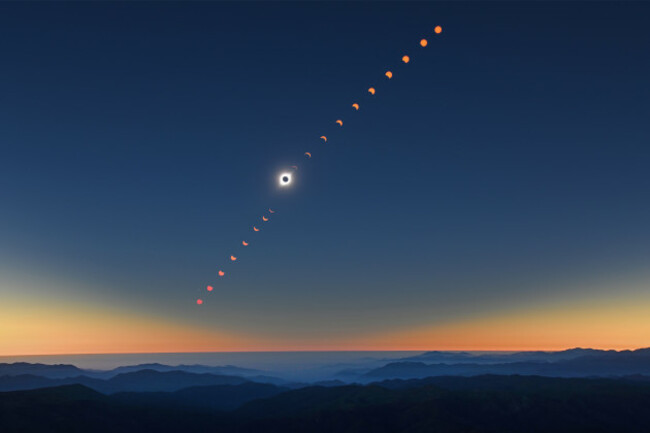
A RARE TOTAL solar eclipse plunged the majority of Latin America’s southern cone into darkness yesterday, briefly turning day into night.
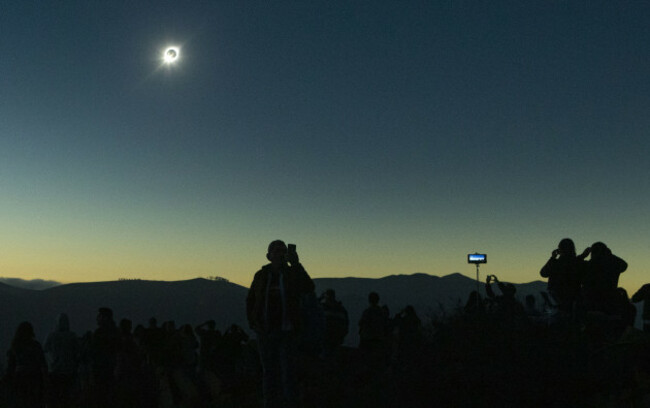
Hundreds of thousands of people flocked to Chile’s northern Coquimbo region near the Atacama desert which was situated directly on the eclipse’s 150-kilometre-wide “path of totality”.
Large crowds also congregated in the town of La Higuera, some 2,400 metres above sea level and near the landmark La Silla Observatory, operated by the European Southern Observatory.
Solar eclipses happen when the Sun, the Moon and Earth line up, allowing the Moon to cast its shadow on Earth.
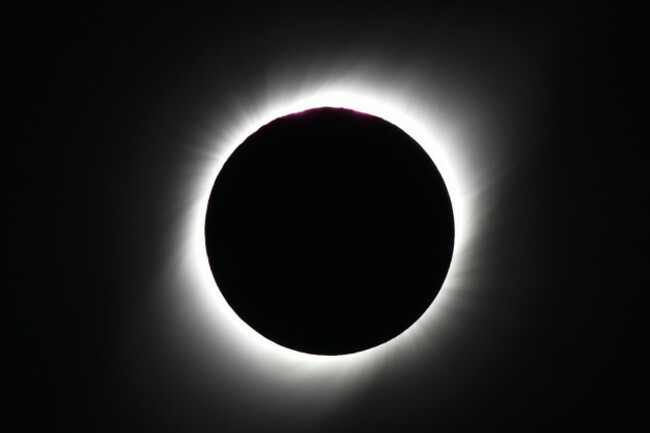
Total solar eclipses are rare, but what is even rarer about yesterday’s event is that it occurred directly over an area of the Earth most prepared to study it.
“Very seldom has it happened that the whole of an eclipse is seen over an observatory, the last time this happened was in ’91 at the Mauna Kea observatory in Hawaii” astronomer Matias Jones said.
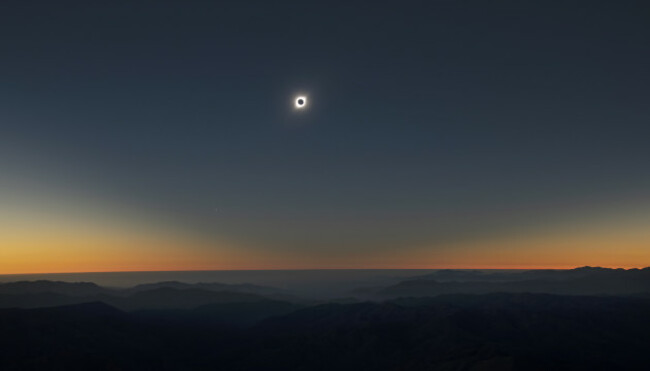
The eclipse began at 1.01pm (5.01pm Irish time) in the Pacific Ocean, and a 150-kilometre-wide band of total darkness reached Chile’s coast at 4.38pm (8.38 Irish time), before crossing into southeastern Argentina and into the wastes of the South Atlantic.
‘Eyes of humanity’
Chile’s President Sebastian Pinera joined the crowds at La Higuera to witness the eclipse.
“Today is a very important day and one we have waited for so long,” Pinera said.
Pinera said Chile was “the capital of the world in terms of astronomy, we are the eyes and the senses of humanity, being able to look, observe and study the stars and the Universe”.
The La Silla observatory and its fleet of powerful telescopes live streamed the event and opened the site to the public, hosting school tours along with talks and workshops.
La Silla was one of the first international observatories installed in northern Chile. Today the region has today almost half the world’s astronomical observation capacity.
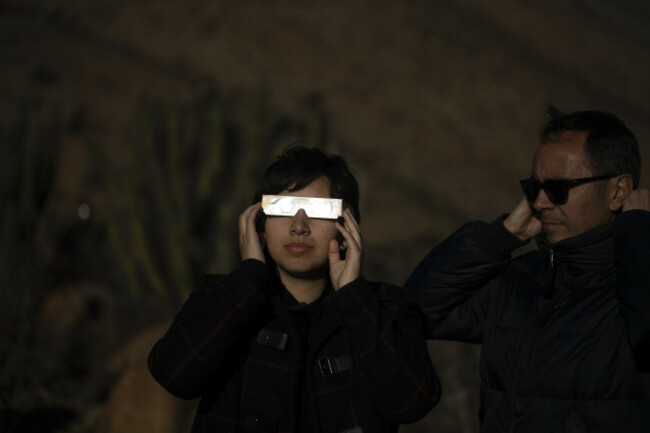
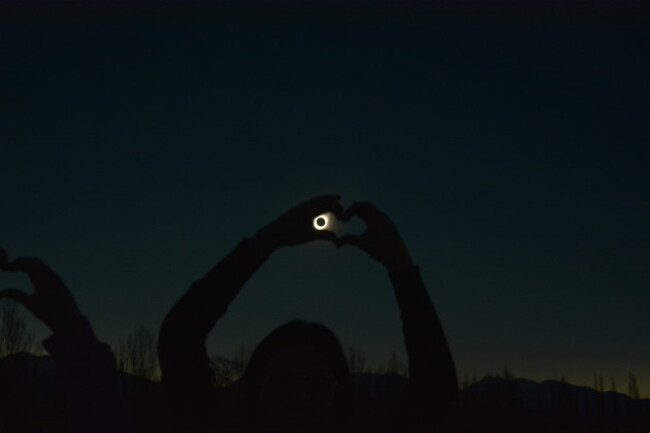
Scientists and astronomers will use data collected from studying the eclipse to verify theories and carry out experiments.
“Eclipses are a chance to study the outer part of the atmosphere, which is the corona, since the moon is covering the entire central part of the Sun,” Jones said.
The next total eclipse will be visible in southern Chile on 14 December 2020.
Includes reporting by © – AFP 2019

To embed this post, copy the code below on your site
















have your say