Sign in. It’s quick, free and it’s up to you.
An account is an optional way to support the work we do. Find out more.
Sign in. It’s quick, free and it’s up to you.
An account is an optional way to support the work we do. Find out more.
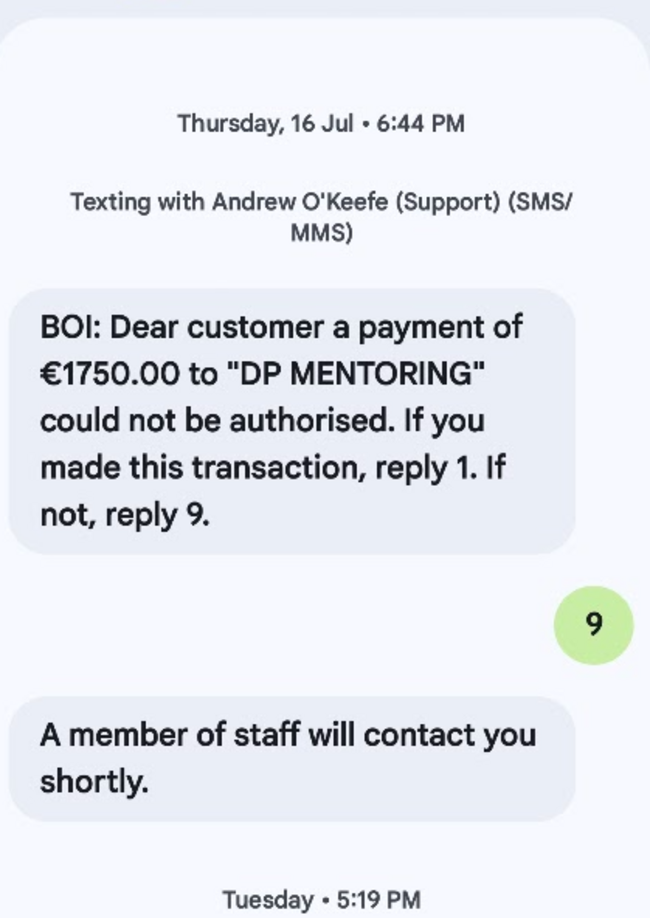
WHEN CAROLYN RAMSAY got a text from Bank of Ireland (or so she thought) last July saying a payment of €1,750 could not be authorised, and asking her to press ’9′ if she hadn’t made this transaction herself, she did so.
“A member of staff will contact you shortly,” came the reply.
Soon she got a call from a man calling himself Andrew O’Keefe.
He said there had been a fraud within Bank of Ireland, which was under investigation. He advised her to transfer money to one of her other bank accounts, if she had one.
“He said, ‘Do you have another account?’ He didn’t mention Revolut. I said, ‘Yes, I have a Revolut account’,” Ramsay explains.
Correspondence continued via a WhatsApp account carrying the name “Andrew O’Keefe (Support)”.
These texts, seen by The Journal, show that the person knew Carolyn’s name, including the correct spelling.

The texts were well written and used familiar Bank of Ireland terminology. For example, she was advised that her Banking 365 (the Bank of Ireland online service) pin would remain the same, and she should delete the BoI app and redownload it.
She was talked through the process of transferring money out of the allegedly compromised Bank of Ireland savings account. She transferred €4,352 to her own Revolut in two instalments, one electronically and one in a Bank of Ireland branch.
Then she transferred the money from her Revolut to what ‘Andrew O’Keefe’ told her was a new, replacement Bank of Ireland account. The name on the account to which she transferred the money was her own.
“I made the transfer and that was the end of it. Then they disappeared,” Ramsay said.
The new account was a fake and her money was gone.
Except that wasn’t quite the end of it. Ramsay followed up with both Bank of Ireland and Revolut’s fraud teams, and reported the incident to gardaí.
She also did some sleuthing herself. She is confident she has identified the scammers and how they harvested her name and phone number.
As yet, however, no one has been brought to justice and she has not recovered her money.
Payment fraud has exploded in Ireland, increasing by 27% last year alone – and that’s just the reported cases.
Ramsay is sharing her story because she wants to draw attention to what she believes are some crucial weaknesses in both Bank of Ireland and Revolut’s anti-fraud defences for keeping their customers safe from scammers.
Firstly, no red flags were raised by Bank of Ireland about Ramsay’s withdrawals from her account, despite the fact that these were completely atypical – and large – transactions for her. She has been a customer with Bank of Ireland for many years.
Secondly, Revolut did not query the onward payments to the scammer’s account, despite the fact that the name she entered as payee – her own – and the international bank account number (Iban) cannot have aligned, since the Iban was attached to an account held by the scammer or an associate.
The Journal has also raised a third problem with Revolut: the fact that the lost money went to a Revolut account, identifiable as such from the Iban, but Revolut still hasn’t confirmed it will be able to return it to Ramsay.
Here’s what the banks had to say for themselves.
Bank of Ireland says it has the technology to spot and deter attempted payment fraud. However, the large and unusual withdrawals Ramsay made from Bank of Ireland following a phishing call proceeded smoothly, and nobody from the bank contacted her to query them.
Just a month before Ramsay was defrauded, Bank of Ireland issued a press release boasting of its “new AI-led pattern recognition technology that can help spot suspicious activity before a payment leaves the bank”. It said its AI understands how accounts are typically used, helping it identify potentially suspicious behaviour earlier.
Bank of Ireland has previously drawn attention to the particular scam Ramsay was subjected to. It calls it the ‘safe account’ scam, and warned of a spike in this type of activity in June 2025 and again in June 2026, just weeks before Ramsay withdrew the money from her account – albeit the two-step scam Ramsay was subjected to seems to have been a particularly sophisticated one.
The response Ramsay has received from Bank of Ireland has been categorical: it does not believe it has any case to answer and directed its customer towards Revolut.
In a letter to Ramsay in August, Bank of Ireland said that while it appreciated that Ramsay was “subsequently” the victim of a phishing scam, the transfers from her Bank of Ireland account to her own Revolut “were not fraudulent transactions from the bank’s perspective”.
“The transactions were authorised by you and were sent to an account belonging to you. For this reason, these payments cannot be treated as unauthorised or fraudulent transactions on your Bank of Ireland account,” a bank official wrote.
As for Ramsay’s concerns about fraud detection and prevention measures, Bank of Ireland said that because the payments were authorised by Ramsay and went to an account held by her, they “presented a lower fraud risk profile” than if they had gone directly to an unknown third party and “would not necessarily be expected to trigger intervention measures”.
“Any potential recovery of funds must be pursued directly with Revolut,” the Bank of Ireland official wrote.
“I have found no evidence of any error or service failure on the part of Bank of Ireland.”
Bank of Ireland told The Journal that it cannot comment on specific cases, but reiterated that in a case where a customer transfers funds to their own Revolut and onward to a scammer, the fraudulent payment has been made from Revolut. As such, it’s a matter for Revolut to initiate any recall of the funds. Bank of Ireland “cannot” do so, it said.
“Fraudsters are commonly using Revolut accounts to extract stolen money. Consumers should be very wary of this,” Bank of Ireland said.
It added that it will never call and ask a customer to transfer their money to another account to keep it safe, and if a customer receives such a call they should hang up immediately and phone Bank of Ireland themselves.
Revolut’s support team, meanwhile, told Ramsay in an email in August in response to her fraud report that it was “actively pursuing the recovery” of her money from the “receiving party”.
Revolut emphasised that while it is trying to get the money back, it will not reimburse her out of its own pocket. It is understood that Revolut does reimburse in some cases.
It said its decision in this case followed a “comprehensive review” of all the circumstances, including the warnings presented at the point of payment and the information available to Ramsay at the time of the transaction.
Its decision hinged on the fact that its app displayed the following warning when it detected that a payment was being made to a new beneficiary: “Do you know and trust this payee? If you’re unsure, don’t pay them, as we may not be able to help you get your money back.”
It said this warning is designed to give customers the chance to pause and check the recipient before proceeding.
As for the payee name and Iban not matching, Revolut told Ramsay it appreciated her raising this concern, but it said the aforementioned fraud prevention warning “exists specifically to mitigate this risk by prompting customers to verify the details before proceeding”.
It said this was an “industry-wide safeguard” and it takes its obligations seriously in “ensuring these warnings are clearly presented”.
The Journal put it to Revolut that other banks in the Irish market, such as PTSB, have security checks which automatically and explicitly flag if an Iban and account name do not align when you are trying to make a payment in their app. Revolut’s generic warning asking whether the customer knows and trusts the payee is not the same thing.
The Journal also asked Revolut why it does not always reimburse for fraud conducted through its platform, and whether it had sent the detail of the account that received the money to gardaí.
In a response today, the company said that it was sorry to hear about this case and any instance in which its customers are targeted by “ruthless and highly sophisticated criminals”.
“We evaluate every fraud claim on a case-by-case basis and, after a careful assessment following the customer’s initial claim, decided not to uphold Ms Ramsay’s complaint,” it added.
It also said it re-examined the details after being contacted by The Journal and stands by its original decision.
It said it takes fraud and the “industry-wide” risk of customers being coerced by organised criminals “incredibly seriously”, and it urged customers to always take stock of its warnings.
Ramsay suspects her name and phone number may have been obtained through her interaction with a phone number on an ad on Facebook advertising a cleaning service.
At one point, the person conducting the scam accidentally rang her from the wrong phone number, which is how she figured this out. She has identified two people she believes conducted the scam, one of whom was possibly using AI voice-altering software to fake an Irish accent on the initial phone call.
Ramsay, in her 70s, is a clued-in person. What was it that led her to let her guard down when she received the first text and phone call?
“I think it was the sense of urgency,” Ramsay reflects now.
The initial phone call with ‘Andrew O’Keefe’ was carefully calibrated to create the impression that she needed to act quickly because her money was not safe at Bank of Ireland.
She notes that this scam could have cleaned out the account of someone who did not have any other funds, without either financial institution calling a halt.
Revolut is ubiquitous in Ireland. Millions of us have accounts. A small but increasing number of Irish people are using Revolut as their primary day-to-day banking option, while hundreds of thousands of us have ploughed €2 billion into its savings accounts and a further €1 billion into investments via its platform.
Ramsay’s story indicates that if we are putting more and more of our money into Revolut, we will need to watch our backs when it comes to what the bank itself calls “ruthless and highly sophisticated criminals”. There are clearly limits to the extent to which Revolut will watch our backs for us, and if the fraudsters hit in such a “highly sophisticated” manner, it may offer little in the way of recourse.

To embed this post, copy the code below on your site














have your say