Sign in. It’s quick, free and it’s up to you.
An account is an optional way to support the work we do. Find out more.
Sign in. It’s quick, free and it’s up to you.
An account is an optional way to support the work we do. Find out more.
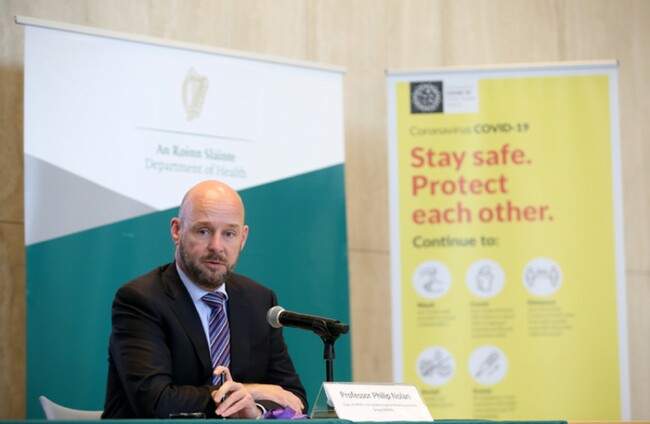
PROFESSOR PHILIP NOLAN has said that restrictions on indoor gatherings “will be with us for some considerable time” and that people will have to attend pubs in small numbers heading into winter – if and when they reopen.
Speaking on RTÉ’s Morning Ireland, Chair of NPHET’s Irish Epidemiological Modelling Group Nolan said that it is too early to say if recent restrictions permitting 6 people to gather indoors and 15 people outdoors has reduced transmission of Covid-19 but that he is “cautiously optimistic”.
However, Professor Nolan warned that – despite a stable number of daily cases since 19 August – “it needs to be lower” and cautioned that the public will need to adhere to these restrictions in the months ahead.
“This is honestly the way we’re going to need to behave coming into the winter. If and when pubs reopen we’re going to have to go to the pub in small groups and each of our small groups are going to have to remain separate,” Professor Nolan said.
“I think those group restrictions will be with us for some considerable time because they’re protecting our priorities around school, work, participation in sport, all those things that we really want to do.”
Professor Nolan was speaking after restrictions were lifted in Co Kildare yesterday evening. He said that regional restrictions are effective but that “they’re not the first defence” against Covid-19.
“What we’ve learned is we need to do it quickly,” said Professor Nolan.
“You’ve a matter of days, probably even better to count it in hours, from the time you see a major amplifying event like we saw [in Laois, Offaly, Kildare] where we go from five to 10 cases in a county to 100, 150 cases within two or three days.”
Professor Nolan said that while cases in Laois, Offaly and Kildare began to spread from settings like meat factories to within the community, recent cases of Covid-19 in Tipperary are well-explained and are confined to clusters.
Dublin, meanwhile, “is in a different position”, said Professor Nolan, due to high population density and more mobility. The capital has seen a gradual increase in cases over recent weeks, prompting concern about possible restrictions similar to Kildare.
Professor Nolan did not rule out further county-level restrictions in future but said “it’s the third or fourth thing one does when you see a rise in cases” that matters.
Nolan also defended the turnaround test time after it emerged that it took more than 72 hours in one weekend.
He said that while the team is “anxious” to bring the testing time down, the delay was caused by a large outbreak.
“The vast majority of tests right now are coming back in 24 to 48 hours,” he added.
“We do have a national target, not only to get the result back, but to have the contacts traced within 72 hours of the referral for test, which would mean the test results should be back well within 48 hours.
“I know the HSE is working extremely hard to hit that target. It’s a very challenging target, it is literally world class. So sometimes it is going to be missed, particularly if there was a big strain on the system.
“Broadly speaking, the idea to take 36 to 48 hours is a reasonable expectation for us as members of the public to expect to get our results back.
“It’s impossible really to do it much faster than 24 hours and therefore 48 hours is a good target.”

To embed this post, copy the code below on your site














have your say