Sign in. It’s quick, free and it’s up to you.
An account is an optional way to support the work we do. Find out more.
Sign in. It’s quick, free and it’s up to you.
An account is an optional way to support the work we do. Find out more.
LAST UPDATE | 3 Feb 2024
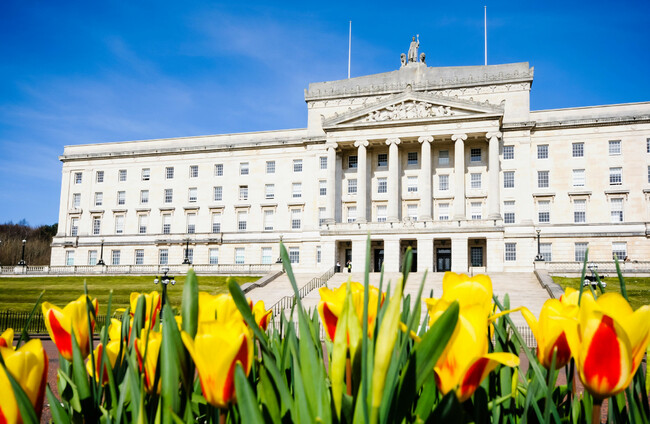
AFTER NEARLY TWO years of deadlock, the Northern Ireland Assembly is on the brink of returning to Stormont.
Sinn Féin’s Michelle O’Neill is set to become First Minister as the DUP finally agreed to stop blocking efforts to form an Assembly over post-Brexit trading arrangements.
Northern Ireland’s political parties will appoint members to ministerial roles using a method called the d’Hondt system.
How does the system work — and who might come away with a role?
The D’Hondt system, named after a Belgian lawyer called Victor D’Hondt, provides a method for allocating ministerial roles between Northern Ireland’s parties in line with principles of powersharing.
First, seats are allocated to parties based on the number of seats they won in the Assembly.
Sinn Féin won the most seats in the 2022 election (27), followed closely by the DUP (25) and then Alliance (17), the Ulster Unionist Party (9) and finally the SDLP (7).
A party must win at least nine seats to qualify for a ministerial role, so the SDLP will not take one of the spots in this Assembly. Sinn Féin will be entitled to three ministers, the DUP to two, and Alliance and the UUP to one each.
The parties will take turns to select a portfolio and a minister to fill it.
Before getting into the ministries, the parties will need to elect a Speaker to the Assembly. The DUP’s Edwin Poots is seen as a likely appointment.
The DUP will also appoint a Deputy First Minister to serve alongside Michelle O’Neill in her term as First Minister. The DUP’s leader is Jeffrey Donaldson but he is currently an MP, not an MLA. Emma Little Pengelly was co-opted to take his seat in Lagan Valley and may also now take up the Deputy First Minister role.
There are eight minister portfolios in the Assembly: Economy, Finance, Health, Education, Communities, Infrastructure, Agriculture and Environment, and Justice.
Justice is selected differently to the other roles because of Northern Ireland’s history. The justice minister will be decided through a cross-community vote.
Naomi Long of the Alliance party, who held the role in the last Assembly, is seen as a likely contender to return to the role.
Sinn Féin’s current justice spokesperson is Aisling Reilly of West Belfast – however, Sinn Féin MLA John Finucane told RTÉ Radio One this morning that it is probably “not a ministry that we will be taking up”. The DUP’s justice spokesperson is Joanne Bunting of East Belfast and the UUP’s is Doug Beattie.
It’s expected that economy and finance will be the first two portfolios snapped up in the D’Hondt process.
Conor Murphy of Sinn Féin (Newry and Armagh) held the finance ministry in the last Assembly and may be the economy minister this time around if Sinn Féin opts for it as its first choice. In response, then, the DUP’s first decision would likely be to go for the economy job, with outgoing finance minister Gordon Lyons (East Antrim) the probable contender.
The UUP and Alliance have both expressed interest in the health portfolio, which is seen as one of the wildcards of this process.
Health was a burdensome job in previous years but a recent funding boost from Westminster makes it a more attractive option for parties this time around, so it may be taken up quickly by Sinn Féin or the DUP. Paula Bradshaw, though, Alliance’s MLA for South Belfast, has said she would be interested in the health job.
The remaining roles could play out different ways depending on which parties nab which portfolios. These are the spokespeople who currently represent their parties in the areas:

To embed this post, copy the code below on your site











have your say