Sign in. It’s quick, free and it’s up to you.
An account is an optional way to support the work we do. Find out more.
Sign in. It’s quick, free and it’s up to you.
An account is an optional way to support the work we do. Find out more.
THE YOUNG WOMAN at the centre of a high-profile case against UCD sat alone in court on Tuesday as her lawyers and the university set out their arguments over the course of several hours.
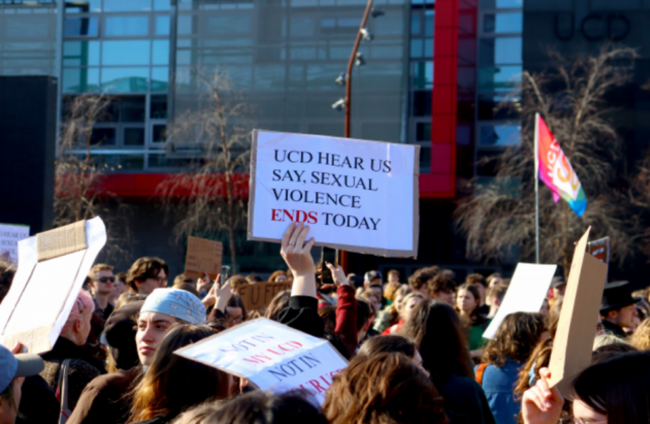
The medical student’s case has become an Irish cause célèbre, the subject of Dáil debate and widespread media coverage, and of an emotional demonstration attended by thousands of students on the UCD campus earlier this year.
The news of the woman’s alleged rape and sexual assault, and the subsequent circulation of a naked image of her and vile comments about her to UCD staff and students by email and WhatsApp, brought an outpouring of support for her from students, and calls for more supports and care for victims and tougher action against image-based abuse.
A month before this protest, the woman’s court challenge to how the university dealt with her academic struggles – including in the aftermath of her alleged rape by a fellow student, by which she became pregnant and had to seek a termination – had been roundly dismissed by the High Court.
Her distressing story resonated with and outraged college students in a way few other issues have in recent years. The perception among many was that while the university may have followed its rules correctly when it demanded that she resit six modules she failed in the academic year in which she alleges she was raped before progressing, those rules were neither fair nor right.
On Tuesday, the young woman escalated her case to the three-judge Court of Appeal. It reserved judgment following a hearing which lasted from 10.30 in the morning into late afternoon.
After leaving court following the hearing, the woman was arrested.
Her arrest pertained to alleged deception of UCD. She was held at Irishtown garda station on the south side of the city for over 24 hours, and released without charge late on Wednesday night. A file is being prepared for the Director of Public Prosecutions.
Gardaí seized electronic devices as part of the investigation, including a burner phone.
Gardaí have been examining the veracity of the woman’s account to UCD of the alleged rape and the reported termination of pregnancy, and whether it aligns with her location and activities at those times.
Her whereabouts at critical parts of the story she has told people are forming a major part of the investigation.
A separate garda investigation was initiated last year into the sharing of the image of the woman, apparently taken after the alleged sexual assault and in which she was naked and bruised. Intimate image abuse is a crime.
The Journal sets out here a timeline of this story to date. Much public discussion over the past four months has been informed by the account of the case given in the Dáil by Solidarity TD Ruth Coppinger, who campaigned strongly on the young woman’s behalf; we have dug into the available High Court information to add more detail.
The young woman’s lawyers and UCD were given opportunities to comment. We have also attempted to contact the young woman but were unable to reach her.
September 2021: The woman starts her medical studies in UCD.
All going well, she is due to graduate in the 2027-2028 academic year.
November 2021: According to the woman’s own witness statement to the High Court, she progressed without any difficulty in her first year.
However, in November 2021, she did request a meeting with someone in the school of medicine to discuss an immediate leave of absence.
February 2022: She meets the chair of her programme, called Prof S in the High Court ruling, to discuss her request for a leave of absence.
Although she had not yet accessed disability services at the college, she later said that he referred to a disability at the meeting and said she should withdraw from the degree programme.
In his evidence to the court, he denied ever having said that but during re-examination he said she had raised a disability at a meeting to discuss a possible transfer to another university. His memory was that the meeting was about ”attending and family commitments and work and all of that having an impact on her studies”, but he also said he did not have a strong recollection of the day.
After this meeting, she continues to communicate with Prof S.
Ms Justice Marguerite Bolger, in her High Court ruling, said she was satisfied that any reference by Prof S to a disability arose as a result of the woman herself initiating a discussion about academic and personal issues she was encountering in her education.
The judge found that Prof S did not demonstrate anything at any time that any reasonable person would interpret as bias against the woman.
“Prof S sought to support the plaintiff,” the judge said.
“The many emails between them that were put into evidence confirm that the plaintiff engaged positively and appreciatively with his efforts.”
September 2022: She begins her second year. She encounters “difficulties in completing her second year modules in 2022/2023″, according to the February 2026 High Court ruling.
The High Court ruling also states that in Autumn 2022 she needed to care for her mother at home, affecting her attendance at university.
December 2022: She fails three exams.
2 February 2023: She is sent a letter by the university setting out an academic plan aimed at getting her back on track.
She is appointed a mentor, called Dr G in the High Court ruling. When she meets him in February 2023 she tells him she has two full-time jobs and economic difficulties. She asks to be assessed by some means other than exam for the three modules she failed.
The High Court ruling states that there was frequent and cordial email correspondence between the student and mentor over the following months. The mentor emphasised, however, that he was not part of the decision-making process for applications for special grades.
Special grades and what being awarded them means in practice will form a big part of the woman’s dispute with UCD in relation to her academic progression.
UCD’s academic regulations set out that special grades can be approved by the programme exam board in particular circumstances or exceptional circumstances, including being medically incapacitated.
The regulations also set out the consequences of being awarded special grades.
The university’s academic regulations for 2023-2024 stated that follow-up assessment of any course component for which special grades were awarded must be completed within two trimesters of the initial attempt. The award of a special grade means no penalty will be imposed on the final mark a student can obtain when they eventually complete the assessment.
9 February 2023: The plaintiff formally applies for special grades for the three failed modules, reiterating that she wants to secure an alternative assessment method and that she spent most of the first term at work or helping her mother.
The university rejects her application for two reasons: it was submitted late, and one of the rationales given – full-time work – is not permitted as grounds for an exception to be made for a full-time student.
The High Court judge said she highlighted this and another application of the same type in her ruling because they confirmed, on the woman’s own account, that she was struggling with her education and “experiencing negative emotional wellbeing” before February 2023.
“By February 2023, she had failed three core modules, had not attended the majority of her classes in the previous term, had been given an academic plan, was assigned to an academic mentor and was looking to be assessed in a manner other than resitting the exams she had failed in December,” the judge found.
February 2023: The woman engages with the university’s disability access office to seek both classroom and examination accommodations. She was entitled to do this when she first started her course but had not done so at that stage.
Late February 2023: The woman is allegedly raped and sexually assaulted in late February 2023 by an unidentified fellow student in the year group below her.
She did not report this to gardaí and disclosed it to the university later.
In March 2026 she told the Irish Times: “I had worked so hard to get into medicine and was so focused on not letting the rape get in my way. I had no control in that situation and focusing on my studies was a way of putting control on it, putting it away in a box.”
She told RTÉ’s Prime Time in the same month: “I thought at the time and frankly I still do believe that I won’t be believed. I wanted to forget it happened and go back to my happy-go-lucky college days.”
April 2023: The plaintiff submits another exceptional circumstances application in relation to the three failed modules, again setting out the situation with her mother and the fact that she had two separate full-time jobs when she failed the three exams in December.
She says her situation affected her emotional wellbeing and her ability to study, preventing her from attending a substantial number of classes. She said she was “constantly struggling” with her education due to a disability “as well as outside influences”. She had also been under significant financial pressure during the autumn 2022 term, her application states.
This application is also refused, for the same reasons as previously.
May 2023: According to the High Court ruling, the woman says that in this time period she availed of medical services following the alleged assault. This is understood to be a reference to an abortion.
She was due to sit eight exams between 8 May and 18 May, some of which clashed with these medical services.
The woman passes two of her exams and either fails or does not attend six, which include some of the modules she had previously failed in December 2022.
That leaves six modules uncompleted, half of the total for her second year of studies, which the High Court heard was an unusually high amount.
On 24 May 2023, the woman makes a fresh exceptional circumstances claim in relation to the most recent exams.
According to the High Court ruling: “She submitted a very brief letter from her GP who said they had been informed that [she] had been recently unwell during the exam period and that [she] felt her performance was impaired by her health.”
The ruling stated that while the woman subsequently said that her GP had declared her “categorically and medically unfit” to sit her exams, this GP’s letter did not confirm any such diagnosis.
This third exceptional circumstances claim by the woman is also refused.
The High Court was given a separate letter from the woman’s GP addressed to the Department of Social Protection and dated from the same period, which set out a much more detailed account of her medical situation and the services and treatment she received at the time of the May exams.
The woman said there were GDPR reasons for her GP not giving the same amount of information to the university, and her GP confirmed in a subsequent letter the policy of the practice not to state medical conditions on sick notes to schools, colleges and employers due to GDPR.
This argument did not wash with the judge, who stated that it was up to the woman to “put her best case forward” in her exceptional circumstances application. She could have explored with her GP the setting aside of GDPR concerns by giving her permission for the disclosure of the nature of her medical condition.
“She knew or ought to have known that the university required far more detail than the brief account of her situation in May 2023 that had been previously provided by her GP and had already been found by the university committee to be insufficient for the grant of special grades,” the judge said.
“She could also have advised the committee herself of the nature of her medical condition,” the judge added.
The woman blamed her academic mentor, Dr G, and, to a lesser extent, her GP, for not having provided her with more information towards her application for exceptional circumstances. Again, this did not wash with the judge in February 2026. She did not accept this as fair or valid criticism.
“The plaintiff had been through a very distressing experience, but it remained her responsibility to process her application for exceptional circumstances that she wished to make and to ensure that the committee had all the relevant information to make a decision, including, if necessary, by sharing the nature of her medical condition with the committee and/or by consenting to her GP sharing that information with them,” the judge said.
11 July 2023: The university gives the plaintiff another academic plan requiring her to remediate some of the six modules she has not passed before proceeding to the next stage of her degree programme.
Follow-up attempts to pass modules are called “remediation” under the university’s regulations and this is a requirement that the university will hold a firm line on.
The plaintiff is unhappy with the academic plan and declines to follow it.
As a result, Prof S arranges a meeting under the university’s “fitness to practice policy and procedures”.
7 September 2023: The meeting takes place.
Prof S advises the woman they are meeting because of: her three applications for special grades; workload and progression issues; the fact that a stage of her degree programme has not been completed; the need to remediate that autumn, including two repeats; the programme board’s concerns about her learning; the need to follow academic advice (understood to be a reference to the most recent academic plan).
18 September 2023: The woman makes another exceptional circumstances application relying on a more detailed letter from the same GP which states that she suffered an unexpected illness in May 2023 which severely affected her ability to perform her activities of daily living and made her “categorically, medically unfit” to sit her exams.
The GP confirms that it is not practice policy to state medical conditions on sick notes due to GDPR concerns.
The woman’s student adviser, referred to as Ms K in the High Court ruling, submits a letter supporting the application and saying the plaintiff has explained to her why she could not attend her exams and has asked for privacy.
The woman states that she is unhappy with her academic plan and wants a new one that will allow her to progress to stage three of her course as soon as possible.
However, the board decides that because the nature of the medical condition has not been disclosed, they have no evidence on which to justify overturning the original decision to refuse special grades. At a minimum she needs to repeat one subject and resit another in the coming semester. Because the repeat would cause a clash with core third year material, she cannot proceed to stage three in this academic year.
“The plaintiff’s wish and/or expectation to progress to stage three was never viewed by the university as a realistic, viable or appropriate option for her, given her academic situation at that time,” the High Court found.
The woman later made allegations of bias in relation to the three applications which were rejected by the High Court.
Early October 2023: An academic referred to as Dr M in the High Court ruling has been appointed as a point of contact between the woman and the school of medicine in relation to the implementation of her academic plan and the need for remediation of the modules she has not passed.
The High Court ruling states that there are a “huge number of emails” between Dr M and the woman in which Dr M makes extensive effort to advise and support her, and adds that the plaintiff was left under no illusion by Dr M that the academic plan was not open to negotiation.
“Rather than engage with what she was being directed to do, the plaintiff repeatedly sought what she referred to in her emails to Dr M as ‘resolutions’ or ‘solutions agreeable to all’, misunderstanding the clear difference between directions given by an academic to a student and the right to input towards an agreed way of doing something,” the judge said.
The woman is told in early October that she cannot progress to third year because of the level of remediation required for the outstanding second year modules.
12 October 2023: Final ratification of the decision to reject the third application for special grades is pending at the standing committee of the programme board meeting on 12 October.
On 12 October, the woman informs the student adviser, Ms K, of the nature of the medical treatment she underwent in May 2023, and gives Ms K permission to disclose this to the university.
Almost immediately on this information being brought to the attention of the school of medicine and the relevant committee, her exceptional circumstances application is granted.
20 October 2023: The woman is informed that she was granted special grades in respect of the six outstanding second year modules. However, the school of medicine remains concerned about her workload in having to remediate six second year modules and is not willing to allow her to progress to third year with this work still outstanding.
Dr M has communicated with the module coordinators for each of the six modules and sends another academic plan to the woman on 20 October. This plan sets out three options for her, all of which require full or partial remediation of the outstanding six modules before progressing to stage 3.
In practice, this will change her progress through her degree programme and her planned graduation date.
The High Court found that a substantial amount of work was done to support the woman to manage her workload and try to ensure her success.
The woman’s view is that the award of special grades “rendered her immune from any workload review or any delay in progressing to stage 3 in October 2023″, according to the judge, who found this to be groundless. It also represented a misunderstanding of her rights within her degree programme and of the university’s right to ensure the integrity of her degree.
“The programme board were satisfied that the plaintiff’s traumatic personal circumstances had impacted her performance/absence during the May exams. However, that could not neutralise the plaintiff’s module coordinators’ concerns or dilute their obligations to assess the plaintiff’s achievement of the learning outcomes necessary for her progress into the next stage of her regulated degree programme,” the judge found.
The judge noted that the university must comply with regulations and with statutory requirements for international recognition.
Later in October 2023: The woman tries to register for third-year modules despite having been told not to do so.
26 October 2023: Dr M proposes a Zoom meeting with the woman, Dr G and Ms K to discuss which of the three options in the academic plan she will choose. The woman insists on having input to the plan and on progressing to third year. Later that evening, Dr M reiterates by email the need to choose one of the three options. The woman asks for more time to consider her options and is given a week to do so, and then, on request, a further 24 hours.
Around this time, the woman discloses the alleged rape in February 2023 to the university, through a doctor’s letter to the governing board in which the nature of the alleged assault is set out. The doctor stated their view that it was in the woman’s best interest to graduate on the original schedule. However, the board confirms that its decision stands, and she has to choose one of the academic plan options.
In her witness statement, the woman criticised this correspondence for being sent outside normal working hours and for not mentioning support or any route for appeal or discussion.
“Receiving such a communication so late at night, in the aftermath of disclosing (assault) to a board of unknown individuals, made me feel overwhelmed, isolated and entirely unsupported,” she said in her witness statement.
“The pressure to choose between academic plans without any flexibility or meaningful engagement with my circumstances compounded my distress.
“It felt as though the trauma I had disclosed was being administratively acknowledged but substantively disregarded.”
The judge’s assessment was that regardless of how sympathetic the school was to the woman’s circumstances – and the alleged assault was clearly very distressing for her – the school owed it to her to manage her workload and ensure her ultimate degree would be a mark of academic excellence, not an expression of sympathy.
The woman now ceases contact with Dr M for three months.
February 2024: Between February and April 2024 she repeatedly requests a meeting with Prof K, the head of the school of medicine.
10 April 2024: Prof K meets her, which the judge later sees as “further evidence of the extensive support” she is receiving from the school of medicine.
At this meeting she discloses that the alleged assault was perpetrated by a student in the year below her. This is the first time this was disclosed to a member of the academic staff; she had previously told two non-academic members of staff, who seem to have been part of the disability support service. They were bound by confidentiality.
The woman says she made the disclosure to explain why she could not agree to the terms of the academic plan.
Prof K says the school will accommodate her in any way it can by rearranging classes, tutorials or placements, although this is difficult when she does not want to identify the student in question. He also offers the option of a leave of absence.
She expresses concern that the other student could take a leave of absence or fail and fall back into her new year group. Prof K responds by saying “what if the sun falls from the sky?”.
The woman later alleges that he laughed as he made this statement. This was denied by both Prof K and by Ms K, the student adviser, who was also at the meeting. The judge said she “preferred their evidence” and it seemed that the woman “yet again interpreted a respectful disagreement with her position and view of what should happen as unfair treatment of her”.
With the woman’s permission, Prof K discloses the woman’s personal circumstances to Dr M, and Dr M re-engages with the woman by email about remediating her stage 2 exams.
11 April 2024: The woman emails Dr M seeking a meeting to discuss her academic plan.
The next day, Dr M responds that a new plan will be needed as the academic year is almost over. The woman requests remediation over the summer. Dr M says this cannot be facilitated because a bespoke professional degree cannot be created for her.
Dr M reminds the plaintiff that the special grades are being held for her but the modules in question must still be remediated within two trimesters.
The woman responds, telling Dr M she has been attending third-year modules even though Dr M had directed her to stop attending them. The student health centre had advised her to get out and engage with professors and her peers, and she had previously been advised that independent learning might be more beneficial than attending labs. She said she knew she had handled the entire situation very badly and she was “incredibly appreciative” of the ongoing support. Dr M is very concerned about the contents of this email.
18 April 2024: Dr M provides a new academic plan. The woman writes back expressing concern about the plan and stating that she wishes to take her remediation exams in May and that she is well prepared.
19 April 2024: The woman emails Ms K indicating her intention to file formal complaints about her treatment by a number of academic staff and alleging discrimination and bad faith.
25 April 2024: Dr M and the woman meet, with Ms K also present. The woman had emailed Prof K, the head of the school, three days earlier saying it was essential that he attend, but he declined. Ahead of the meeting she had also asked if she could bring the president of the students’ union. Dr M declined, but the woman brought the president of the students’ union anyway. As a result, the meeting did not proceed.
Late April 2024 – May 2024: There follows more email correspondence. The woman sets out again to Ms K that she wants to discuss her academic options rather than having a plan emailed to her. She wants to speak to module coordinators individually, and she wants Ms K to involve two other academics in the discussion as they might help to ensure her voice was heard. Ms K declines to act as a go-between and the woman’s correspondence with Ms K comes to an end.
On 13 May, she is offered a meeting with Dr M and Ms K to discuss the academic plan but again asks to be accommpanied by the president of the students’ union and by a representative of the university’s disability support service. This meeting does not take place.
Dr M susbsequently reminds the woman that the coordinators of two of the outstanding modules had requested that she reattend the modules. The woman says she had been awarded special grades and, as she set out in her witness statement, “the module coordinators did not have the authority to compel me to reattend”.
In her witness statement, student adviser Ms K later said: “It just seemed that every option that was being given, if it wasn’t what [the woman] wanted it wasn’t going to work. I just wanted her just to pass, just do the exams, pass them, focus on them [rather] than trying to get a bespoke programme that wasn’t really possible.”
June 2024: The woman begins to correspond with the university’s disability support services claiming she had not received supports to which she was entitled. She makes a range of requests. The director of the service later gave evidence that when she was offered what was requested, she did not respond and there were no further asks.
June-August 2024: The woman lodges complaints under the university’s dignity and respect policy against Dr M, Prof K and Prof S in June 2024 and August 2024.
On 15 July Prof K dismisses her complaints; she is advised she can make a further complaint but because the High Court case is by then underway that internal process is paused.
In late July, a Prof G is appointed as liaison person between the woman and the school, and proposes that the six remediation exams could be taken in September 2024. In August, the woman declines to meet Prof G to discuss her academic plan because it is now at issue in the High Court proceedings.
30 July 2024: The woman commences her High Court action challenging the university’s imposition of an academic plan on her in October 2023 having accepted her exceptional circumstances application and awarded her special grades.
She contends that she is entitled to a prompt opportunity to progress to third year despite not having remediated her second year modules, and also to register for fourth year.
It is noted in the course of the subsequent High Court ruling that she has also taken a case against the university under the Equal Status Act at the Workplace Relations Commission pleading that the university acted unlawfully in “causing and/or allowing and/or permitting the plaintiff’s disability supports to be blocked in [academic year] 2023/2024 and when it was, in all of the prevailing circumstances, unreasonable to do so”.
September 2024: By now much of the correspondence with the university is undertaken by the woman’s solicitors. There is back and forth about the exams scheduled for her for 16-25 September.
Her solicitors send a 10-page letter setting out requirements including registering her for third year of study backdated to 2023 and allowing her to register now for fourth year.
The university provides reassurances that the material to be examined in September will be the same as it would have been the previous academic year, and that reasonable accommodations for her have been put in place. The disability support service confirms it is satisfied the student has access to the materials she needs.
Her solicitors continue to take issue on both of these matters and further demand classroom accommodations, despite the fact that this would not have been needed to complete the exams. They express concern that lecture or tutorial notes or slides could have changed from year to year.
The woman also indicated she was reluctant to take the exams at this point because she did not have access to tutoring, part of her classroom reasonable accommodations. When the disability support service offered to fund tutoring ahead of the exams, she rejected the offer because she did not believe their approach was “grounded in policy”. The support service wanted to liaise with Prof G and she wanted them to liaise directly with module coordinators.
The judge noted that the student had repeatedly claimed to be ready, willing and able to sit these exams. The judge concluded: “The plaintiff’s stated excuses for not availing of the opportunity afforded to her to sit six remediation exams in September 2024 on the 2022/2023 materials, are entirely unconvincing and groundless in fact.”
9 November 2024: A “Gilchrist” or anonymity order is granted in respect of the court proceedings. UCD does not seek costs as they relate to the Gilchrist order. In her later High Court ruling, Ms Justice Bolger says these will “include half of the costs of the proceedings before the court on 23 January 2026″.
Late 2024 – February 2025: The High Court ruling states that the woman says she became aware of disturbing messages about her on a class online group in late 2024, including references to her alleged assault, and in February 2025 she received a highly offensive email with images attached.
9 April 2025: The university sends a proposal for the woman to sit the six remediation exams between 3 May and 19 May 2025. They have had to obtain internal derogations to allow this. Her solicitors respond two days later with a holding letter.
22 April 2025: Over 170 academic staff and students receive a graphic photo of the woman. She is naked, bruised and lying face up across a bed. The photo is sent from an anonymous, encrypted Proton account.
The woman later tells the Irish Times that her life was shattered when she saw the photo in that week in April, and she sat in her room and cried.
“No-one in UCD even lifted the phone to see if I was alive,” she later tells the Irish Times.
She told Newstalk this year that no-one from UCD reached out to her for over a week.
She said in her evidence to the High Court that after the sending of the photo in the week of 21 April 2025 she did not think about the remediation exams that were scheduled for her for the following month. She described that time as “a horrific month”.
UCD reports the sending of the image to gardaí the next day.
25 April 2025: Gardaí speak with the woman about the image abuse that has been reported to them.
She later told RTÉ’s Prime Time the first time she became aware of the image was when she was contacted by gardaí. The guards tell her UCD is going to block the email server so there will be no more emails.
7 May 2025: Four days after the woman’s proposed exams were due to begin, her solicitors respond to the university, setting out various reasons why she cannot sit them and reiterating many of their previously made arguments. There is no mention in this letter of the woman being unable to sit the exams because of the image-based abuse. There was no medical certification of unfitness to sit the exams, the judge noted.
The woman later tells the court: “It was an incredibly distressing time, I don’t think there was a need to lay out exactly what happened.”
The judge did not find her reasons for not sitting these exams to be “convincing or acceptable”.
June and July 2025: The woman was emailed the photo to her UCD account about 10 times in June and July, she later tells Prime Time.
November 2025: The same image is sent into a 300-member UCD students’ WhatsApp group, accompanied by deeply offensive language about the woman. The Journal understands that the image and the offensive comments are sent together (as opposed to other people in the group making offensive comments on the photo).
The messages are sent from an unknown number. It is generally possible to join a WhatsApp group using an invite link or QR code. These can be generated by any administrator of a WhatsApp group. In many WhatsApp groups all members are administrators.
A February 2026 report in the UCD student newspaper, the University Observer, indicates student representatives complained to UCD authorities at some point after this, criticising what they perceived as the university’s inaction.
“This group chat was made quite recently, so that it is evident that someone within it (i.e. a current UCD student ) is sharing the link,” the email from class reps stated, according to the newspaper.
The class reps’ email further states that UCD has failed the victim and its students by its “inaction” since the last attack, adding that it is “extremely disturbing” that no-one from UCD has contacted the woman. She found out about both incidents from class reps, the email states.
January 2026: The image is sent to another student group chat.
3 February 2026: The High Court issues its ruling against the student in her case against UCD, finding against her on all her grounds.
“What happened to the plaintiff between February and May 2023 was deeply traumatic for her and, in her own words, her life fell apart. Once the university was told in October 2023, they responded fairly and sympathetically and immediately recognised the impact that those events had on her ability to attend or pass her May 2023 exams,” the judge says.
“It will be a matter for the university to decide how or if the plaintiff will be allowed a further opportunity to remediate her outstanding modules and/or progress to the next stage of her degree programme.
“The plaintiff is a talented young woman with her life ahead of her and it is to be hoped that she will avail of whatever opportunities are given to her, if any.”
10 February 2026: Ruth Coppinger raises the case in the Dáil in the course of a debate on AI deepfakes.
She sets out the initial sharing of the image and the offensive messages, and what she characterises as insufficient action by the university to prevent it being shared on two further occasions.
She says more information about safeguarding should have been sent to students. She claims the university has “never had a proper meeting with the victim” and claims no compassion or real sympathy had been shown to her. She calls on the head of UCD to meet the woman.
12 February 2026: The University Observer, the UCD student newspaper, publishes an article based on Coppinger’s Dáil statement, and an email sent by a class representative to UCD authorities after the image was sent to a student group chat in November 2025 (as described above).
It had been working on the story about the circulation of the images for a number of months, but had been sent a legal letter by UCD when it sought comment from university authorities. UCD has been asked for comment on this by The Journal this week.
Coppinger’s account of the case in the Dáil is covered by parliamentary privilege, meaning protection from being sued for defamation or otherwise prosecuted over statements made. This protection extends to media outlets repeating claims made in the Dáil and facilitates the student newspaper and other media to cover the story.
The story reverberates on campus, and is viewed by tens of thousands of people on the newspaper’s social media.
The university tells the paper it cannot comment on individual cases but it has a zero-tolerance approach to bullying, harassment, sexual harassment and sexual misconduct and takes these matters and the safety and wellbeing of its students very seriously.
25 February 2026: Ruth Coppinger raises the case in the Dáil again.
She says UCD is preventing the woman from continuing her degree and asks what can be done to make the university allow her to complete her degree as soon as possible.
“As a result of being raped, she became pregnant. She had to have a termination and missed some of her medical exams due to having to schedule that. She asked UCD if she could resit her exams over the summer but UCD said no.
“It attempted to make her drop back a year, into the year in which her rapist was also a student. She was then forced to take High Court action to try to stop UCD putting her into the assailant’s year.
“UCD fought the case, won and, two weeks after the second case of image abuse against her, it pursued the rape victim for a couple of hundred thousand in costs against her,” Coppinger tells the Dáil.
UCD has been asked for comment on this legal costs claim.
Minister for Public Expenditure Jack Chambers of Fianna Fáil, responding on behalf of the government, says he has seen the reporting on the case and “it is shocking what that particular student experienced”.
He says UCD should work with a student who has had experienced such “shocking circumstances” and he calls on the university to work with her to allow her to complete her studies.
“She has gone through enough,” he says, twice.
3 March 2026: Ruth Coppinger raises the case in the Dáil with Taoiseach Micheál Martin. Coppinger says she has spoken to other students who have been victims of sexual assault at UCD.
The Taoiseach says he is not familiar with the case but will ask his officials to contact UCD.
“Absolute priority must be given to a victim of gender-based and sexual assault,” the Taoiseach says.
That afternoon, the judge alters the anonymity order on the High Court ruling to allow it to be linked with UCD.
On the evening of 3 March, an interview with the student is aired on RTÉ’s premier current affairs programme, Prime Time, in which she describes her extensive injuries following the alleged sexual assault and explains how she found out from gardaí about the circulation of the image, which she says she had not known was taken.
The broadcast includes the words which were circulated with the image including: “She’s a filthy lil pussy ass needs to tie a noose around her throat and her wrists slit” and “the dirty lil tramp is still roaming around UCD, get rid of the nasty lil whoooore”.
The woman says gardaí have not been able to identify who was behind it and the university has not made any attempt to investigate. She says she feels abandoned by the university she trusted to protect and support her.
UCD has given a statement to Prime Time saying it is supporting gardaí with their investigation. The university says the person sending the messages went to great efforts to circumvent the measures put in place to block them and remain undetected. The university says the young woman has had access to a wide range of supports.
4 March 2026: Thousands rally at UCD in support of the woman, with students chanting “not in our UCD” and “UCD, shame on you”. Speakers at the rally include a representative of the Dublin Rape Crisis Centre who urges victims to seek support. Students call for stronger policies against gender and sexual based violence, and in support of victims, with input from students.
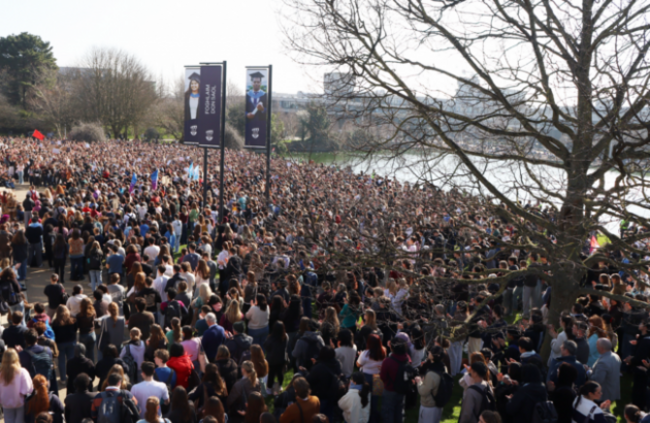
As reported by the Irish Times, UCD president Orla Feely sends a message to staff saying the university does not know the identity of the perpetrator(s) and cannot progress an internal investigation that could prejudice any future criminal case and prevent justice being served.
She says there is no evidence the offensive messages have been further circulated by students or staff, except to gardaí.
5 March 2026: Ruth Coppinger asks Minister for Health Jennifer Carroll MacNeill to use her influence with UCD’s school of medicine to ensure the student can complete her medical degree on the original timeline.
The minister says the Medical Council, the doctors’ regulator, is aware of the case and “actively engaging with the associated parties to get more information”. She says she expects the regulator to make full use of its inspection powers as they apply to training sites, adding that her officials are engaging with it.
The minister says she is certain UCD will fully support the young woman to succeed in her course. She expresses confidence in the university president.
She praises the previous day’s student protest as a “statement against gender-based violence in any context and in support of a vulnerable woman who should not have to deal with this”. She says incidents of sexual and gender-based violence should be reported to gardaí.
21 July 2026 The woman’s appeal against the High Court’s dismissal of her case against UCD is heard at the Court of Appeal.
The court reserves judgment and Mr Justice Donald Binchy urges both sides to try and resolve the dispute in the meantime.
The woman is arrested.
With reporting by Niall O’Connor and Andrew Walsh.

To embed this post, copy the code below on your site















have your say