Sign in. It’s quick, free and it’s up to you.
An account is an optional way to support the work we do. Find out more.
Sign in. It’s quick, free and it’s up to you.
An account is an optional way to support the work we do. Find out more.
THE IRISH ECONOMY grew by 5% last year when using a “deglobalized measure of economic performance” called Gross National Income (GNI).
This metric has been used since 2017 and excludes the distorting effects of multinationals to give a more accurate picture of the Irish economy.
However, the economy shrank by 5.5% when measured against the commonly used Gross Domestic Product (GDP).
The figures were released today by the Central Statistics Office (CSO) in its annual national accounts results for 2023.
Gross National Income (GNI) is an indicator designed to exclude globalisation effects from disproportionately impacting Irish economic results.
Gross Domestic Product (GDP) meanwhile is a measure of Ireland’s total economic activity that counts money that is made here but does not stay here.
It includes profits that are generated in Ireland but then go straight out to the owners of companies abroad.
GNI differs from GDP in that it excludes the net profits of companies that have been sent abroad.
When using the GDP metric, the economy contracted by 5.5% and this was driven largely by a 13.8% fall in export of goods.
The CSO said this fall in GDP last year followed strong growth of 9.4% in 2022 and 13.6% in 2021.
Last year was also the second year in a row that Ireland’s GDP exceeded €0.5 trillion.
However, the Irish economy can be measured against yet another metric, that of Gross National Product (GNP).
GNP is a measurement that excludes the profits of multinationals and is similar to GNI – it rose by 5.5%, slightly more than the 5% rise of the GNI metric.
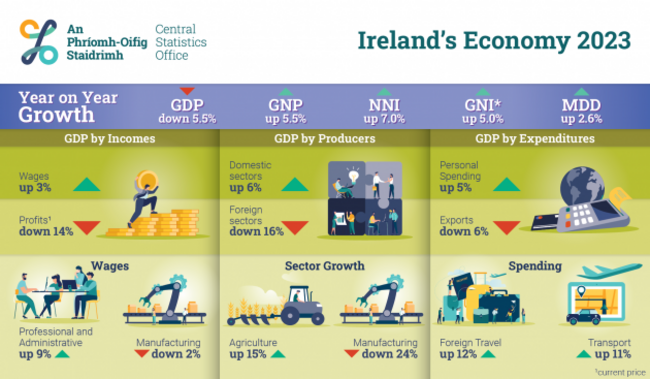
Meanwhile, Modified Domestic Demand (MDD), a broad measure of underlying domestic activity that covers personal, government and investment spending, rose by 2.6% last year.
Elsewhere, the Agriculture, Forestry & Fisheries sector grew by 14.8% last year, while the Financial and Insurance sector grew by 14.1% and Real Estate Activities increased by 10.9%.
However, the Construction sector fell by 2.9% and the Distribution, Transport, Hotels and Restaurants sector posted a decline of 1% last year.
Speaking today, newly appointed Finance Minister Jack Chambers said the figures “confirmed strong growth in the domestic economy last year”.
He also noted that consumer spending was up 4.8% despite “significant inflationary pressures”.
Meanwhile, Chambers brushed aside a fall in GDP and said it is “not a useful measure in assessing the living standards of domestic residents, given the outsized role the multinational sector plays in our economy.”
He said the decline in GDP “reflects the volatile nature of multinational production”.
Chambers pointed to the pharma sector by way of example and remarked that Ireland was a “major hub” for the production of vaccines and therapeutics during the pandemic, which drove export growth and GDP.
“With the pandemic firmly in the rear-view mirror, these exports eased back, causing a negative drag on exports and GDP,” said Chambers.
He added that the “Covid-effect is now washed-out of the data” and pointed to an estimated 0.7% increase in GDP for the first Quarter of 2024.

To embed this post, copy the code below on your site















have your say