Sign in. It’s quick, free and it’s up to you.
An account is an optional way to support the work we do. Find out more.
Sign in. It’s quick, free and it’s up to you.
An account is an optional way to support the work we do. Find out more.
THE INTERNATIONAL MONETARY Fund chief has urged the EU to speed up the completion of legislation to allow the Irish public to be customers of European banks in the future.
Cross-border European banking makes up the final part of the EU’s Banking Union, which standardised the regulation and monitoring of lenders following the 2008 financial crash.
It has been operating relatively successfully for nearly two decades and the European Commission has sought to expand the policy out to smaller lenders and institutions in recent years. With that, it leads to a more integrated banking sector in Europe.
Speaking in Washington D.C today, the IMF’s Kristalina Georgieva voiced support for the completion of the European Banking Union during a speech which detailed the extreme levels of uncertainty of the current global economy.
The IMF Managing Director warned that every country needs to get their own house in order to offset negative financial impacts of the upheaval of trade policy and that standardised banking policy across the EU was needed to boost growth and resilience.
Some European countries have pushed back on the idea of integrating banks.
Germany most recently argued, during a dispute over the merger of Italy’s UniCredit and Frankfurt’s Commerzbank, that the acquisition threatened its economic stability and that an Italian financial crisis could lead to Berlin’s federal budget being slapped with a bail-out bill.
The EU and other economic experts argued that that was the whole point of the union however. Professors Phedon Nicolaides and Alessandro Cuomo from Maastricht University in the Netherlands highlighted that increased, cross-border regulation would also come with higher levels of security for customers and an integrated support system.
Speaking this afternoon, Georgieva said Europe needs to strip back fiscal rules, similar to how Germany has done for defence spending in recent weeks, and cut back on red tape around internal trade between EU member states.
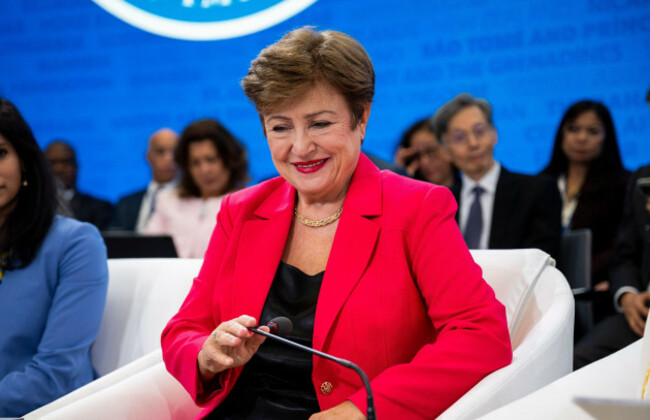
The IMF boss, who is currently serving her second term, said that this would help to boost internal economic growth within Europe and the single market’s resilience. She added that the strength of the global economy is being tested under threats of tariffs.
Georgieva also voiced agreement on the need for a Capital Markets Union which would give smaller businesses in Ireland greater access to funding from investors based elsewhere in Europe, and is heavily supported by Ireland and France.
The implementation of the Capital Markets Union and Banking Union also feature heavily in two major economic policy documents which are currently influencing how the EU manages, diversifies and strengthens its single market.
Former European Commissioner Mairead McGuinness was in charge of overseeing the implementation of both policies but the work was disrupted as a result of Brexit, the global pandemic and the war in Ukraine.
The Journal previously reported that McGuinness sought to prioritise these policies within her portfolio so that her successor, Portugal’s Maria Luís Albuquerque, could progress the work.
Meanwhile, Georgieva also indicated that the global economy will most-likely not face a recession this year as a result of tariffs from the US and other countries.
During her speech, she also sought to give some credence to US President Donald Trump’s opinions on global trade markets.
She said that it was common for people to feel that globalised trade was “unfair”, particularly when it results in the loss of jobs, impacts economic growth and the widens trade imbalances between countries.
Georgieva added, however, that the imposition of tariffs by countries such as the US, China or EU will have the worst impact on emerging markets from developing countries – as those blocs serve as the three largest global trading partners.
Additionally, she said, negative perceptions of the global trade economy are fueling increases senses of uncertainty which is leading to paused investment decisions, delayed consumer purchases and slowing down economic growth as a result.
Though Georgieva ruled out the possibility of a recession this year, all markets should expect “notable markdowns” in their economies – which may disrupt future budgets. She advised policy makers to uphold the independence and advice of Central Banks.

To embed this post, copy the code below on your site














have your say