Sign in. It’s quick, free and it’s up to you.
An account is an optional way to support the work we do. Find out more.
Sign in. It’s quick, free and it’s up to you.
An account is an optional way to support the work we do. Find out more.
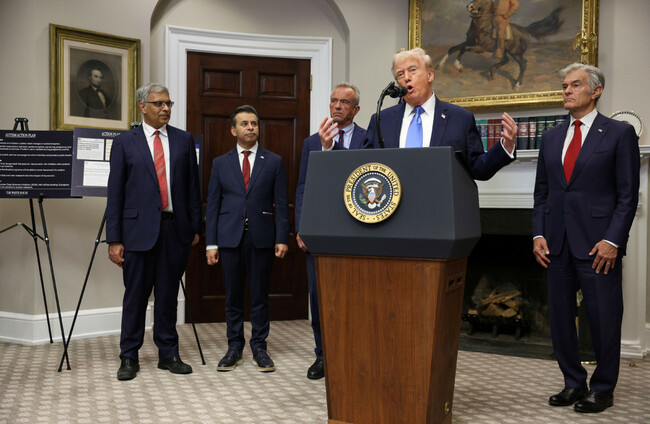
MEDICS, SCIENTISTS AND autism campaigners in Ireland have today pushed back on the claim US President Donald Trump made that the pain reliever Tylenol is strongly linked to autism as a causation factor.
There is no evidence that Tylenol (which is a brand name for paracetamol) usage in mothers causes autism in children.
Trump told the US nation yesterday that pregnant women should “fight like hell” to only take Tylenol in cases of extreme fever.
He said that the drug was “no good” and that there is “no harm” in not taking it.
At one point Trump said that autism is “among one of the most alarming public health events in history”.
“Autism rates have surged by much more than 400%,” the President said, while he claimed that in some areas of America “one in 12” boys are being diagnosed with autism.
He also claimed that there are no autistic people within the Amish population of America.
Trump talked about an “epidemic” in autism in children, while a medic who spoke at the conference at one point said “children with autism are hard to watch”.
The CEO of AsIAm, Adam Harris, today told The Journal that he was “horrified” by the press conference, and that it seemed to be a “concerted effort to bring us thirty years into the past when it comes to acceptance of autism.”
Harris said that we heard repeated last night several “debunked theories of autism” that were sometimes not even based on any medical knowledge, but rather “the President’s own personal views”.
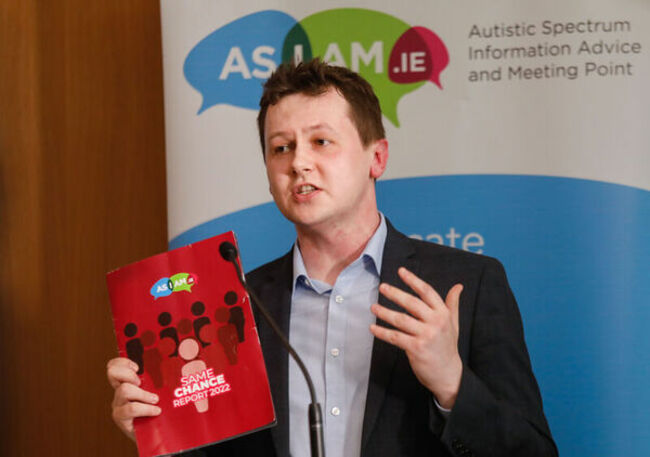
He also said that much of the language used during the conference was “ableist” and framed autism as a “disease that needs to be cured”.
“This is a man who previously advised us to inject bleach into our bodies during the Covid-19 pandemic, and a man who has mocked disabled journalists at his press conferences.
“I think what’s really important now is that we address the President’s framing of autism as something that needs to be fixed. That, of course, is not how we should see autism.
“Autism is a natural variation in human neurology, and autistic people are often disabled by environmental and societal factors within our society.
“There are obligations on us as a society to put the focus on asking the important questions, like, why do autistic people have such poor mental health outcomes? Why do we enjoy a shorter quality of life? Why are so many autistic people unemployed? That should be the focus of political leaders,” Harris further said.
Taoiseach Micheál Martin today said that he is not aware of “any evidence base” that support Trump’s claims.
“What we have learned is a wide spectrum, it’s not one specific condition,” he said.
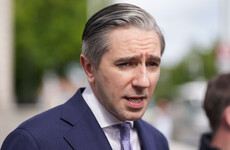
Tánaiste Simon Harris also spoke in reaction to Trump’s claims today.
Harris, who is currently in the US, said “vaccines save lives, vaccines are really really important to public health, and vaccines don’t have any causal link to autism.”
“I think it’s a concerning development, we’ve got to follow the science here. We’ve worked really really hard as a world to promote vaccination,” he added.
Trump warned parents about having their children vaccinated – repeating claims that stem from a piece of medical research that linked vaccines as a causation factor for autism, which has been definitively debunked by the World Health Organisation, and widely condemned as an unethical piece of medical research.
“Don’t let them pump your baby up with the largest pile of stuff you’ve ever seen,” he said.
He advised parents to “break it up” and go to the doctor for multiple visits, over multiple years, in order to complete their child’s vaccinations.
World experts in medicine and research have reacted to the claims today, including those based in Ireland.
The official HSE advice is that paracetamol is “safe to take in pregnancy” and while breastfeeding, at recommended doses.
“Take the lowest dose of paracetamol that works for you for the shortest possible time,” the official advice says.
Today the HSE told The Journal: “There is no new evidence that would require any changes to the current advice. No connection between paracetamol and autism has ever been established”.
The Irish Medical Organisation (IMO) today said that the claims Trump and his Health Secretary Robert F Kennedy made today linking autism to vaccines and mothers’ paracetamol usage are “demonstrably false and hugely irresponsible”.
The organisation said that the comments also pose a “real threat to public health”.
“There is no scientific evidence to suggest that paracetamol usage while pregnant is linked to autism in children, and this assertion does nothing but undermine pregnant women’s confidence in the medical system for no justifiable reason at a particularly vulnerable time in their lives,” the IMO said.
The organisation said that Trump’s comments on vaccines were particularly regrettable in a time when Governments around the world are trying to promote a further uptake of vaccination programmes.
Irish scientists have also reacted to Trump’s claims.
Dr Jeffrey Glennon, the Assistant Professor at University College Dublin’s School of Medicine today said that autism affects around 1 in 100 people in Ireland, with autistic traits occurring in 1 in 65.
“There are media reports that use of paracetamol (also known as acetaminophen) during pregnancy may constitute a risk factor for autism spectrum traits. This is incorrect,” he said.
Dr Glennon said that a recent large scale study by both Swedish and US researchers in 186,000 people showed no link between paracetamol use by mothers and autistic traits in their children.
That study was funded by the US National Institute of Health in 2024.
“What makes this study convincing is that researchers examined registry data for 2.4 million Swedish-born children between 1995 and 2019. They then combined the prescription register and reports to midwives during pregnancy to study nearly 186,000 children whose mothers were treated with paracetamol.
“These children were compared with their own brothers and sisters in cases where the mother had not been treated with paracetamol when she was pregnant with them. They concluded that there was no evidence of a link between maternal paracetamol use and autistic traits,” Dr Glennon further explained.

To embed this post, copy the code below on your site














have your say