Sign in. It’s quick, free and it’s up to you.
An account is an optional way to support the work we do. Find out more.
Sign in. It’s quick, free and it’s up to you.
An account is an optional way to support the work we do. Find out more.
EVER SINCE THE Journal started back in 2010, our readers and their thoughts have been fundamental to our coverage of the news. Here’s what you’ve been saying to us this week. Have something to say? Send a mail to letters@thejournal.ie. You can see our letter guidelines here.
Dear Editor,
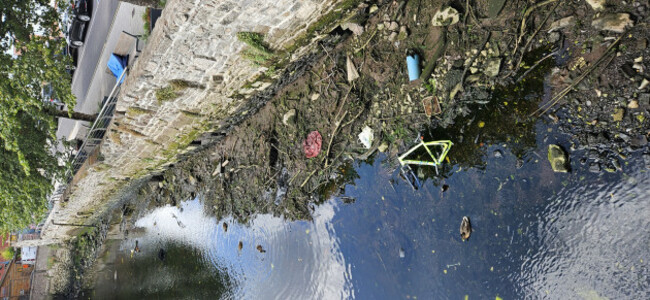
In Cork city centre, it is extremely sad to see large amounts of rubbish littering the riverbed stretching from Hanover Street social welfare office and Wandesford Quay to beyond the new footbridge leading to Crosses Green.
Multiple traffic cones, roadworks signs, glass bottles, unused plastic pipes, bicycles and bicycle frames, trolleys and assorted domestic rubbish currently litter the riverbed.
This mess poses a threat to wildlife and marine life. Build-ups of debris also increase the risk of flooding. Cork City Council urgently need to clean out the riverbed and should regularly inspect the riverbeds in Cork city centre.
Furthermore, I would appeal to gardaí to consider installing CCTV on Crosses Green to deter illegal dumping into the river and anti-social behaviour. There is currently no CCTV camera covering Crosses Green or the new footbridge from the Crosses Green side.
Shane O’Sullivan,
Cork City
[Gavan Reilly: €288k is the Skyclarys asking price, but what is the cost to patients of waiting?]
Sir,
The HSE’s decision to reimburse Skyclarys (omaveloxolone) for people with Friedreich’s ataxia is welcome news. It matters far beyond the roughly 200 people in Ireland who will now be able to access the first licensed treatment for their condition.
We did so in this case because the road to this decision exposed real challenges with how Ireland’s reimbursement system incorporates unmet medical need and manages uncertainty when assessing and reimbursing rare disease medicines. The lack of transparency means that these weaknesses that will recur unless they are addressed.
Patients and families campaigned publicly for over two years for access to this medicine. One person took the extraordinary step of seeking a judicial review of the HSE’s handling of the process. The fact that patients felt they had no choice but to protest and litigate to access a licensed medicine that is available in other European countries should give us pause.
Ireland remains among the slowest countries in Western Europe to provide access to rare disease medicines, and still has no formal early access scheme for them. Were such a scheme to exist for Skyclarys, these patients might not have watched the long, drawn-out process from the sidelines while their health continued to deteriorate.
The Programme for Government and Ireland’s National Rare Disease Strategy 2025–2030 both commit to earlier reimbursement and early access schemes for rare disease medicines. Urgent reform incorporating learnings from this Skyclarys experience must now be the priority. We need a predictable pathway that does not require patients to fight this hard, for this long, every time.
We thank the HSE and the Minister for Health for reaching this conclusion, and thank especially the patients and families whose advocacy made this outcome possible.
Vicky McGrath
Chief Executive
Rare Diseases Ireland
[The Journal Friday Newshound Quiz]
Hi there,
Just wanted to say much I enjoy your quizzes on The Journal. I share them with my son who lives in England and we both give them a go, sharing our results. It’s ‘our thing’ and I love that!
Please keep them coming…
Louise Healy,
Dublin
Would you like to have a letter published? See guidelines for submission here.

To embed this post, copy the code below on your site









have your say