Sign in. It’s quick, free and it’s up to you.
An account is an optional way to support the work we do. Find out more.
Sign in. It’s quick, free and it’s up to you.
An account is an optional way to support the work we do. Find out more.


In Politics by Numbers, broadcaster, author and spreadsheet stan Gavan Reilly takes a data deep dive into a political point of the week.
IT IS HARD not to feel some empathetic joy at the images, in the last few days, of Friedreich’s Ataxia patients learning the HSE will cover the cost of a drug to slow its path. Skyclarys cannot cure their condition but can at least patients resist the progressive damage to their peripheral nerves.
In medicine, the phrase ‘time is muscle’ was originally coined in relation to heart attacks – the longer that blood flow is impeded, the more tissue of the heart dies. But for those with Friedreich’s Ataxia, and other degenerative conditions like muscular dystrophy, it has a different meaning: the quicker they can access drugs to slow the progression, the more muscle mass they can retain. Treatment delayed is treatment denied.
Dr Suzanne Crowe wrote eloquently here last week about the sprawling bureaucracy and impaired transparency behind the approval of new drugs like Skyclarys (or omaveloxolone, to give it its scientific name). The events of the last week – albeit with a satisfactory outcome for those who need the drug to prolong any quality of life – will certainly illustrate that Ireland’s is a system which knows the price of everything and the value of nothing.
For the record, those in the inner workings of the health service insist that many aspects of the long, drawn-out process of reimbursing Skyclarys were not of their own making. The patients’ fight to access the drug has been a two-year battle, but the manufacturer, Biogen, only listed its €288,000-a-year asking price to the HSE in May of this year. A cost-benefit analysis couldn’t have started any sooner.
Even that step could come only after a lengthy over-and-back where the process was stalled for 10 months while (HSE sources say) the manufacturers pulled together the information needed for a decision – and though this might duplicate the process of other countries, because the manufacturer has to apply for the HSE to use it in the public system, the onus is on them to provide the paperwork. (This also explains why the 180-day turnaround, required in law, is often missed: until supplementary information is granted, an application is considered incomplete.)
Indeed, the events of the last few days suggest that, through the gimlet eye of an accountant, the system worked exactly as intended. Biogen named their price; the HSE publicly said no; Biogen came back with a “substantially” reduced offer, and the deal was done. This is not unique: political estimates are that the cost of new drugs approved for reimbursement in 2025 was haggled down by over 60% as the cost-bartering process runs its course.
The newly lowered price charged by the manufacturers hasn’t been divulged to the public, on the grounds of commercial sensitivity. The laws of supply and demand mean drug companies can charge different amounts in different markets, depending on the number of prospective users and the depth of their government’s pockets. That means 27 possible prices across the European Union, and with nobody knowing for sure how their market’s cost compares to anyone else’s.
What the Skyclarys campaign has highlighted, however, is how this process is fundamentally not designed for a world in which people have a vested interest in the outcome.
The minutes of the HSE Drugs Group – which are all published online, albeit a month or two after the fact – offer a useful insight into the sort of decisions usually made. The vast majority of drugs considered by the group are for conditions that already have drug treatments available, or where the new drug is complementary to others or has more niche application.
Indeed, the minutes of the July meeting where Skyclarys was first considered make another fleeting point: that reimbursement could not be recommended at that point “on the basis of the available clinical evidence” as well as its price. Yes, the drug had already been licensed by the European Medicines Agency, but that body does not assess whether a drug is especially effective –merely whether it’s safe to take. Ireland’s domestic assessment of whether the drug works is a different issue.
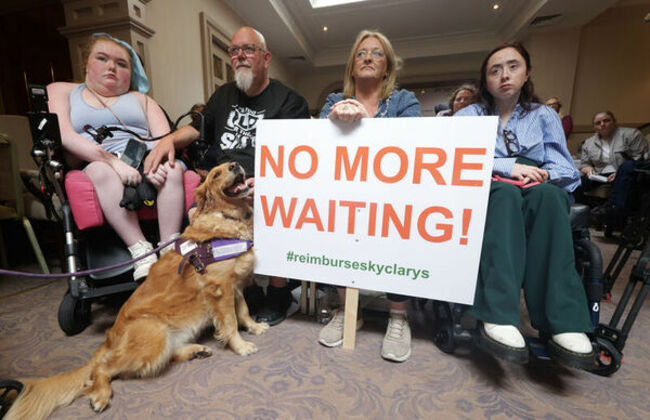
The calculus was different for the group in this case because there was no other licensed therapy for the condition, and that treatment otherwise amounts to symptom management. This highlights how the example of Friedreich’s Ataxia is a rare one: it is so unusual for the clinicians on the group to have to consider an application while a group is gathered, figuratively waiting right outside the door, desperate for a green light to access it themselves.
One other item in the minutes suggests how the system is not designed for public engagement or consumption. The HSE does, in fairness, operate a portal that allows interested members of the public to follow the process of a drug’s approval… but it’s, unequivocally, not a user-friendly experience. One would have to know the manufacturer’s application number – which appears only to be published when the Drugs Group has already made its decision – simply to be able to search and see where the process sits.
Ireland’s structures to determine whether the public should cover the cost of a drug, are not designed to be public facing. The law setting out the process was adopted in 2013, long before the Covid-19 pandemic suddenly meant society was much more interested in the process of approving new drugs (a process which might also have led people to think the EU controls the process of buying medicines; it doesn’t, and the vaccines were a bulk-buying aberration).
It is, in effect, an industrial system designed only for industrial users. It is not equipped to deal with, and does not communicate for the benefit of, ordinary people whose quality of life materially hinges on the outcome of their decisions. The work of groups like Ataxia Foundation Ireland means more people are invested in the process and its outcomes –and that it is simply unfair that vulnerable, desperate people must learn the jargon of the State to navigate complex processes.
The world will keep turning, and the HSE’s Drugs Group will continue meeting monthly to consider the costs and benefits of buying other novel medicines that will change somebody’s life in the future. Nobody can know when science will deliver another drug that can dramatically improve people’s lives in the here and now. But whenever that drug emerges, patients will deserve better than the same jargonism that prevails today. If it remains, something will have gone wrong.
Gavan Reilly is the Political Correspondent for Virgin Media News and the host of Monday with Gavan Reilly, which airs every Monday at 10pm on Virgin Media Play and Virgin Media One.
To embed this post, copy the code below on your site














have your say