We need your help now

Support from readers like you keeps The Journal open.

You are visiting us because we have something you value. Independent, unbiased news that tells the truth. Advertising revenue goes some way to support our mission, but this year it has not been enough.

If you've seen value in our reporting, please contribute what you can, so we can continue to produce accurate and meaningful journalism. For everyone who needs it.

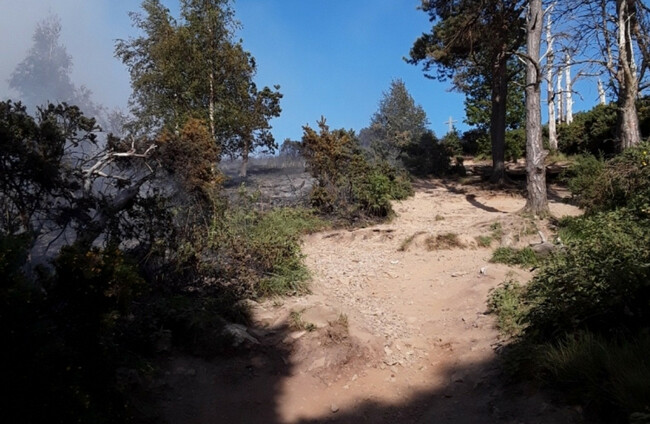
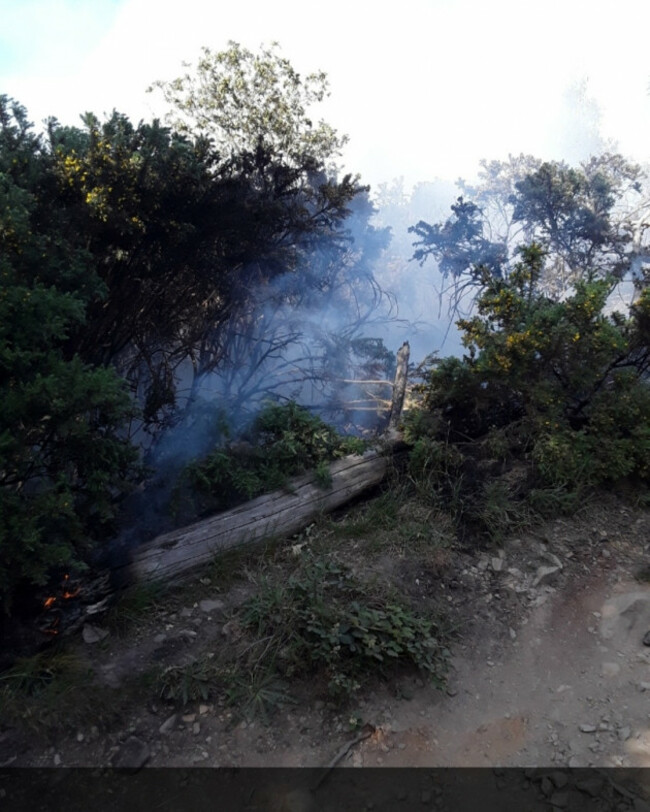
The fire at Bray Head. Wicklow Fire Service

Ireland on fire Climate breakdown and wildfires go hand in hand, and we're woefully unprepared

With hill fires devastating habitats in Ireland in dry spells, we need tougher enforcement, restored peatlands and a new approach to managing our uplands, writes Pádraic Fogarty.

THE HOT DRY spell at the end of May was, for many people, welcome sunshine after a particularly wet and miserable winter. However, the flip side of the nice weather is the near inevitability with which it is accompanied by large fires on the hills.

A blaze engulfed the south Dublin Mountains as well as areas of Wicklow in what the National Parks and Wildlife Service (NPWS) described as “lit intentionally, destroying hundreds of hectares of habitat and all associated animals, insects and plants within it”.

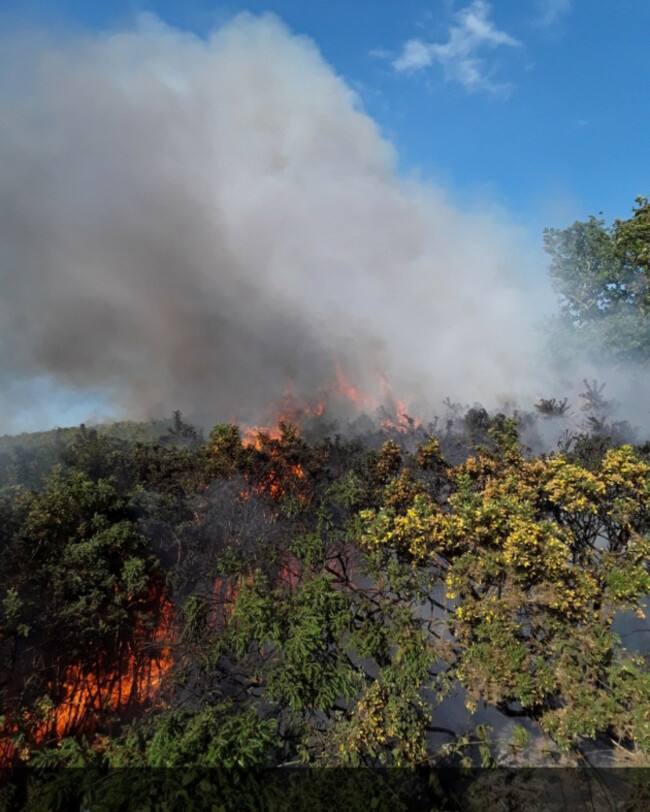
Another fire, reportedly caused by disposable barbecues, incinerated Bray Head. A fire earlier in the year took out an area of Mount Leinster in Co Carlow, a location that reliably goes up in flames every year.

Ongoing challenge

Shocking and disruptive as these fires are, they are nothing new. According to the European Forest Fires Information System, 4,355 hectares of land in Ireland were burned in 31 fires in 2025.

This number is lower than in 2011 (the first year for which statistics are available) but is the highest recorded since 2017. In that year, in a formal complaint to the European Commission, the Irish Wildlife Trust, an environmental NGO, noted 97 fires that they had gathered evidence for from 19 counties. 40% of them were in areas ‘protected’ for nature conservation.

707931244_18363107590233513_9113949769921654219_n The recent fire at Bray Head. Wicklow Fire Service Wicklow Fire Service

In the last decade, some things have changed. The Department of Agriculture, Food and the Marine (DAFM) now issues alerts in the run-up to dry spells with appeals for ‘vigilance’.

Farmers with land that has been burnt have their subsidy payments deducted. In 2025, a record 283 farmers were penalised for having burnt land, a sharp increase from 52 the year before, according to figures obtained by Agriland.ie, an online farming news outlet.

Farming and fires

Following a giant fire in Killarney National Park in 2021, the NPWS is now better equipped, including with surveillance drones and back up on call from helicopters with dousing buckets. The social acceptance of fires has also gone up in smoke; many farmers who once saw burning as a part of normal practice to maintain grazing land now accept that it is harmful.

Nevertheless, not nearly enough has been done. Fires between March and August are illegal, but prosecutions are rare. The Killarney fire resulted in no prosecutions despite investigations by Gardaí and forensic fire experts.

Even when there is a successful prosecution, the fines are derisory. In 2022, a Galway landowner was fined only €750 upon conviction for illegal burning.

BRAY HEAD Bray Head fire. Wicklow Fire Service Wicklow Fire Service

Farmers continue to receive mixed messages about burning. As recently as 2022, Teagasc, Ireland’s state-funded farm advisory service, said that “fire has a traditional and important role in the management of upland areas”, while in 2023, the Irish Farmers’ Journal carried an article headlined “The best way to burn upland areas”.

Neither condoned illegal burning, but to suggest that legal, or ‘controlled’, burning is either desirable, traditional or even beneficial, is both irresponsible and lacking in evidence.

Climate breakdown and fire

Climate change is a significant factor in this issue; 2025 was the second-warmest year on record in Ireland. That year also saw a significant dry spell – and the fires that go with it – in February, well outside the normal fire season.

Met Éireann confirmed that the national maximum temperature record for May was topped by a full two degrees in the one just past.

The areas where fires are occurring overlap perfectly with our uplands, which we know are in terrible condition despite being essential stores of carbon.

Upland peatlands and bogs should be wet, which would reduce their vulnerability to fires, but a century of drainage, mining out the turf for burning and over-grazing with excessive numbers of livestock mean they don’t have the capacity to hold water that they once did.

So, what should we be doing?

We can’t completely prevent fires from happening, assuming we will always have reckless arsonists or careless campers. Climate change will continue to intensify even under best-case scenarios for fossil fuel phase out.

However, this doesn’t mean we can’t fire-proof the country and, in doing so, meet a plethora of other environmental targets while we’re at it.

Let’s start with the messaging. Setting fire to the countryside is a bad thing – it should not be happening under any circumstances and should be prohibited in law.

Teagasc should be researching how upland farming can be maintained without burning, something they have not been doing.

Secondly, we need to create a Wildlife Crime Unit, along the lines of what exists in the UK, with rapid response, forensic capabilities and close liaison with An Garda Síochána.

Fines upon conviction need to be substantially higher than they are currently. In New South Wales, Australia, the maximum penalty for intentionally setting a fire is 14 years in prison; even when not proven to be intentional, the sentence can be up to seven years or a €74,000 fine.

Communication needs to be much improved. Appeals for vigilance are all well and good, but signage and messaging in fire-prone areas are nonexistent. People need to be left in no doubt about the harm that can be done and the penalties that apply.

However, even these measures will only get us so far if we do not start to change how we use land. The drone footage of the aftermath of the fire on Bray Head was revealing. The land was largely black and scorched, but the few trees that were there remained green. In fact, the small woodland on the north slope might have prevented the fire from entering the town itself.

Native trees are less likely to burn in wildfires than non-native species. We saw this pattern in Killarney National Park in 2021, and the lesson should have been learned then, but it was not.

In fact, the current forestry programme explicitly rules out grants for native forests in the hills, in ‘protected’ areas or on deep peat. True, we don’t want commercial plantations in these areas, but naturally-seeded native forest is the natural vegetation in large parts of the uplands and should be promoted, not actively discouraged.

On areas of deeper peat, where trees would not naturally grow, drains need to be blocked to hold onto water. Peat extraction, the reason why bogs are drained in the first place, needs to stop. Farming subsidies should be redirected from free-roaming sheep to rewilding or low-intensity farming with small cattle breeds.

These ideas would have benefits beyond reducing the impact of fires: flood prevention, carbon storage, water purification, habitat restoration and sustainable farming. Is it too much to ask that we see this kind of joined-up thinking?

Pádraic Fogarty is an environmental campaigner. 

Readers like you are keeping these stories free for everyone...
A mix of advertising and supporting contributions helps keep paywalls away from valuable information like this article. Over 5,000 readers like you have already stepped up and support us with a monthly payment or a once-off donation.

Close
44 Comments
This is YOUR comments community. Stay civil, stay constructive, stay on topic. Please familiarise yourself with our comments policy here before taking part.
Leave a Comment
    Submit a report
    Please help us understand how this comment violates our community guidelines.
    Thank you for the feedback
    Your feedback has been sent to our team for review.

    Leave a commentcancel

     
    JournalTv
    News in 60 seconds