Sign in. It’s quick, free and it’s up to you.
An account is an optional way to support the work we do. Find out more.
Sign in. It’s quick, free and it’s up to you.
An account is an optional way to support the work we do. Find out more.
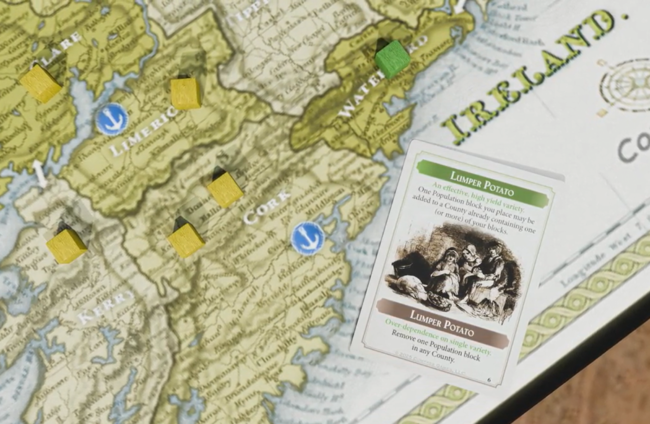
THE DESIGNER OF a board game that is centred on the Irish famine has defended it against criticism that it is “offensive”, “insensitive” and “repulsive”.
‘The Great Hunger: Ireland’s tragedy in the 19th Century’ was created by Compass Games for the US market. Developed through crowdsourcing with a goal of €2,000, it has raised over €13,000 so far.
The card-driven game sees between two and five players representing families of tenant farmers and field hands, with the premise of the game to expand your family across the map of Ireland.
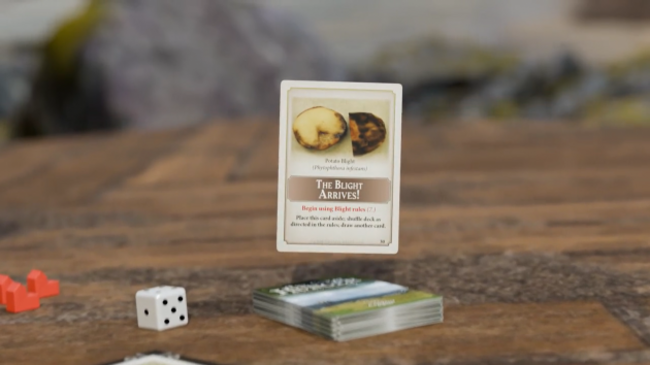
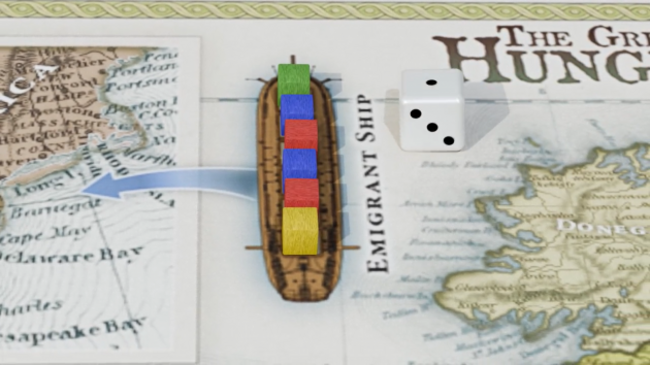
Then a card is drawn saying ‘the blight arrives’ is drawn, and the rules of the game changes to saving as many people as possible, finding aid or employment or emigrating to the United States.
“Victory is survival. When the blight finally abates, the family with the largest surviving population across Ireland and America will be deemed the winner,” the game’s website states.
People took to social media to criticise the game before it was featured on RTÉ’s Liveline, where one of its designers Kevin McPartland spoke about it.
“Any important event in history, I think, is worth telling using a simulation game,” he said, describing such games as “paper time machines” that give people a sense of what happened during a point in history, such as World War Two.
“If you don’t know your history, you’re doomed to repeat it, and this is just a different way of telling that history,” he said.
“It’s very immersive. You see the events that did occur, the people who were involved are represented in the game. Instead of just watching a documentary or reading a book, you’re there.”
McPartland, whose grandfather was born in Co Leitrim, said he spent a lot of time researching what happened during the famine, adding that most Americans don’t understand the whole story. “Hopefully I’ve been able to tell that story.”
The segment attracted several callers, who had differing opinions on the prospect of using a board game to learn about the Great Hunger.
One of the callers, Tom, said that when he heard the game being discussed on the programme, “it was like as if somebody had got a knife and literally plunged it through my heart.”
I cannot believe that somebody would be so insensitive.
He asked McPartland if he would “come up with a game called ‘The Holocaust’. ‘How to Escape Auschwitz’” before going on to say: “There was a Holocaust in my country in the 1800s… I feel very passionate about this. My ancestors ate grass to survive.”
McPartland said this was an unfair analogy and focused on the definition of the word game, saying: “Simulation games are not trivial. They’ve very serious. They take their topic very seriously.”
Tom said: “A board game is not the way to educate young people and children about what happened to our ancestors.”
Mary agreed, saying that when she heard them discussing the game, “it hit me in the stomach. It was absolutely offensive.”
Another caller, Ruth, said the notion of educating people through a game “is highly questionable” and that people should instead learn by going to lectures or reading.
“There’s just a sense of your history being condensed down,” she said. “Imagine actually using a roll of a dice to decide whether you go on the Jeanie Johnston… or you go on one of the coffin ships.
“Maybe I’m not the person to discuss it, because to me, it’s just repulsive, the notion of it at a very fundamental basis.”
Brendan told the programme that he was “fully open” to the idea of simulation games, citing a video game inspired by the siege of Sarajevo that allows players to experience what it was like to be a civilian at the time of the military blockade.
“However, this game is not that,” Brendan said, describing the trailer as having “diddly-eye music” and “the fakest Irish accent I’ve ever heard”.
McPartland said the voiceover was, in fact, performed by “a born and bred Irishman”.
But other callers felt differently. Rosita said she thought the game was “a really good idea”.
“Teenagers aren’t going to go to a lecture about the famine. So if there’s a game there, brilliant. They can go to that, they can play that, and then they can ask questions. It’s increasing knowledge, and that’s a really good thing.”
Another caller, Paula, congratulated McPartland for designing the game.
“I’m passionate about our history… but I also know that it is something that is dying, and unfortunately, anything that will excite the younger generation to know their history for me, is a good thing, so thank you very much indeed.”
She said that people who are interested enough in history to go to a lecture about the famine “are not the target audience, I would imagine” that the game is positioned towards.
I do believe that it will open a whole new genre of people can get as passionate and as excited about our history. At least that’s what I would hope.
Kirsty told the programme she would have bought the game for her children if it came out when they were younger.
“The way everyone learns is different,” she said. “Any way that we can bring knowledge that isn’t there to people who wouldn’t otherwise engage with it is a positive thing.”

To embed this post, copy the code below on your site














have your say