Sign in. It’s quick, free and it’s up to you.
An account is an optional way to support the work we do. Find out more.
Sign in. It’s quick, free and it’s up to you.
An account is an optional way to support the work we do. Find out more.
LAST UPDATE | 5 Sep 2025
A BRITISH MINISTER has come under pressure in the House of Lords over a special defence agreement between Ireland and Britain in place since 2015 which will be updated in 2026.
During a robust debate and questioning in the House of Lords, Vernon Coaker, the Minister of State in the British Ministry of Defence, outlined the detail of the deal.
Coaker outlined the specifics of current contacts between the two Governments.
“Michael Fallon [former British Defence minister] and Simon Coveney signed an agreement in 2015 on defence co-operation between the two countries, while respecting Ireland’s neutrality and the fact that it is not a member of NATO.
“Like many countries across the whole of Europe, whether in NATO or outside, Ireland has been forced to confront the reality of what we face.
“Like every country, including our own, it is increasing defence spending and looking at what more it can do, not least, as I say, through a refreshed memorandum of understanding between us and the Irish Government, which we hope to be in place during 2026,” he said.
Throughout the debate various members of the British House of Lords alleged that Ireland was not paying its way on defence and was not reciprocating British goodwill.
Julie Smith, a Liberal Democrats baroness, mentioned the need for Ireland to “come up to the plate” and spoke about the inability of Britain to push for Ireland to pay for the defence cover by the RAF and other agencies.
Alan West, who is a former admiral in the British Navy, also rounded on Ireland.
“If one looks at Norway and Ireland, which have about the same population, one finds that Ireland has 719 people in its navy while Norway has 4,000, and that Ireland has four coastal patrol craft while Norway has 69.
“Is it not time that we made it clear to the Irish that, in this globally dangerous world, they have to make an appropriate contribution to defence?” he claimed.
Paul Bew, who is a House of Lords member from Northern Ireland, said that transparency about the Defence arrangements would help both Ireland and Britain.
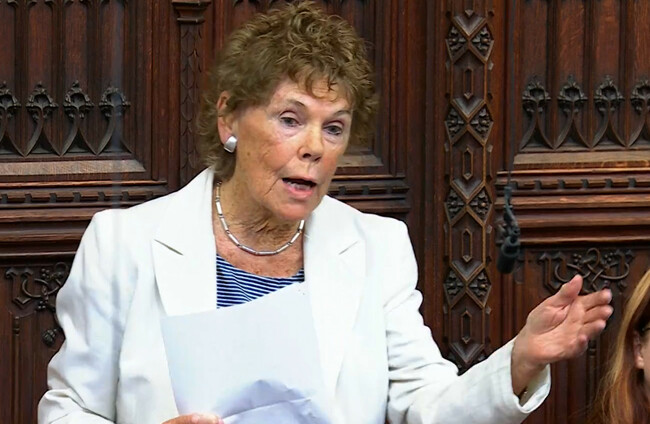
During the hearing on Wednesday Kate Hoey, a baroness who was born in County Antrim and formerly of Labour, has a reputation for calling out Ireland particularly during the Brexit negotiations. She rounded on the Irish Government during the debate with Croaker.
“Does he agree that it is important that the British public understand just how much support the Irish Government get from the United Kingdom and NATO for their defence capabilities, and that they keep their neutrality without having to pay any contributions?
“I am not asking the Minister to send them a bill, but does he agree that there could be more co-operation on other aspects?
“The hostile state of the Irish Government is taking the United Kingdom to court on the legacy Bill and refuses to be involved in trying to get much more information about some of the terrible atrocities, when the IRA went across the border. The next time he meets the Irish Government, will the Minister tell them that co-operation is a two-way process?” she said.
Coaker defended Ireland during the debate and said it was beginning to invest in its defence. He also said that there were efforts being made by both Governments to ensure there is strong cooperation on security matters.
“Discussions are taking place, in an appropriate way, between us and Ireland about what we can do around, for example, critical underwater infrastructure. Ireland is also looking at establishing its own radar capability.
“There are signs that Ireland is looking at what it can do to enhance its own defence and security,” he added.
Coaker said that the new memorandum of understanding between the UK Government and the Irish Department of Defence covers a “whole range” of co-operation measures He said it would include defence and security.
“That is something to be celebrated in Ireland and in the United Kingdom,” Coaker added.
The Journal has written extensively on a secret security deal between the UK and the Irish State using multiple sources.
It has been extensively reported, and backed by sourcing both here and abroad, that a secret deal was struck after the terror attacks in the US on 11 September, 2001. This permits British military fighter planes access to Irish airspace to intercept suspect aircraft.
Irish Senator Gerard Craughwell currently has a case before the High Court in an effort to compel the State to confirm the existence of the deal. Efforts by the Irish Government to have the case struck out has so far failed.
The Minister’s comments in the British House of Lords do not speak of that earlier secret deal but do speak extensively about interactions between Britain and Ireland on defence matters since 2015 and more recently this year.
In 2023 the then Tánaiste Micheál Martin said that reports that there is a secret deal between the British and Irish governments are “inaccurate”.
A statement from the Irish Department of Defence said the 2015 memorandum of understanding “provides a framework for developing and furthering bilateral co-operation”.
“It includes cooperation in such areas as military forces training; exercises and military education; exchange of views; potential for joint contributions to UN Crisis Management Operations; joint procurement initiatives; pooling and sharing resources; general sharing of reform in defence services; potential for staff exchanges; sharing of information, and joint contribution to Security Sector Reform and capacity building in crisis locations.
“It envisages cooperation and exchanges involving both civil and military personnel. The MoU placed previously existing co-operation arrangements in the Defence area between Ireland and the UK on a more formal and transparent footing, while fully respecting the differing policy positions and security arrangements of both States, including Ireland’s neutrality and non-membership of NATO,” the statement said.

To embed this post, copy the code below on your site










have your say