Sign in. It’s quick, free and it’s up to you.
An account is an optional way to support the work we do. Find out more.
Sign in. It’s quick, free and it’s up to you.
An account is an optional way to support the work we do. Find out more.
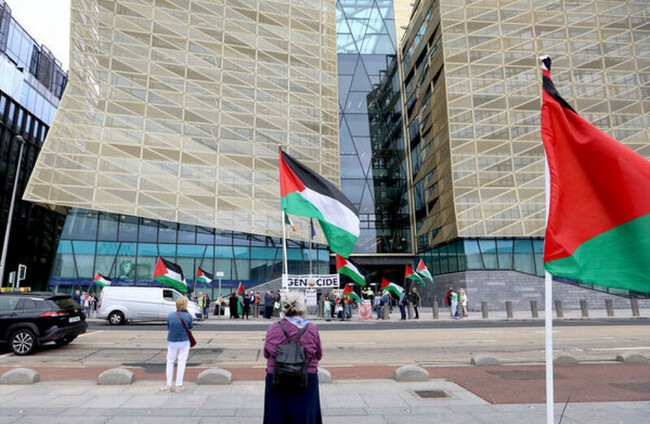
PLENTY OF IRISH people who have tried to protest Israel’s actions in Gaza have come up against an uncomfortable reality.
Ireland is a tiny country. It does have a voice on the world stage, one which is definitely outsized relative to our population.
But given the huge number of global powers trying to influence the conflict in Gaza, how can individuals based in Ireland make themselves heard?
Activists here appear to have found a way: target Ireland’s economic ties with Israel.
The story of the Central Bank’s ‘war bonds’ controversy is a perfect example.
The regulator previously approved the European prospectuses for the sale of Israeli bonds.
These are a financial instrument used by the Development Company for Israel (International) Ltd, which sells debt on behalf of Israel.
Basically, selling bonds lets Israel raise money from international investors. The bonds have to be registered with an international financial centre to meet technical requirements.
Previously, Israel got its bonds rubber-stamped in the UK. After Brexit, it shifted to Ireland to retain access to the European market.
The Irish Central Bank’s involvement in this has become a flashpoint, as the Israeli Development Company signalled on its website that money raised from selling the bonds would be used for the conflict in Gaza.
This was effectively portrayed as the Irish Central Bank having an indirect role in funding the invasion of Gaza.
Normally, bond sales are a snooze-fest which barely even make it into newspaper business pages. But when protestors started talking about ‘war bonds’, all of a sudden, people took notice.

There have been multiple protests outside the Central Bank since the conflict between Israel and Hamas broke out in October 2023.
Most have been relatively small, urging the regulator not to approve Israel’s bond sale, saying that doing so would make the organisation, and the wider Irish state, “complicit in genocide”.
The Central Bank pointed out that its remit doesn’t give it the scope to make morality calls on bond sales.
Once Israel’s bond prospectus met the requirements, the Central Bank would have had to approve it under EU rules – even if the money ended up being used to fund the conflict in Gaza.
This is because the criteria used to judge bond prospectus documents do not cover the morality of the transaction. They only look at it to see if the prospectus complies with risk and financial guidelines.
“Ultimately, the judgement rests on whether the disclosure is appropriate to the financial risk,” the Central Bank said.
Unimpressed, opposition TDs started looking at ways to change the rules to allow the Central Bank to refuse the bond sale.
Likely eager to avoid a controversy, Israel then decided to instead seek approval from Luxembourg.
It’s worth noting this wasn’t an active decision from the Irish Central Bank. It has been reported, or at least implied, by several commentators that the Central Bank perhaps refused to approve the bond sale due to the controversy.

Instead, Israel switched to Luxembourg’s regulator, taking the decision out of the Central Bank’s hands.
And it is worth noting that Luxembourg’s financial regulator has already approved the transaction.
On top of that, it remains the case that Ireland is still the designated “home member state” for the approval of bond sales.
As explained by The Currency, this basically means that the transfer to Luxembourg was a one-time thing. The Irish Central Bank will still be the default regulator tasked with approving Israel’s next bond prospectus, which will likely be 12 months from now.
And top of even that, it looks like the Central Bank did actually play a role in this particular bond sale.
As pointed out by The Currency, the Central Bank “did not simply transfer” the approval process to Luxembourg.
“It first had to scrutinise the request from Israel and approve it, as per the rules in the regulation,” the publication reported.
With all that in mind, there’s an argument to be made that the Irish demonstrators achieved little.
Israel will sell its bonds anyway, and raise the same amount of money anyway. Ireland will still have some role in facilitating it, with the only real difference being Israel’s prospectus got signed off in Luxembourg, instead of Ireland.
That argument is understandable - but likely a touch fatalistic.
As noted before, no one normally pays much attention to bonds.
No one cared about who approved Israel’s bond sale before demonstrators started protesting.
If they hadn’t, the transaction would’ve proceeded via the Irish Central Bank, with no one batting an eye.
So the activists did make something happen.
But the sale will still proceed via Luxembourg. While that’s true, the bond sale has now become a source of controversy there as well.
Opposition politicians are accusing Luxembourg’s financial regulator of ignoring international law and enabling war – essentially the exact same points the Irish activists raise.
Again, it’s worth remembering – this is all because of maybe a few hundred Irish activists consistently raising the issue.
So this bond sale will go through with a band-aid solution. But the issue hasn’t gone away – it’s only gained more traction. It’s likely Israel’s next bond sale will run into significant controversy. And it’s unlikely that pulling the same trick of a one-time transfer to a different EU regulator will work as smoothly.
On top of that, literally hundreds of articles have been written about the Israel ‘war bonds’ story. People are now much more aware of the importance of how Israel’s conflict is financed.
To bring this full circle – why does all of this matter?
Why do people care so much about bond sales, and where they’re approved?
It’s because selling bonds is a way for Israel to raise money.
If the Irish Central Bank – or another EU regulator – didn’t approve the bond sale, it would essentially cut off a source of revenue for Israel.
If that is the ultimate goal of the Irish demonstrators, then no, they haven’t yet succeeded.
But with all the attention garnered this time round, it is a certainty that Israel’s bond sale next year will garner both a massive amount of attention and public pressure.
It’s unlikely the Irish Central Bank will again get away with simply allowing another EU regulator to come in and rubber stamp the transaction.
So Ireland approving the deal this time round may not be the major win it is being viewed as in some circles.
But it’s not nothing either. Most systematic changes are slow. They’re incremental.
That’s especially true when the institutions involved are shielded from ethical and moral considerations by bureaucracy and legal protocol – and it’s possible the Irish activists have started a process to change that.

To embed this post, copy the code below on your site













have your say