Sign in. It’s quick, free and it’s up to you.
An account is an optional way to support the work we do. Find out more.
Sign in. It’s quick, free and it’s up to you.
An account is an optional way to support the work we do. Find out more.
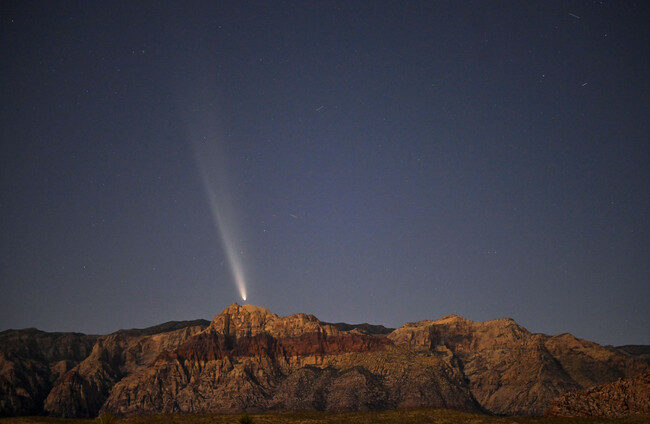
THE IRISH PUBLIC has been urged to look to the horizon this evening for a chance to sight a comet that was last visible when Neanderthals were walking the planet 80,000 years ago.
Comet A3, formally known as Tsuchinshan-ATLAS, has been billed by some as “comet of the century”.
Tsuchinshan is a Chinese word that translates to Purple Mountain and is named after the Purple Mountain Observatory in China where it was discovered on 9 January 2023.
Speaking to The Journal, astronomer and editor of magazine Astronomy Ireland David Moore said that as long as we have a clear sky, the comet will be visible.
And while the forecast doesn’t appear to be on the side of stargazers, Moore said he is hopeful the weather will play its part.
“We’re very excited about this comet, and unfortunately it’s moving away from the Earth, so the Irish weather is really the only culprit,” said Moore.
“As it fades away, let’s just hope we get a few more clear nights.”
Comet A3 will be visible until 30 October, but the best chance to see it will come tonight as the comet will decrease in brightness as it moves away from Earth.
It’ll be visible at around 7pm and Moore has advised people to “watch the western horizon soon after sunset, as the twilight is fading”.
“So wherever the sun sets, that’s where you look,” said Moore.
“If the sky is clear, you are going to see this comet and it will be immediately obvious to the naked eye, you don’t need your binoculars or telescopes.”
Moore is encouraging people to send their photographs to Astronomy Ireland magazine for consideration of publication in the society’s next issue of its magazine.
“We’ve already been sent a great picture from the Phoenix Park,” said Moore.
“Try and find a place with a clear western line, and you’ll be able to follow the comet for longer.”
He added that “you don’t need a fancy telescope or a fancy camera” as most people’s phone cameras work fine.
And while Moore said Comet A3 is “as bright as the brightest stars in the sky,” he was wary of dubbing it the “comet of the century”.
“First of all, century is not over yet,” said Moore.
“And secondly, there was another comet called NEOWISE during the lockdown.
“But you weren’t allowed to travel because of lockdown and if you didn’t have a clear normal horizon, you couldn’t see it.”
Dr Robert Massey of the Royal Astronomical Society agreed that Comet A3 is unlikely to beat out NEOWISE.
And both Massey and Moore pointed to Hale-Bopp in 1997 as the pre-eminent example of a visible comet.
“Hale-Bopp was the comet of a millennium, not the century,” said Moore.
“We’re going to be able to see Comet A3 fairly bright for around two weeks, but Hale-Bopp was there for months.
“But in terms of great comets that we’ve seen this century, NEOWISE is on an equal pegging to Comet A3 but it’s now over yet.”
Meanwhile, Moore urged people to not become complacent with comet sightings.
“We had NEOWISE in 2020 and then now Comet A3 in 2024, but they don’t come every four years,” Moore cautioned.
“They’re like busses; none come along for a decade, and then two come at once.”

To embed this post, copy the code below on your site















have your say