Sign in. It’s quick, free and it’s up to you.
An account is an optional way to support the work we do. Find out more.
Sign in. It’s quick, free and it’s up to you.
An account is an optional way to support the work we do. Find out more.

MINISTER JAMES LAWLESS is preparing to visit the European Organisation for Nuclear Research (CERN) tomorrow, marking a significant step in Ireland’s bid to become a full member of one of the world’s foremost scientific research facilities.
The Minister for Further and Higher Education, Research, Innovation, and Science will be joined by a delegation of professors, researchers and doctors from across Ireland for a meeting at the European research facility to advance Ireland’s membership application.
CERN is globally recognised for its work in particle physics and advanced technology.
Based outside Geneva in Switzerland, its primary focus is on particle physics but it also plays a vital role in developing future technologies. It operates particle accelerators including the famous Large Hadron Collider.
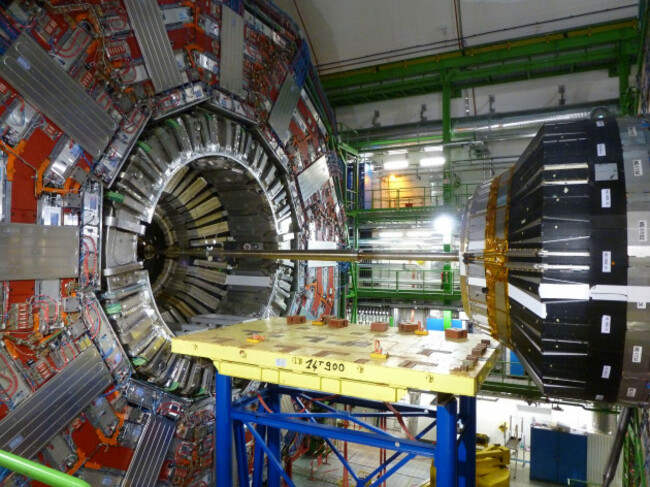
The science and research community in Ireland has been advocating for decades for Irish membership. Now, the country will officially join as an ‘Associate Member’, taking the first step toward full membership.
“We will start as Associate Members, that’s usually a five-year term,” Lawless told The Journal.
“At the end of the five years, we’ll see where we’re at, and if we feel that it is the right decision, we can get increasingly more involved and become full members.
“CERN is one of the most important science collaborations that exists internationally,” Lawless said.
He added that Ireland stands to “gain a lot” from the associate membership.
Previous Irish governments had paid little attention to the idea of an Irish CERN application, with the application only gaining momentum in recent years.
Ireland remains the only country in Western Europe that is not a part of the organisation. CERN currently has 24 member states, made up of mostly EU nations.
Lawless confirmed that Ireland will pay almost €2 million in contribution fees to CERN annually as part of the associate membership status.
“Financially, it will cost about €1.9 million annually, that will be the contribution that we make. But we get that back up to seven times over in terms of scientific advancements and business opportunities,” Lawless said.
When asked why it has taken so long for Ireland to consider joining CERN, Lawless cited economic challenges.
“I suppose it connects to the economy in respect to the crash,” he said, referencing the financial crisis of the late 2000s.
“I think historically it wasn’t on the radar politically, to the extent that it could and should have been. We saw that from 2011 onwards, basic services were being cut back right across the board, education, housing, and more, so it might have been the case where we couldn’t afford at that time.”
“I’ve argued for a number of years that Ireland should be a member of CERN,” Lawless said.
“When you’re a member, you get access to labs, researchers, equipment, and also from an economic perspective, you get access to CERN’s major contracts.”
Ireland’s CERN membership could financially boost the country’s high-tech sectors – including information technology, healthcare, and engineering.
“There is tens of millions of euro spent every single year at CERN in terms of the equipment, the procurement, the supplying technologies, the supporting services – everything from electricians to particle physicists to energy,” Lawless explained.
“Irish companies will now be able to bid for all of that and more.”
Lawless added that Irish researchers and third-level students, particularly those working in fields related to CERN’s areas of focus, will now have the opportunity to connect with CERN directly.
“If there is someone in Ireland studying one of the fields that is researched in CERN and they are interested in advancing their research, they’ll want to connect with CERN and be able to use the facilities there,” Lawless said.
“At the moment, in our universities, they can’t do that.
“Some of our best and brightest have gone to the UK or France to study, because they know they’ll have access to CERN over there that they haven’t had here.”
Lawless has advocated for Ireland’s participation in CERN for some time, having campaigned for membership since 2016.
“I led a campaign for joining CERN when I was up to spokesperson of science for Fianna Fáil in 2018, and that’s kind of come full circle, as I now get to head to CERN as a Minister to progress our application,” he said.
Lawless was clear on the his belief that investing in CERN would keep Ireland “at the cutting edge”.
“Investment in research, technology and innovation is critical for Ireland, and for the country’s economic development over the next couple of years,” Lawless said.
“We’re in a changing global environment, we can’t rely on the uncertainties—be that US investment or stability in Europe. We are in a very volatile world.”
Lawless emphasised his view that Ireland “needs to continue to invest” in talent, development skills and in research supports.
“That’s what I’m going to be about as a minister,” he added.

To embed this post, copy the code below on your site














have your say