Sign in. It’s quick, free and it’s up to you.
An account is an optional way to support the work we do. Find out more.
Sign in. It’s quick, free and it’s up to you.
An account is an optional way to support the work we do. Find out more.

YOUNG BOYS IN Ireland are three times more likely to have received an autism diagnosis than girls of the same age.
The Central Statistics Office (CSO) has today published its 2025 survey on children’s health in Ireland.
The survey was conducted via an online questionnaire sent to the guardians of a sample of children aged between three and 14 in the second half of last year.
In a selection of cases, a telephone interview was conducted.
They were asked about their child’s health status, access to health care, and their health factors such as nutrition, recreational activities, and screen time.
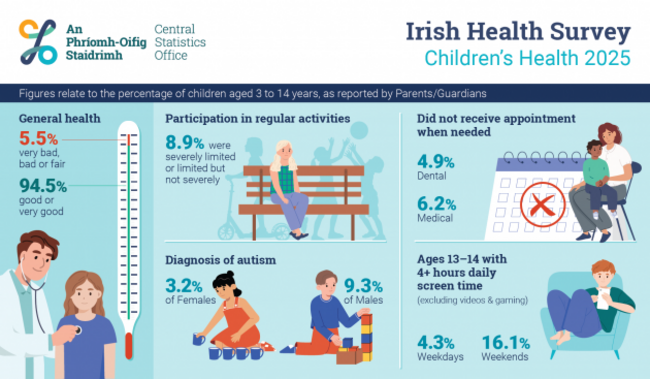
The survey found that at a rate of almost one in 10 (9.3%), males aged 3 to 14 years were three times more likely than females (3.2%) to have a diagnosis of autism.
Boys were also more likely to be diagnosed with Attention Deficit Hyperactivity Disorder (ADHD), but the gap was less pronounced, with 2.7% of males and 2% of females having a diagnosis of ADHD.
And while the general health of 94.5% of children was considered by their parents or guardians to be “good or very good”, the dental health of some 18% of children was deemed to be either “fair, bad, or very bad”.
This dental rating of fair, bad or very bad was higher for males (20%) than for females (16%).
Males were more likely than females to have a long-standing health problem or illness.
In 2025, about a fifth (21%) of males aged 3 to 14 years had such a condition, compared with 17% of females the same age.
Less than one in 10 (9%) children were deemed to be limited, either severely or not severely, in activities typically undertaken by children of the same age.
One in 16 (6%) children were reported as needing a medical examination or treatment on at least one occasion during the previous 12 months but did not receive it.
Reasons as to why the examination or treatment did not take place included affordability, waiting list times, distance to travel, or an inability to take the time due to other commitments.
One in 20 (5%) children needed a dental examination or treatment on at least one occasion during the previous 12 months but did not receive it.
Meanwhile, younger children were more likely than older children to have used non-prescription medicines, such as herbal remedies or vitamins in the past two weeks, with more than a third (37%) of those aged 3 to 8 years having done so.
Older children were more likely to have used prescription medicines in the past two weeks, with 17% of those aged 13 to 14 years having done so.
Elsewhere, around one in 10 children aged 3 to 8 years wore glasses or contact lenses and among older children aged 13 to 14 years, this rose to almost one in five.
Most children were eating fruit and vegetables at least once a day, with older children aged 13 to 14 slightly less likely to do so, at 83%, compared with 93% of children aged 3 to 8 years.
More than 95% of children had a meal with meat, chicken or fish (or vegetarian equivalent) at least once a day.
Participation in regular leisure activities such as swimming, playing an instrument, or youth organisations was highest for those aged 9 to 12 years (91%) and lowest for those aged 3 to 8 years (80%).
Excluding watching videos and playing games, 16% of 13- to 14-year-olds spent at least four hours daily on screen-based activities during weekends.
On weekdays, this figure dropped to 4.3%.
Meanwhile, on weekdays, 80% of children aged spent an hour or more per day watching television, films or videos.
Playing video games was the screen-based activity with the least number of hours spent on it.
On weekends, more than half of children aged 13 to 14 years (55%) and aged 9 to 12 years (54%) spent an hour or more per day playing video games.
Just over two in 10 (24%) children aged 3 to 8 years did so.

To embed this post, copy the code below on your site














have your say